
What are Floquet codes?
Floquet codes are quantum error-correcting codes which evolve in time. With standard stabilizer error-correcting codes, the information is encoded into a space of quantum states “stabilized” by certain operators, meaning that the latter operators leave invariant the quantum states. This space of valid quantum states used to store the information is called the code-space, and it does not evolve in time. If no error occurs, states remain valid and measuring the stabilizers gives +1 outcomes whereas errors can give invalid states, leading to a –1 outcome. This enables to detect (and then correct) the errors.
In Floquet codes, contrary to the case of stabilizer codes, the code space evolves in time: Floquet codes can thus be thought of as switching between several stabilizer codes, in a periodic way. It is possible to remove the periodicity constraint, in which case people usually use the term “dynamical codes” instead of “Floquet codes”. One of the most interesting features of Floquet (and dynamical) codes is that they are often easier to implement than stabilizer codes.
Indeed, the measurement result of the stabilizers is obtained as a product of several measurement outcomes, and these measurements are easier to perform than the direct full-stabilizer measurement.
For instance, a weight-6 X_1 X_2 X_3 X_4 X_5 X_6 measurement may be obtained as the product of three weight-2 measurements, X_1 X_2, X_3 X_4, and X_5 X_6.
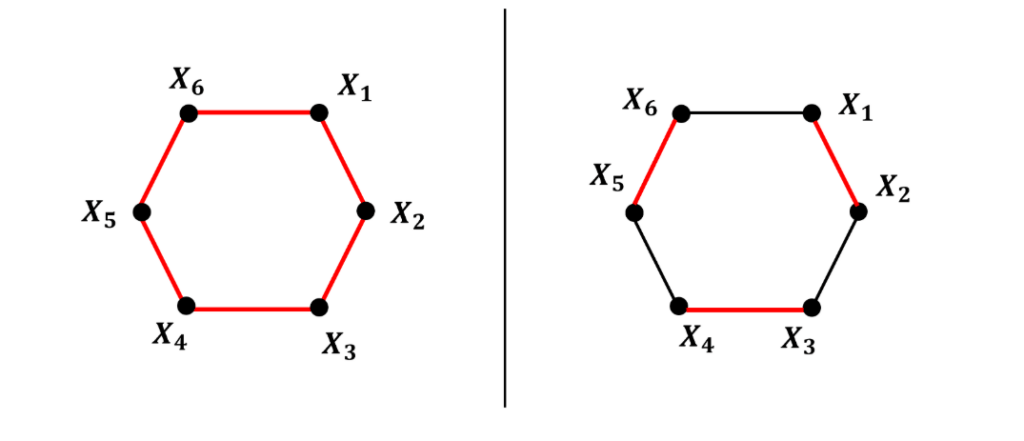
The implementation of Floquet codes is especially simple on architectures for which pairwise measurements are native, i.e. very easy to realize, which is the case of the hybrid spin-optical quantum computing (SPOQC) architecture envisioned by Quandela.
Frequently Asked Questions
- Are Floquet codes better than stabilizer codes? At the moment, Floquet codes are less mature than stabilizer codes, because they are much more recent. However, since they generalize stabilizer codes, they may enable to circumvent certain known no-go theorems that apply to stabilizer codes, for instance regarding the design of logical gates. Their reduced complexity in error-detection is a clear advantage, but the improvement will most likely be architecture-dependent and implementation-dependent. Their reduced complexity in error-detection is a clear advantage, but the improvement will most likely be architecture-dependent and implementation-dependent.
- Why is Quandela interested in Floquet codes? Researchers at Quandela have shown that pair-wise measurements, the main operation needed to implement Floquet codes, are easy to realize on its envisioned hybrid spin-optic architecture, SPOQC. This makes Floquet codes well suited to the platform. Moreover, some numerical simulations indicate that the honeycomb Floquet code, which can be thought of as a “floquetification” of the surface code, performs better on the architecture than the surface code, in terms of threshold.
- How would one perform a computation on a quantum computer where the quantum information is encoded into a Floquet code? To perform a computation on encoded information, one needs to implement logical gates, i.e. operations performed at the level of the logical qubit. Since Floquet codes switch between different stabilizer codes, it is possible to adapt known methods for logical gates of stabilizer codes to Floquet codes. Moreover, in certain cases, some logical gates can also be applied dynamically, by changing the type and order of the measurements performed to implement the code. In this case, error detection and gates are performed at the same time. Floquet codes therefore offer more ways to perform logical gates and run a computation on error-corrected qubits than stabilizer codes do. Understanding how to perform a universal logical gate set (to be able to apply any gate) is code dependent. Like for stabilizer codes, this is an important research direction (with the caveat that Floquet codes have been introduced much after stabilizer codes and as a result gate techniques have yet to be optimized for them).
- Are all Floquet codes implemented through pairwise measurements? This depends on the precise definition of Floquet codes used but it is generally admitted that the codes can be implemented with both low-weight Pauli measurements and Clifford unitaries. Famous examples of Floquet codes generally use pair-wise measurements only though. A few examples of dynamical codes occasionally use weight-3 measurements.
- What is the difference between subsystem codes and Floquet codes? Subsystem codes and Floquet codes share important similarities: in both cases, the measurement outcomes performed to detect errors are obtained as the product of several measurements. Moreover, in both cases as well, the code-space (equivalently the instantaneous stabilizers) evolves in time. However, Floquet codes allow the logical Pauli operators of the logical qubits to also evolve in time whereas they remain static in subsystem codes.