


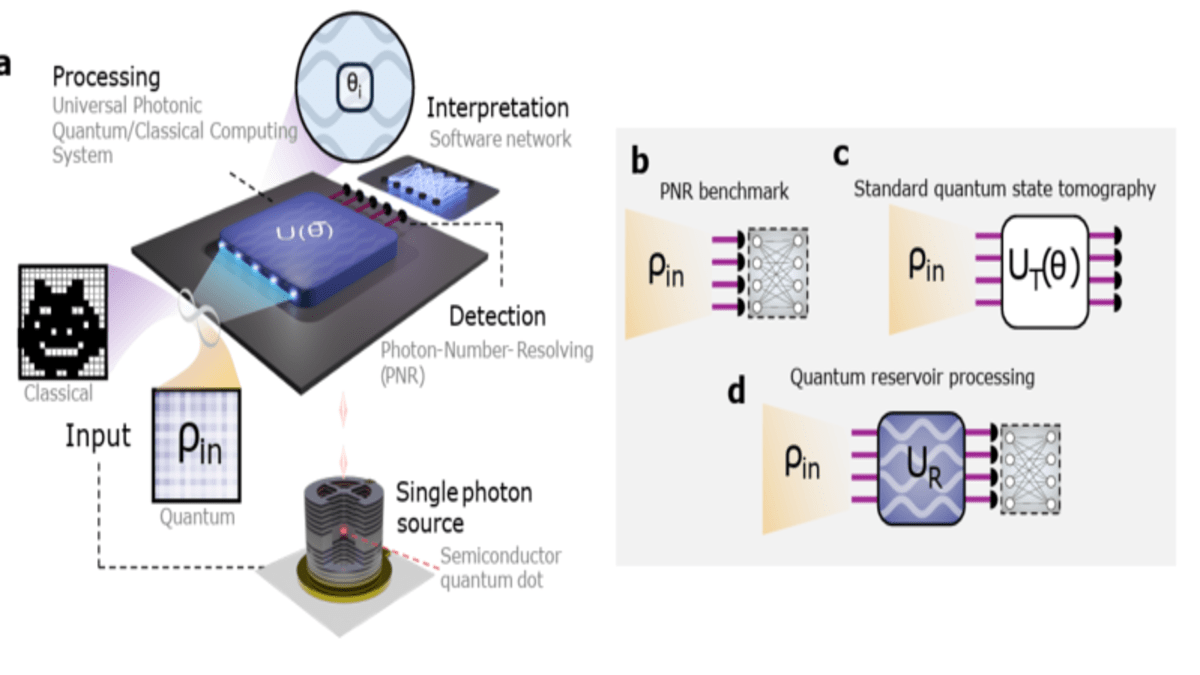
Machine learning systems are becoming increasingly powerful, but also increasingly computationally demanding. In our recent work with our partners from the QUONDENSATE consortium, we explore how Quandela’s QPUs can perform both quantum-information-processing and machine learning tasks within the same experimental platform. The results highlight the growing potential of integrated photonics for quantum machine learning research while addressing practical challenges such as quantum state characterisation and experimental imperfections.
Introduction
Artificial intelligence and machine learning are now embedded across scientific research, industry, and everyday technologies. As machine learning models continue to grow in complexity, their computational requirements are also increasing rapidly. This has led researchers to investigate whether quantum systems could provide alternative approaches to certain computational tasks.
One emerging direction is photonic quantum machine learning (QML), where information is processed using photons (particles of light) travelling through integrated optical circuits. By combining machine learning techniques with programmable quantum hardware, researchers are exploring new ways of analysing and transforming complex data.
In our recent work with our partners from the QUONDENSATE consortium, we present a quantum reservoir processing device implemented on a programmable silicon photonic chip and operated with single photons on Quandela’s quantum processing units (QPUs). Using this platform, we perform both quantum-information-processing and classical machine learning tasks within the same experimental system. We also introduce a hardware-aware mitigation method designed to improve robustness against experimental imperfections.
What Is Quantum Reservoir Processing?
Reservoir computing is a machine learning approach in which input data is passed through a complex dynamical system (known as the reservoir) that transforms the data into a richer representation. A simpler trainable layer then extracts useful features from this transformed information, which can be used for various tasks including classification or time-series prediction.
Quantum reservoir processing is attracting growing interest because it may provide efficient ways of analysing quantum systems while reducing some of the optimisation complexity associated with quantum machine learning models.
In our implementation, the reservoir consists of a programmable silicon photonic circuit, where single photons propagate through networks of waveguides and phase shifters that manipulate their quantum states. Because these photons obey the laws of quantum mechanics, the resulting system can perform complex transformations of input data within a compact photonic architecture.
Why Photonics?
Integrated photonics provides a scalable platform for implementing programmable quantum circuits on compact silicon chips. Photonic systems are particularly attractive for quantum information processing because they can be fabricated using mature semiconductor technologies while supporting flexible optical architectures. This combination of programmability and scalability makes photonics an important platform for ongoing quantum machine learning research.
Exploring Quantum and Classical Tasks on a Photonic Chip
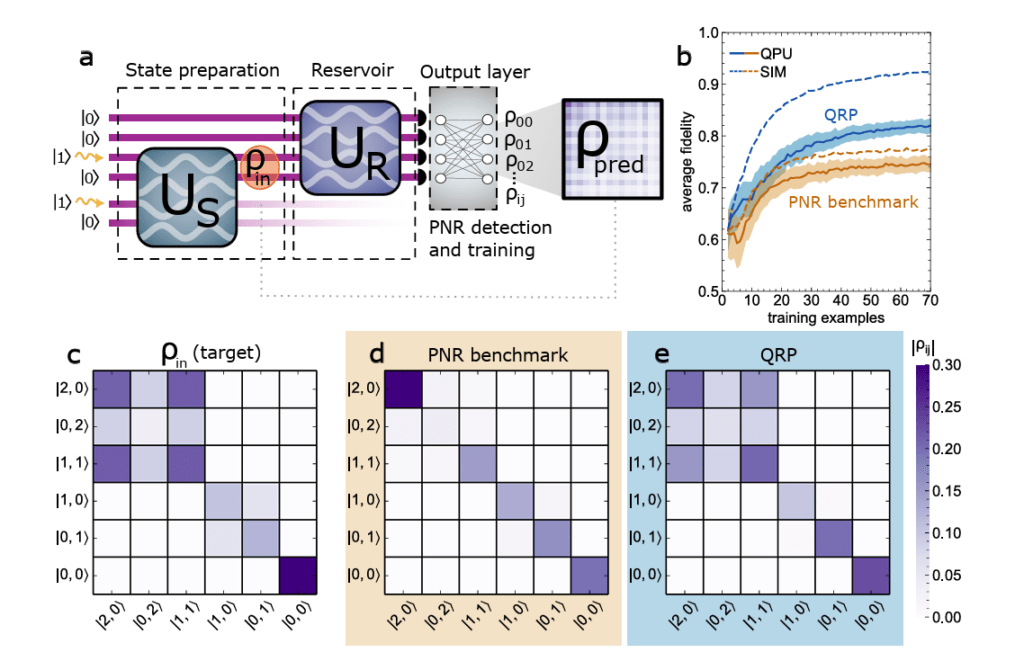
Using the programmable photonic reservoir, we implemented several quantum-information processing tasks, including quantum state tomography and the measurement of entanglement via negativity. In a nutshell, these two tasks allow us to investigate and study the structure of quantum states, which can be highly complicated objects.
In particular, quantum state tomography is the process of reconstructing the state of a quantum system from measurement data. As quantum systems become larger and more complex, this process becomes increasingly resource intensive. Our results demonstrate a practical method for probing quantum states using quantum reservoir processing on an integrated photonic platform.
Alongside these quantum tasks, the same reservoir implementation was also used for classical machine learning classification experiments. Both approaches to reservoir computing are highly relevant: while quantum-focused applications naturally require quantum models, classical tasks are prevalent in many industries and there is a growing interest in exploring the utility of quantum models in solving them.
Quantum State Tomography Results
Mitigating Experimental Imperfections
Naturally, real-world quantum hardware is affected by noise, fabrication variability, and experimental imperfections. To address this, we introduced a hardware-aware mitigation method that incorporates experimentally measured imperfections directly into the optimisation process of the simple trainable layer.
In practice, this mitigation method works similarly to data augmentation and improves the flexibility and robustness of the overall algorithm, which is a crucial property under actual experimental conditions.
Why This Research Matters
Quantum machine learning is an active research field, and practical quantum advantage for machine learning applications is an exciting open scientific question. In that context, programmable photonic quantum processors are becoming increasingly valuable as experimental platforms for exploring hybrid quantum–classical learning methods and quantum-information-processing tasks.
Our work contributes to broader research efforts in:
- Hybrid quantum–classical machine learning;
- Quantum state characterisation;
- Scalable photonic quantum hardware;
- Hardware-aware optimisation methods.
At Quandela, we are actively exploring these topics and we believe that quantum reservoir computing is a particularly interesting paradigm, as it relates to active research areas in the classical computing world as well, such as neuromorphic computing. With our participation in the QUONDENSATE EU Pathfinder project, we contribute to the exploration and demonstration of the value of quantum systems in new computational models, and for a variety of tasks.
Key Takeaways
- We demonstrate a quantum reservoir processor based on Quandela’s QPUs, operating with single photons on programmable silicon photonic chips.
- The system performs both quantum-information-processing and classical machine learning tasks within the same experimental platform.
- The processor successfully implements quantum state tomography and entanglement measurement via negativity.
- A hardware-aware mitigation method improves robustness under realistic experimental conditions.
- Integrated photonics continues to emerge as an important platform for scalable quantum machine learning research.