
NEWSROOM
Our latest news
New demonstrator shows how photonic quantum processors can become tightly integrated accelerators within future AI and HPC infrastructures, as Quandela expands its technology and industrial footprint in Germany. Berlin, Germany, 13 October 2026 — Quandela, a European leader in photonic quantum computing, will showcase a new hybrid AI–quantum computing demonstrator at NVIDIA GTC Berlin, to…
Quandela demonstrates its GPU–QPU integration architecture using NVIDIA NVQLink
×
New demonstrator shows how photonic quantum processors can become tightly integrated accelerators within future AI and HPC infrastructures, as Quandela expands its technology and industrial footprint in Germany.
Berlin, Germany, 13 October 2026 — Quandela, a European leader in photonic quantum computing, will showcase a new hybrid AI–quantum computing demonstrator at NVIDIA GTC Berlin, to show how quantum processing units can become integrated resources within accelerated computing infrastructures.
The demonstrator builds on Quandela’s experimental validation, announced at ISC High Performance in Hamburg earlier this year, of a low-latency integration path between NVIDIA accelerated computing and Quandela photonic quantum processors using NVIDIA NVQLink.
At GTC Berlin, an AI workflow running on an NVIDIA DGX Spark exchanges data directly with Quandela’s FPGA-based System Controller through NVIDIA NVQLink.
A reservoir-computing use case and live visual dashboard allow visitors to follow the interaction across the workflow, from classical data preparation to quantum processing and the final result.
For this demonstration, the QPU itself is simulated. The setup is designed to reproduce the system architecture and interaction model previously validated by Quandela with a physical photonic QPU, while making the GPU–QPU workflow visible and accessible in a live exhibition environment.
From remote quantum access to integrated quantum acceleration
Today, most quantum computers are accessed as remote resources through cloud environments. Quandela’s work with NVQLink explores a growing deployment model: one in which QPUs operate alongside CPUs and GPUs as specialized accelerators within AI and high-performance computing infrastructure.
In this architecture, the CPU orchestrates the application, the GPU handles intensive AI and classical computation, while the photonic QPU can be called for selected workloads where quantum processing may provide an advantage.
The approach combines Quandela’s photonic quantum computing technology and Quantum System Controller with NVIDIA accelerated computing, through NVQLink and the NVIDIA CUDA-Q platform for hybrid quantum-classical computing, creating a path toward increasingly tightly coupled hybrid computing environments.
Jean Senellart, Chief Technology and Product Officer at Quandela, said:
“The next challenge for quantum computing is not simply to make QPUs available. It is to make them work naturally inside the computing infrastructures that researchers and companies already use. What we are demonstrating at GTC Berlin makes that architecture tangible: GPU and QPU are no longer treated as isolated resources, but as complementary processors within the same workflow viaNVIDIA NVQLink.”
Germany at the heart of Quandela’s European development
Quandela’s presence at GTC Berlin also marks another step in the company’s growing engagement with the German technology and quantum ecosystems.
GTC Berlin follows Quandela’s participation at ISC High Performance in Hamburg, where the company presented its first results on low-latency GPU–QPU integration, and its recent presence at AIDAQ in Berlin, focused on the convergence of AI, data, high-performance computing and quantum technologies.
Germany also plays an important role in Quandela’s industrial strategy.
Quandela works closely with German technology company attocube systems, one of its key European technology partners. The two companies notably collaborated on Lucy, the photonic quantum computer delivered to EuroHPC and GENCI and installed at the CEA’s TGCC in France, combining Quandela’s photonic quantum technology with cryogenic systems developed by attocube.
This industrial collaboration sits within a broader Franco-German effort to strengthen Europe’s quantum ecosystem.
Over the past two years, Quandela has actively contributed to the Franco-German Dialogue on Quantum Technologies, bringing together companies, research institutions, HPC centres and public stakeholders from both countries. In May 2026, Quandela joined CEA, Fraunhofer, CNRS, Inria, Le Lab Quantique, QUTAC and the European Champions Alliance in a joint declaration aimed at accelerating cooperation between the French and German quantum ecosystems.
Thomas Volz, Managing Director of Quandela GmbH, said:
“Germany is strategic for Quandela not simply as a market, but as an industrial, scientific and technological partner. From our cooperation with attocube to our work with the HPC and AI communities, we see a strong opportunity to connect French and German capabilities to build a competitive European quantum computing industry. GTC Berlin is exactly the kind of environment where these worlds — AI, accelerated computing, HPC and quantum — increasingly come together.”
Building the hybrid computing infrastructure of tomorrow
Quandela’s presence at GTC Berlin reflects a broader evolution in quantum computing.
As quantum processors mature, the focus is progressively moving beyond standalone quantum machines toward architectures in which classical and quantum processors can cooperate at increasingly low latency.
For photonic quantum computing, where quantum operations and photon generation can operate at high repetition rates, the speed at which information moves between classical and quantum hardware becomes a fundamental part of overall system performance.
By developing this integration layer today, Quandela aims to prepare photonic QPUs to become deployable accelerators within future AI factories, supercomputing centres and industrial computing infrastructures.
Meet Quandela at NVIDIA GTC Berlin, 20–22 October 2026, at booth no. 7078
About Quandela
Quandela is a global leader in quantum computing, designing, building, and delivering cutting-edge quantum solutions for research and industry. Its offerings include the most energy-efficient quantum computers for data centers, full-stack quantum computing solutions accessible via the cloud, and algorithm access services for academic and industrial customers. Following a pragmatic, step-by-step roadmap, Quandela has been deploying industrial-grade systems since 2023 while developing future generations of fault-tolerant quantum computers capable of scaling through the integration of thousands of photonic components. Quandela is committed to making quantum computing accessible to all in order to address the most complex industrial and societal challenges. Learn more at: Quandela | Leading Photonic Quantum Computing Solutions
Media Relations
Maarc PR agency
- Iva Baytcheva, iva.baytcheva@maarc.fr +33(0)6.28.59.07.03
- Oréna Cigar, orena.cigar@maarc.fr +33 (0)6 52 02 93 35
The partnership between Quandela and the Korea Research Institute of Bioscience and Biotechnology (KRIBB) aims to develop new use cases combining artificial intelligence, classical computing, and photonic quantum computing to tackle some of the most complex challenges in the life sciences. Massy, October 7, 2026 – Quandela, a European company, leader in photonic quantum computing,…
Quandela and KRIBB join forces to accelerate biotechnology research and drug discovery through photonic quantum computing
×
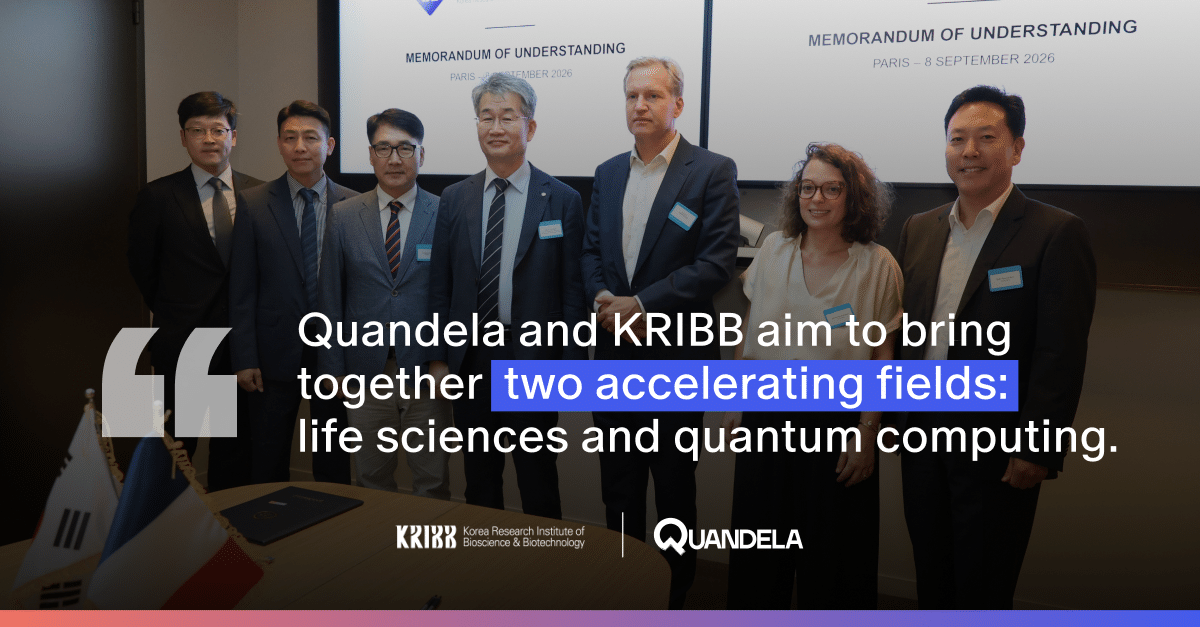
The partnership between Quandela and the Korea Research Institute of Bioscience and Biotechnology (KRIBB) aims to develop new use cases combining artificial intelligence, classical computing, and photonic quantum computing to tackle some of the most complex challenges in the life sciences.
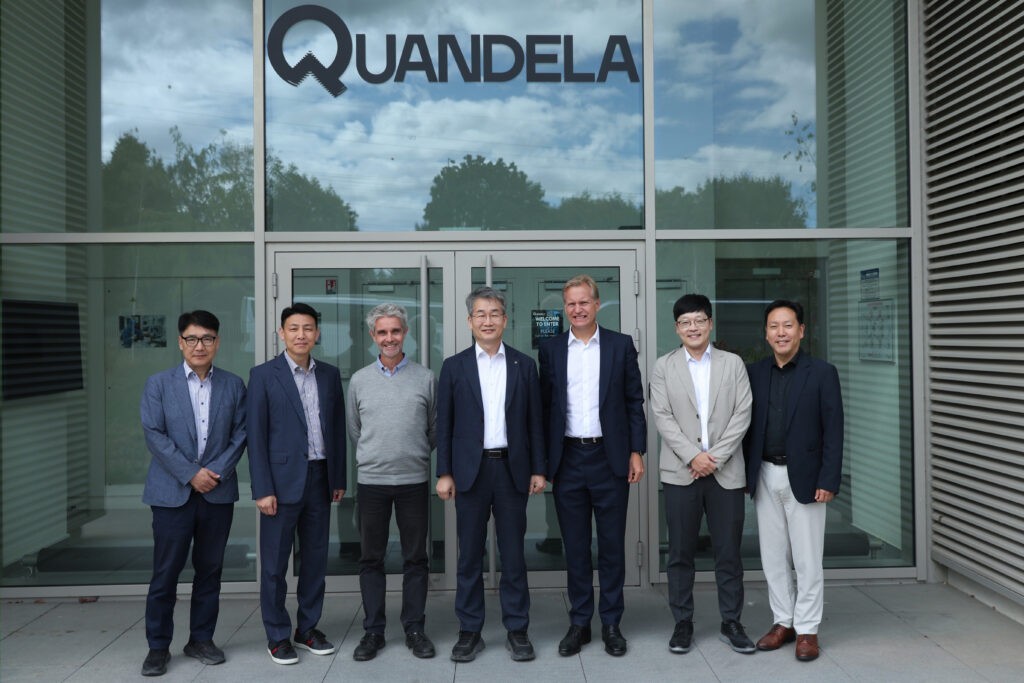
Massy, October 7, 2026 – Quandela, a European company, leader in photonic quantum computing, and the Korea Research Institute of Bioscience and Biotechnology (KRIBB), South Korea’s national reference institute for biosciences and biotechnology, signed a Memorandum of Understanding (MoU) in Paris on September 8, 2026, to strengthen their collaboration on applying quantum technologies to advanced biotechnology research and drug discovery.
Through this partnership, Quandela and KRIBB aim to bring together two accelerating fields: life sciences and quantum computing. Their objective is to develop and validate practical applications of photonic quantum computing capable of addressing complex biological challenges, while pioneering new research models that combine artificial intelligence, classical computing, and quantum technologies.
This partnership arrives at a pivotal moment to strengthen Franco-South Korean scientific and technological cooperation. Building on the Memorandum of Understanding signed in Paris on September 8 during South Korean President Lee Jae-myung’s state visit, both nations have committed to deepening collaboration in key strategic sectors, including artificial intelligence, semiconductors, and quantum technologies.
“Our goal is to give researchers new tools for navigating the complexity of biological systems. By combining KRIBB’s bioscience expertise with Quandela’s photonic quantum technology, we aim to accelerate the path from computational insight to experimental validation.” says Suk-Yoon Kwon, President at KRIBB.
Combining AI and quantum technologies to explore new frontiers in biomedical research
By combining KRIBB’s expertise in biotechnology and life sciences with Quandela’s capabilities in photonic quantum computing, both partners aim to develop new approaches for analyzing and solving biological problems characterized by vast search spaces and complex interactions.
Several application areas will be explored: Targeted Protein Degradation (TPD), particularly the design of PROTAC candidates; cellular therapy optimization; the identification of new therapeutic targets for rare diseases; and the analysis of gene regulatory networks involved in infectious diseases.
“Quantum computing becomes meaningful when it helps researchers solve real-world problems. With KRIBB, we are developing hybrid workflows that combine AI, classical computing and photonic quantum computing to create practical, reproducible applications for biotechnology and drug discovery.” says Sam Yoosuk Kim, General Manager of South Korea at Quandela.
At the core of this partnership lies a hybrid computing approach that seamlessly combines artificial intelligence, classical computing, and photonic quantum technologies. AI enables the analysis of large volumes of biological data and progressively narrows down the number of candidates to evaluate. Classical computing resources then handle processing and simulations suited to their architectures, while photonic quantum processors are deployed to explore particularly complex combinatorial optimization problems.
The project seeks to assess how this integrated model can refine the way researchers prioritize and select candidates prior to experimental validation, particularly in drug discovery, cell therapy design, and genetic target identification.
Transforming initial research into reproducible use cases
As part of this collaboration, KRIBB researchers have already shared initial findings generated on Quandela’s platform, with plans to build upon these results for an upcoming scientific publication. For its part, Quandela will analyze these outcomes as a breakthrough use case for photonic quantum computing in biotechnology, aiming to assess their reproducibility and potential to address broader drug discovery challenges.
Training a new generation of researchers at the intersection of biology, AI, and quantum technologies
Beyond joint research, the partnership also focuses on talent development. Both organizations plan to launch joint training programs, hackathons, seminars, scientific workshops, and technology exchange initiatives to support work at the intersection of biosciences, artificial intelligence, and quantum computing.
About Quandela
Quandela is a global leader in quantum computing, designing, building, and delivering cutting-edge quantum solutions for research and industry: providing the most energy-efficient quantum computers for computing centers, comprehensive quantum computing solutions accessible via the cloud, and algorithm access services for academic and industrial customers. Quandela follows a pragmatic and progressive roadmap, deploying industrial systems since 2023 while developing future generations of fault-tolerant quantum computers capable of scaling by integrating thousands of photonic components. Quandela is committed to making quantum computing accessible to all in order to tackle the most complex industrial and societal challenges. For more information: www.quandela.com
About KRIBB
The Korea Research Institute of Bioscience and Biotechnology (KRIBB) is one of South Korea’s leading national research institutes specializing in biotechnology and the life sciences. Founded in 1985, KRIBB works to advance scientific knowledge in areas including molecular biology, genomics, bioinformatics, synthetic biology, and aging research. As a government-funded institute, KRIBB plays a key role in fostering innovation, supporting national research and development strategies, and collaborating with academic and industry partners in South Korea and internationally. For more information: https://www.kribb.re.kr
Press Contacts
Quandela – Maarc Agency
- Iva Baytcheva – iva.baytcheva@maarc.fr – 06 28 59 07 03
- Oréna Cigar – orena.cigar@maarc.fr – 06 52 02 93 35
For IEEE Quantum Week 2026, held in Toronto from September 13 to 18, Quandela is showcasing an approach to progressively integrating quantum computing into existing AI and high-performance computing (HPC) infrastructures with NVIDIA NVQLink. In this approach, the GPU remains at the core of the AI workflow, with the quantum processor (QPU) acting as a…
Quandela publishes a vision for integrating QPUs into AI and HPC infrastructure with NVIDIA NVQLink
×
For IEEE Quantum Week 2026, held in Toronto from September 13 to 18, Quandela is showcasing an approach to progressively integrating quantum computing into existing AI and high-performance computing (HPC) infrastructures with NVIDIA NVQLink. In this approach, the GPU remains at the core of the AI workflow, with the quantum processor (QPU) acting as a specialized accelerator for specific workloads.
Paris, September 14, 2026 – Building on our June announcement of a low-latency integration between a Quandela photonic QPU and NVIDIA AI infrastructure, the companies are publishing a technical white paper today. This paper outlines a vision and architectural framework for gradually integrating quantum computing into current AI and HPC environments.
This approach is based on the complementarity of CPUs, GPUs and QPUs. The CPU orchestrates workflows, while the GPU remains at the center of AI processing, notably handling intensive computation and simulation. The QPU acts as a specialized accelerator for workloads for which quantum computing could bring significant value.
Thanks to the NVIDIA CUDA-Q platform (an open quantum-GPU supercomputing programming platform) and NVIDIA cuQuantum (an SDK optimized for simulating quantum computations on GPUs), algorithms can be developed, simulated and tested on GPU before being run on an actual photonic QPU. NVIDIA NVQLink enables a low-latency connection between the NVIDIA GPU environment and the Quantum System Controller, which then controls the QPU.
Organizations can thus progressively explore quantum applications by relying on their existing computing infrastructure, without having to replace their current environments.
A step toward more accessible quantum computing
By facilitating the integration of quantum computing into current AI and HPC environments, this platform empowers users to experiment, develop, and test quantum applications directly from their standard workflows.
The primary goal is to identify workloads where quantum computing can deliver significant value and progressively bring the most relevant applications to light.
The collaboration follows a three-step approach: Access, Integration & Discovery, and Scale.
- Access allows researchers and organizations to discover and experiment with quantum computing without having their own infrastructure.
- Integration & Discovery involves integrating the QPU into existing CPU and GPU environments to develop, simulate and test various algorithms, and to identify the workloads for which quantum computing could be particularly relevant.
- Scale aims to scale up applications that have demonstrated their potential toward larger, more powerful quantum systems.
This approach allows users to progress step by step toward quantum computing, building on their existing infrastructure and developing new capabilities as high-potential applications are identified.
An architecture presented at IEEE Quantum Week
The architecture developed by Quandela building on NVIDIA technologies will be presented at IEEE Quantum Week 2026 in Toronto on the morning of September 17, at the NVIDIA booth (#600).
At the event, Quandela’s teams will discuss the integration of photonic QPUs into AI and HPC infrastructures with visitors and present their joint publication on this new hybrid architecture combining GPU and QPU computing capabilities.
Jean Senellart, Chief Technology and Product Officer at Quandela states:
“The challenge is no longer just about accessing a QPU, but about integrating it directly into AI workflows. With NVIDIA, we are opening a path where the photonic QPU becomes a specialized accelerator for exploring and validating hybrid algorithms, particularly in QML, before scaling the most promising use cases.”
Sam Stanwyck, Director of Quantum Product at NVIDIA says:
“Quantum computing becomes more useful when it moves beyond standalone access and becomes part of the accelerated computing researchers already use. Our work with Quandela provides a step-by-step model for bringing photonic QPUs into NVIDIA quantum-GPU supercomputing, helping teams identify promising applications today and scale them as more powerful systems come online.”
About Quandela:
Quandela is a global leader in quantum computing, designing, building and delivering cutting-edge quantum solutions for research and industry. Its offering includes the most energy-efficient quantum computers for data centers, cloud-accessible full-stack quantum computing solutions, as well as algorithm access services for academic and industrial clients. Following a pragmatic, step-by-step roadmap, Quandela has been deploying industrial-grade systems since 2023 while developing future generations of fault-tolerant quantum computers, capable of scaling through the integration of thousands of photonic components. Quandela is committed to making quantum computing accessible to all in order to address the most complex industrial and societal challenges. To learn more: Quandela | Leading Photonic Quantum Computing Solutions
Media Relations
Maarc PR agency
- Iva Baytcheva, iva.baytcheva@maarc.fr +33(0)6.28.59.07.03
- Oréna Cigar – orena.cigar@maarc.fr +33 (0)6 52 02 93 35

Announced during the Vietnam–France Leaders Forum, in presence of Vietnamese General Secretary and President Tô Lâm and French President Emmanuel Macron, the agreement combines Quandela’s full-stack photonic quantum computing platform with Quanova’s local integration capabilities, backed by strategic investment from Nam A Bank, to develop talent, infrastructure and concrete quantum use cases in Vietnam. Paris,…
Quandela and Quanova sign strategic partnership to build quantum capabilities in Vietnam
×
Announced during the Vietnam–France Leaders Forum, in presence of Vietnamese General Secretary and President Tô Lâm and French President Emmanuel Macron, the agreement combines Quandela’s full-stack photonic quantum computing platform with Quanova’s local integration capabilities, backed by strategic investment from Nam A Bank, to develop talent, infrastructure and concrete quantum use cases in Vietnam.
Paris, 11 September 2026 – Quandela, a European leader in photonic quantum computing, and Quanova, a Vietnamese quantum technology and ecosystem development company, announce the signing of a strategic partnership agreement aimed at supporting the long-term development of quantum computing capabilities in Vietnam.
The agreement was formalized during the Vietnam–France Leaders Forum, held in the presence of French President Emmanuel Macron and General Secretary and President of Vietnam Tô Lâm as part of his official visit to France.
Under the agreement, Quanova will act as a strategic integrator for Quandela in the Vietnamese market. The two companies will work together to promote, develop and commercialize solutions based on Quandela’s photonic quantum computing technology.
Their collaboration will include the training of Quanova’s technical and commercial teams, the development of joint offerings, customer engagement and demonstrations, and the identification of relevant use cases with Vietnamese universities, research organizations and businesses.
“Vietnam is emerging as one of Southeast Asia’s most dynamic quantum ecosystems. Our ambition is to help turn this momentum into lasting capabilities: trained talent, access to photonic quantum computing and concrete projects for universities, research institutions and businesses,” said Niccolo Somaschi, co-founder and CEO of Quandela. “Quanova’s strong local roots and expertise as a strategic integrator make it the right partner to build this bridge with us.”
The agreement builds on several initiatives already undertaken by Quandela and its Vietnamese partners. With Quanova and other local stakeholders, Quandela recently supported a quantum hackathon organised by VNQuantum and the province of Gia Lai, focused on applications connected to Vietnam’s development priorities.
One of the first concrete initiatives supported by the partnership with Quanova is the quantum technology training programme at Quang Trung University, backed by Nam A Bank as a strategic investor. The programme aims to train students and researchers while expanding their access to quantum computing capabilities.
“Vietnam’s opportunity in quantum will be built through real capabilities: trained teams, access to world-class platforms and projects connected to local needs,” said Rossy Nguyen Hoang Hong Nhung, CEO of Quanova. “Working with Quandela will help Vietnamese organizations move from initial exploration to concrete applications, while strengthening the national ecosystem for the long term.”
The two companies also share the ambition of preparing for the future deployment of a photonic quantum computer in Vietnam. Their approach is based on ensuring that any future infrastructure is supported by the skills, software and local ecosystem required to use it effectively and create long-term value.
The agreement signed in Paris provides a framework for developing joint offerings and new opportunities with Vietnamese stakeholders. Quandela and Quanova expect to announce further concrete steps in the coming months.
About Quandela
Quandela is a leading quantum computing company that designs, builds, and delivers cutting-edge quantum solutions for industry: ready-to-use quantum computers for data centres, cloud-accessible quantum processors, and algorithm access services for industrial clients. Quandela is committed to making quantum computing accessible to all in order to address the most complex industrial and societal challenges.
Discover our vision at: Quandela | Leading Photonic Quantum Computing Solutions
About Quanova
Founded in 2025, Quanova is a Vietnamese quantum technology and innovation company focused on education, quantum-readiness consulting, ecosystem building and international collaboration. The company works to connect research, industry and talent development to support the emergence of quantum capabilities in Vietnam.
For more information: www.quanova.org
Media Relations
Maarc PR agency
- Iva Baytcheva, iva.baytcheva@maarc.fr +33(0)6.28.59.07.03
- Oréna Cigar – orena.cigar@maarc.fr +33 (0)6 52 02 93 35
Established in Canada, Quandela’s photonic quantum computer is the only device of its kind available to companies participating in this Canada-wide research and development program.MONTREAL, September 2, 2026 – Quandela, a leading player in photonic quantum computing technologies, has signed a memorandum of understanding with CMC Microsystems to join the Quantum Computing Sandbox as a…
Quandela becomes the first photonic platform in Canada’s cloud-accessible Quantum Computing Sandbox
×
Established in Canada, Quandela’s photonic quantum computer is the only device of its kind available to companies participating in this Canada-wide research and development program.
MONTREAL, September 2, 2026 – Quandela, a leading player in photonic quantum computing technologies, has signed a memorandum of understanding with CMC Microsystems to join the Quantum Computing Sandbox as a provider of cloud-based computing services. Quandela’s expertise, based within the country, now joins forces with other providers to offer a comprehensive suite of quantum options made available to small and medium-sized enterprises, organizations, and academic researchers, with the aim of developing and accelerating the solutions that will be applied to a wide range of fields and needs.
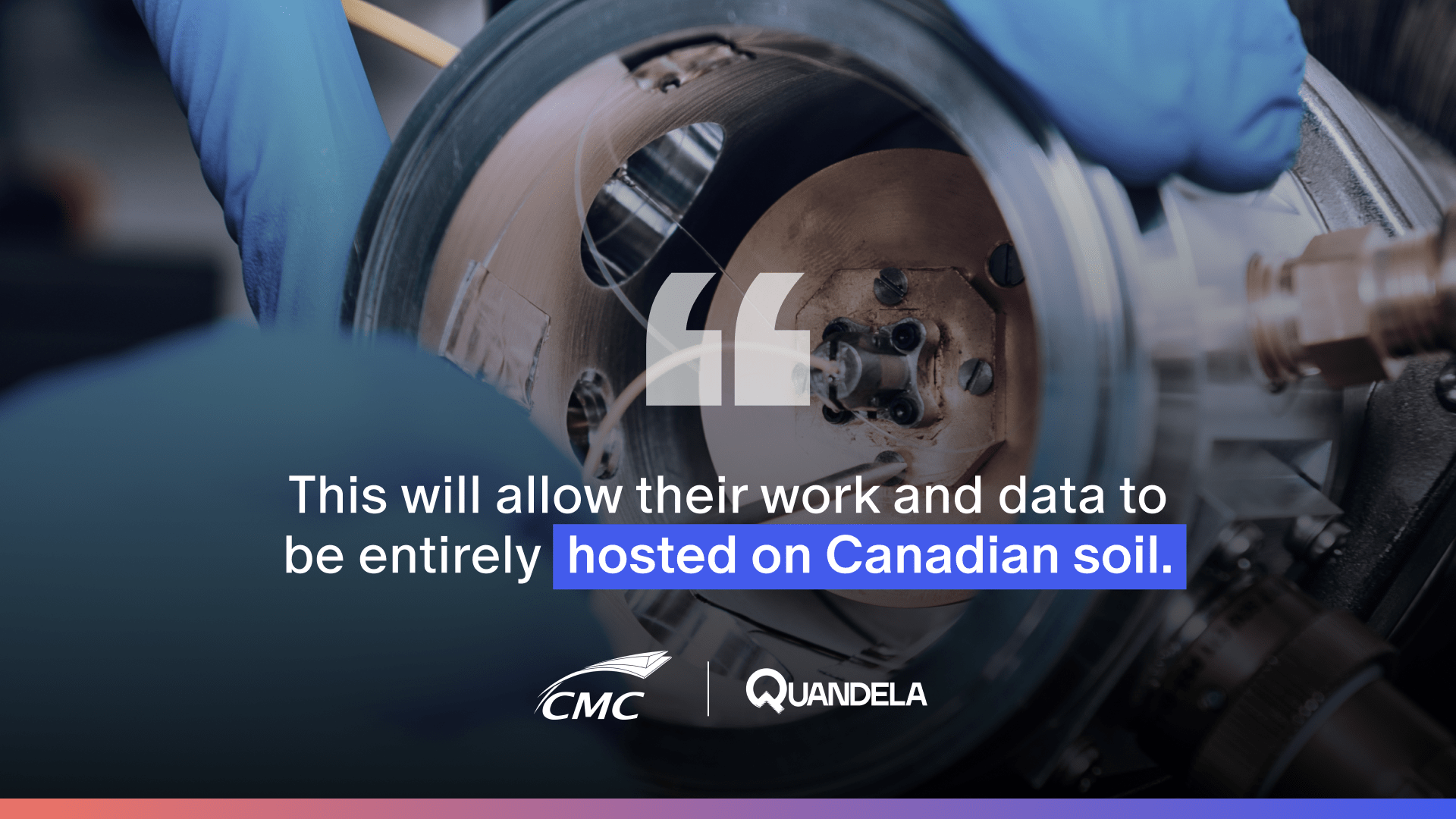
“As data sovereignty in the digital realm becomes an increasingly important issue given the current global context, we are proud to be the first to include a Canada-based photonic quantum computer among the cloud computing options available to the participants of the QCS program”, stated physicist Valérian Giesz, Co-Founder and Director of Strategic Partnerships at Quandela. “This will allow their work and data to be entirely hosted on Canadian soil, without having to go through a structure located in another country.”
The Quantum Computing Sandbox (QCS) is supported by FABRiC, an organization funded by Innovation, Science and Economic Development Canada (ISED), whose mission is to build an ecosystem which strengthens Canada’s semiconductor sector. QCS’ role, through technical support and research grants, is to foster the development of quantum applications for Canada’s various industrial sectors and fields of activity, including national and strategic projects. CMC Microsystems is the nonprofit organization responsible for managing FABrIC on behalf of the Government of Canada; its mandate is to facilitate affordable access to the tools required for the development of advanced technologies.
Multifaceted support
The memorandum of understanding between Quandela and CMC Microsystems also includes a provision to provide support to companies and organizations whose high-potential projects have been selected, thus granting them access to the Quantum Computing Sandbox. This assistance, which may be both technical and practical in nature, will be offered by Quandela in collaboration with CMC Microsystems. The latter is directly involved in selecting the companies eligible for a grant.
As Quandela and CMC Microsystems already have a well-established relationship, the framework of the QCS program will enable the two entities to further share their expertise and experience with companies, organizations, and universities which do not have teams or personnel sufficiently trained in the rules and requirements of quantum computing.
“Since the algorithms used in certain projects perform better on certain specific computing architectures, integrating Quandela as an additional tool further diversifies the options made available to the participants who have access to QCS, whether in terms of research, prototyping, or implementing solutions,” added Valérian Giesz. “This is what makes the QCS model even more attractive to companies looking to invest not only in the development of quantum solutions, but also in the development of quantum computing itself.”
About Quandela
Quandela is a global leader in quantum computing which designs, builds, and delivers cutting-edge quantum solutions for research and industry, offering the most energy-efficient quantum computers for data centres, comprehensive quantum computing solutions accessible through the cloud, and algorithm access services for academic and industrial customers. Quandela follows a pragmatic and incremental approach, installing industrial systems since 2023 and developing future generations of fault-tolerant quantum computers capable of scaling up through the integration of thousands of photonic components. Quandela is committed to making quantum computing accessible to all in order to address the most complex industrial and societal challenges.
Media Relations:
- Léanne Dessureault, leanne.dessureault@derabane.com, 438-403-3601
Hamburg, Germany – June 23, 2026 – Quandela today announced that it has experimentally validated a low-latency integration path between photonic quantum processors and NVIDIA AI infrastructure, marking an important milestone toward bringing quantum processing units directly into high-performance computing environments. Results presented at ISC 2026 demonstrate a path toward accelerator-style integration of photonic quantum…
Quandela Validates Low-Latency Photonic QPU Integration with NVIDIA Accelerated Computing
×
Hamburg, Germany – June 23, 2026 – Quandela today announced that it has experimentally validated a low-latency integration path between photonic quantum processors and NVIDIA AI infrastructure, marking an important milestone toward bringing quantum processing units directly into high-performance computing environments. Results presented at ISC 2026 demonstrate a path toward accelerator-style integration of photonic quantum processors in GPU-driven HPC environments.
The results show how a Quandela photonic QPU can be integrated with an NVIDIA GPU host and an FPGA-based Quantum System Controller through NVIDIA NVQLink. More than a simple interconnect, NVQLink provides a hardware-and-software architecture for low-latency, real-time communication between GPU supercomputing infrastructure and quantum system controllers. The validation supports a new execution model for hybrid quantum-classical computing: moving beyond remote quantum access toward collocated quantum acceleration inside HPC infrastructure.
Today, most quantum processors are accessed through cloud APIs, job queues and orchestration layers. This approach remains valuable for experimentation and batch execution, but its asynchronous nature introduces latency that limits workflows requiring real-time responses inside AI or HPC pipelines.
Quandela’s results address this bottleneck. By measuring low-latency communication between GPU infrastructure and the FPGA-based Quantum System Controller, the company has validated a practical route for photonic QPUs to participate more directly in GPU-driven workloads.
“This is not just a demonstration of connectivity,” said Jean Senellart, Chief Technology & Product Officer at Quandela. “This validation confirms a technical path toward integrating photonic QPUs into the HPC accelerator stack. For the HPC community, the important shift is that quantum processors can start to be treated less like remote experimental instruments and more like accelerators deployed alongside GPUs.”
The validation is based on a collocated architecture combining NVIDIA accelerated computing and networking with an FPGA-based Quantum System Controller connected to a Quandela photonic QPU. In this model, existing HPC schedulers remain responsible for reservation, allocation and accounting, while the active GPU–QPU session is designed to avoid repeated traversal of the full cloud-style orchestration path.
The first target workloads are in photonic Quantum Machine Learning, including quantum reservoir computing, quantum feature maps and hybrid neural-network architectures. These workloads are particularly well suited to the architecture because many photonic circuits can remain configured during inference, while new data points require only lightweight updates before measurement.
This is where photonics offers a distinctive advantage. For selected QML workloads, the same optical configuration can be reused across many inference calls, while new data points require only lightweight updates before measurement. Combined with fast photonic sampling, this makes system-level latency – not only quantum execution time – a decisive factor in performance, which is why the low-latency interaction model enabled by NVQLink is crucial for successful operation.
Quandela’s MerLin framework provides the software environment used to design, simulate, benchmark and validate these hybrid photonic QML workflows. The work also builds on Quandela’s MosaiQ photonic quantum computing platform, whose current systems are designed with FPGA-based control capabilities aligned with the Quantum System Controller model defined by NVIDIA NVQLink.
For HPC centers, sovereign AI and quantum programs, advanced research organizations and industrial users, the validation points toward a future deployment model in which a customer-owned photonic QPU could be installed on-premise or in a dedicated data center environment and connected to NVIDIA accelerated computing infrastructure.
“Tightly integrating quantum systems with accelerated computing is proving hugely impactful for quantum research,” said Sam Stanwyck, Director of Quantum Product at NVIDIA. “Quandela’s work with NVQLink shows how quantum-GPU supercomputing systems will fundamentally transform how we are able to think about computing applications when information can be passed seamlessly between different processors.”
This announcement marks a technical validation milestone toward low-latency GPU–QPU integration, paving the way for future NVQLink-enabled MosaiQ deployments.
Beyond near-term hybrid AI and QML workloads, the same integration principles are relevant to future quantum computing architectures, where QPUs, FPGA-based control systems and GPU-accelerated infrastructure will need to operate in tightly coordinated environments. Low-latency GPU–QPU integration is therefore both a near-term enabler and a foundation for future hybrid quantum-classical computing systems.
Quandela will present these results at ISC High Performance 2026 in Hamburg on 23 June 2026.
About Quandela
Quandela is a global leader in quantum computing, designing, building, and delivering cutting-edge quantum solutions for research and industry. Its offerings include the most energy-efficient quantum computers for data centers, full-stack quantum computing solutions accessible via the cloud, and algorithm access services for academic and industrial customers. Following a pragmatic, step-by-step roadmap, Quandela has been deploying industrial-grade systems since 2023 while developing future generations of fault-tolerant quantum computers capable of scaling through the integration of thousands of photonic components. Quandela is committed to making quantum computing accessible to all in order to address the most complex industrial and societal challenges.
Learn more at: Quandela | Leading Photonic Quantum Computing Solutions
Media Relations
Maarc PR agency
- Iva Baytcheva, iva.baytcheva@maarc.fr +33(0)6.28.59.07.03
- Charles Courbet, charles.courbet@maarc.fr +33(0)6.28.93.03.06
FIND OUT MORE
You’re journalist, a blogger or
a content creator ?
Don’t hesitate to reach us