Newsroom / Press release

Quandela and Alysophil Renew Their Collaboration with TotalEnergies and MBDA 

Paris, June 4th – Quandela, a leader in quantum computing, and Alysophil, a company specializing in AI-assisted continuous flow chemistry, announce that TotalEnergies and MBDA have renewed their trust by extending […]

Paris, June 4th – Quandela, a leader in quantum computing, and Alysophil, a company specializing in AI-assisted continuous flow chemistry, announce that TotalEnergies and MBDA have renewed their trust by extending their initial partnership. This new commitment will allow the four partners to continue working together on the contributions of quantum computing to the study of new materials. This partnership, initiated over a year ago, represents an important milestone in the practical application of quantum technologies to industrial challenges. 

Quantum computing reinforcing AI 

The project aims to enhance the design of new molecules by combining two breakthrough technologies: quantum computing and artificial intelligence. While AI has already proven its ability to accelerate the discovery of new materials, it now faces the limitations of classical computers, particularly when it comes to accurately simulating interactions at the electronic level. The quantum approach overcomes these limitations by leveraging the fundamental properties of quantum physics, allowing direct modeling of electron behavior within molecules. 

The goal of the project is to explore new frontiers for innovative materials, such as high-performance polymers meeting the needs of industries that require materials which are more energetic, more resistant, and lighter. Machine learning algorithms, optimized to run on quantum processors, will make it possible to explore a much wider solution space than traditional approaches. 

“This partnership, initiated with two cutting-edge players in the French DeepTech ecosystem, Alysophil and Quandela, and with an industrial leader such as TotalEnergies, is a true opportunity. It allows us to explore the potential of quantum computers combined with Artificial Intelligence and to draw insights to guide our research in the field, confirming our position as a leader in science and technological progress” says Denis Gardin, Director of Innovation at MBDA

“The project fits perfectly into our strategy of exploring the potential benefits of Quantum Computing for our digital activities. Assessing the impact of Quantum Computing on Machine Learning-based algorithms is at the heart of our focus, particularly in the field of advanced materials” states Jean-Patrick Mascomere, Head of Scientific Computing at TotalEnergies R&D

Complementary expertise to accelerate the development of new materials 

The partnership is an important step in the industrialization of quantum technologies, by bringing together complementary areas of expertise. Alysophil contributes its know-how in machine learning and quantum chemistry, developing specific algorithms that will be used for quantum chemistry computations in the next phase of the project. Quandela complements this approach with its expertise in quantum machine learning, providing access to its photonic quantum processors (QPUs) and simulators, thereby significantly accelerating the prediction of chemical properties of materials. For its part, MBDA brings concrete perspectives for applying these new technologies, especially by steering the research toward the development of advanced materials. 

“Our expertise in machine learning and quantum chemistry enables us to develop tailored algorithms for this ambitious project. This collaboration paves the way for a new approach to molecular design—faster and more accurate” explains Philippe Robin, President of Alysophil

“Our quantum computing capabilities, combined with our expertise in quantum machine learning, allow us to explore novel approaches to material optimization. This collaboration perfectly illustrates the potential of combining quantum technologies with artificial intelligence to tackle real-world industrial challenges” says Niccolo Somaschi, co-founder and CEO of Quandela

This hybrid approach, combining the power of AI with the unique capabilities of quantum computers, opens the door to a new generation of molecular design tools. By simulating the behavior of electrons within molecules using photonic qubits, researchers will be able to explore complex molecular configurations much more efficiently than with conventional methods. This acceleration promises to drastically reduce the time required to develop new materials, thus contributing to faster and more sustainable innovation across industries. 

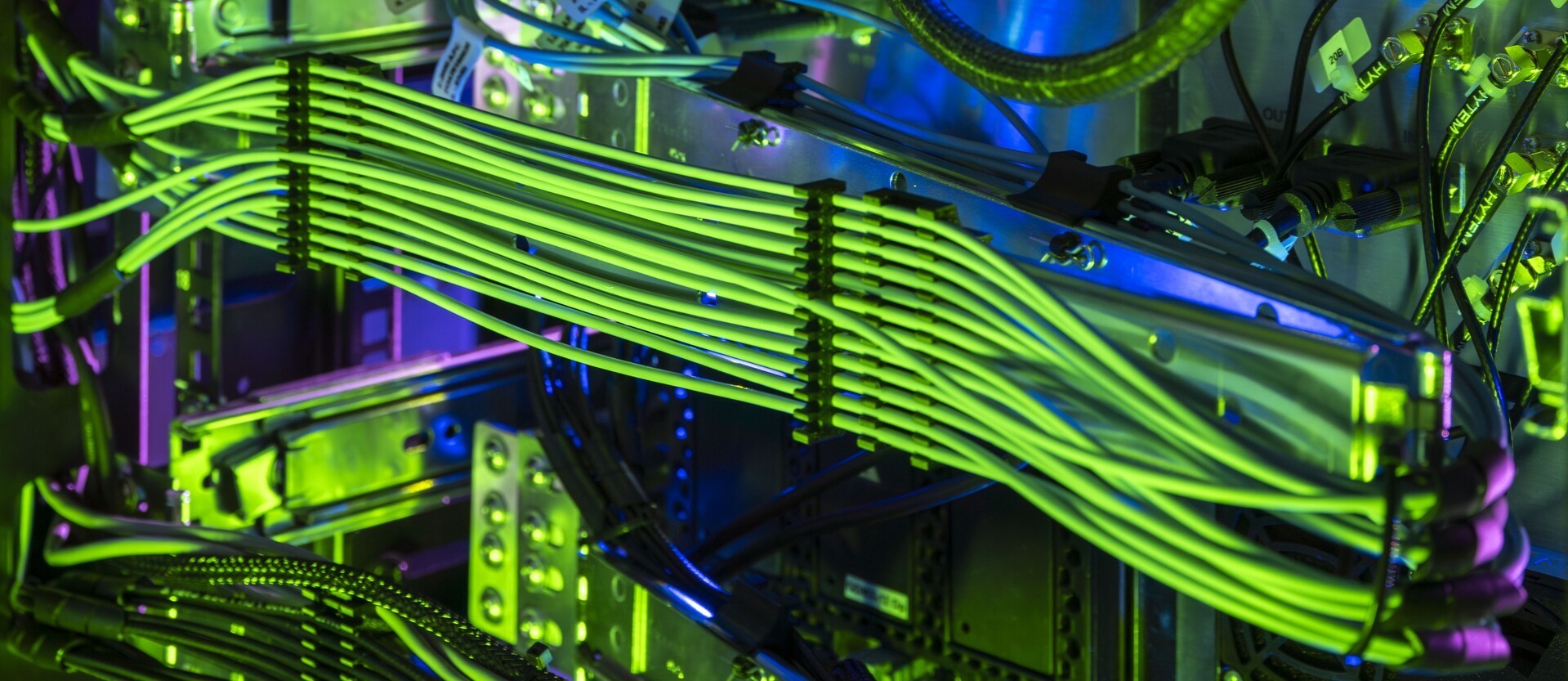
Artistic view of molecules and their electronic orbitals 
Explore More

Read more

Quandela Wins DIGITALEUROPE 2026 Future Unicorn Award

×

Quandela was honored with the 2026 Future Unicorn Award by DIGITALEUROPE, recognizing its leadership in photonic quantum computing, deployment of five quantum computers across Europe and North America, and launch of Europe’s first open-source quantum cloud. The award highlights Quandela’s contribution to Europe’s innovation ecosystem and digital sovereignty. The Future Unicorn Award jury included representatives from the European Investment Bank (EIB) and the European Innovation Council Fund (EIC Fund), among other European investment and innovation leaders.

Brussels, 25th February 2026 – Quandela was awarded the 2026 Future Unicorn Award by DIGITALEUROPE in recognition of its technological excellence and contribution to Europe’s innovation ecosystem. The award was presented during Masters of Digital 2026 (#MoD2026) in front of Europe’s digital and industrial leaders.

The Future Unicorn Award recognizes Europe’s most promising tech scale-ups and emphasizes the importance of supporting European innovation and digital resilience. Quandela was selected for its pioneering photonic quantum technology, the deployment of five quantum computers across Europe and North America, and the launch of Europe’s first open-source quantum cloud. These milestones provide researchers and industry with scalable quantum computing resources and a path toward fault-tolerant, energy-efficient quantum systems.

Quandela’s COO, Valérien Giesz received the award on behalf of the company. During the ceremony he commented “This recognition reflects the dedication, expertise, and vision of our teams. Europe has the scientific talent and industrial depth to lead in quantum computing, and at Quandela, we are committed to turning this potential into real-world impact.”

The Future Unicorn Award jury comprised leaders from Europe’s investment and innovation ecosystem, including the European Investment Bank (EIB), European Innovation Council Fund (EIC Fund), Bridgepoint Group, Invest Europe, Temasek, DIGITALEUROPE, and Atomico.

Other finalists for the Future Unicorn Award included Canatu and Sparrow Quantum. Sateliot, meanwhile, was the winner of the Dual‑Use Technology Award.

About Quandela

Quandela develops and deploys photonic quantum computers designed for real-world environments, with room-temperature operation, data-center compatibility, and a full software stack for programming and running workloads via cloud and on-prem access. Beyond hardware, Quandela works with corporations, research teams, and public institutions to identify, prototype, and integrate quantum use cases through training, technical support, and joint pilot projects. Founded in Europe, Quandela pursues a progressive path from usable systems to fault-tolerant quantum computing.

Read more

Quandela and Seoul Metropolitan Government Sign MoU to Support a Quantum Technology Development Center in Seoul

×

Building on Seoul’s efforts to strengthen its position as a global quantum hub, Quandela entered into a MoU with the Seoul Metropolitan Government (SMG) to support the establishment of a Quantum Technology Development Center in Seoul.

The signing took place at Seoul City Hall on November 12, 2025, and the MoU was signed by Kim Tae-Kyun, Administrative First Deputy Mayor of Seoul, and Niccolo Somaschi, CEO of Quandela. Under the MoU framework, SMG outlined an investment plan of up to ₩80 billion, subject to applicable review, approval, and administrative processes, to support the center and related initiatives.

The ceremony was attended by Philippe Bertoux, French Ambassador to Korea, and Kim Yoo-seok, head of Quandela Korea.

Under the agreement, Quandela plans to build a public–private, academia-linked R&D network in Seoul to support quantum talent development and the local ecosystem, including component manufacturers and startups in the quantum sector.

“This MoU is a major milestone in Quandela’s global strategy,” said Niccolo Somaschi, CEO of Quandela. “Our goal is to help create an ecosystem in Seoul where innovation, research, and industrial applications of quantum technologies are closely connected and made accessible.”

Kim Tae-Kyun, Administrative First Deputy Mayor of Seoul, stated that the city will provide comprehensive support to global companies investing in Seoul, including Quandela.

About Quandela

Quandela develops and deploys photonic quantum computers designed for real-world environments: room-temperature operation, data‑center compatibility, and a full software stack for programming and running workloads (cloud and on‑prem access). Beyond hardware, Quandela helps corporations, research teams and public institutions identify, prototype and integrate quantum use cases through training, technical support and joint pilot projects. Founded in Europe, Quandela pursues a progressive path from usable systems to fault‑tolerant quantum computing.

Read more

Quandela and OVHcloud join forces to democratize quantum machine learning with MerLin

×

At the international Adopt AI event in Paris, Quandela and OVHcloud announce a strategic initiative to bring closer AI and quantum computing thanks to MerLin, Quandela’s quantum machine learning environment. This collaboration will enable researchers and companies to prototype and simulate hybrid models on NVIDIA GPUs before testing them on Quandela’s photonic quantum computers, directly accessible from OVHcloud’s cloud platform.

Paris, Roubaix (France), November 25, 2025 – Quandela, European leader in photonic quantum computing, and OVHcloud, a major European cloud provider, announce that MerLin – the first programming language and environment dedicated to quantum machine learning – will be made available on OVHcloud’s platform starting mid-2026. This unified approach will accelerate the development of hybrid applications within a sovereign cloud environment.

A bridge between AI and quantum

Unveiled in summer 2025, MerLin lays the groundwork for a new generation of Quantum Machine Learning (QML) tools, integrated into standard AI frameworks such as PyTorch and scikit-learn.
Now, thanks to its integration into the OVHcloud platform, users will be able to design, simulate, and test their hybrid AI-Quantum neural networks in a unified cloud environment powered by NVIDIA GPUs, a shared partner of both companies.

This approach will accelerate the development of industrial quantum applications: users will first be able to run their simulations on GPUs, then test and validate their models on Quandela’s photonic quantum computers, hosted and operated within OVHcloud.

A clear quantum roadmap

As part of this partnership, OVHcloud has published its quantum roadmap, announcing that Quandela’s quantum computers will become available on its cloud platform in mid-2026. The first systems to be offered will be BELENOS, a 12-qubit photonic processor, and CANOPUS, a 24-qubit photonic processor.

This deployment will be a major milestone in integrating quantum computing into the cloud, paving the way for democratized and sovereign access to European quantum power.

This partnership with OVHcloud perfectly embodies our vision: to make quantum accessible and useful for AI experts. With MerLin, we provide a seamless environment – from GPU to quantum processor – allowing the exploration of new hybrid algorithms and accelerating the journey from concept to real-world application,” says Jean Senellart, Chief Product Officer at Quandela.

With MerLin, data scientists finally have an accessible framework that does not require quantum computing skills – an actual tool that democratizes its use for the most innovative function in companies: data science,” says Fanny Bouton, Quantum Lead and Product Manager at OVHcloud.

Toward a sovereign European quantum cloud

By combining their expertise – photonics and hybrid algorithms for Quandela, cloud and sovereign infrastructure for OVHcloud, GPU acceleration for NVIDIA – the two partners are laying the foundations of a competitive and open European quantum ecosystem. An ecosystem expected to foster the emergence of hybrid applications in fields such as cybersecurity, finance, energy, healthcare, and logistics.