

Can quantum computers help predict how materials break? We introduce a quantum algorithm for fracture mechanics that encodes elastic systems efficiently and retrieves local crack information with few measurements [1]. By combining variational methods with remeshing-inspired warm starts, we show how to scale beyond typical optimization limits.
Introduction
Imagine crack forming in a dam. At first, it’s barely visible. A microscopic defect in the material. But under stress, it begins to grow. Slowly at first, then faster, branching, propagating… until the dam breaks. Or not.
This is exactly what engineers need to predict: will the crack propagate?
In this work, we show how a quantum algorithm can tackle this problem.
Approach
We consider the equations of linear elastic fracture mechanics:
$$
\mathrm{grad}(\mathrm{div}\,\mathbf{u}) + (1 – 2\nu)\,\Delta \mathbf{u} = 0
$$
and reformulate the problem using its energetic formulation: the physical solution is the displacement field that minimizes the elastic energy.
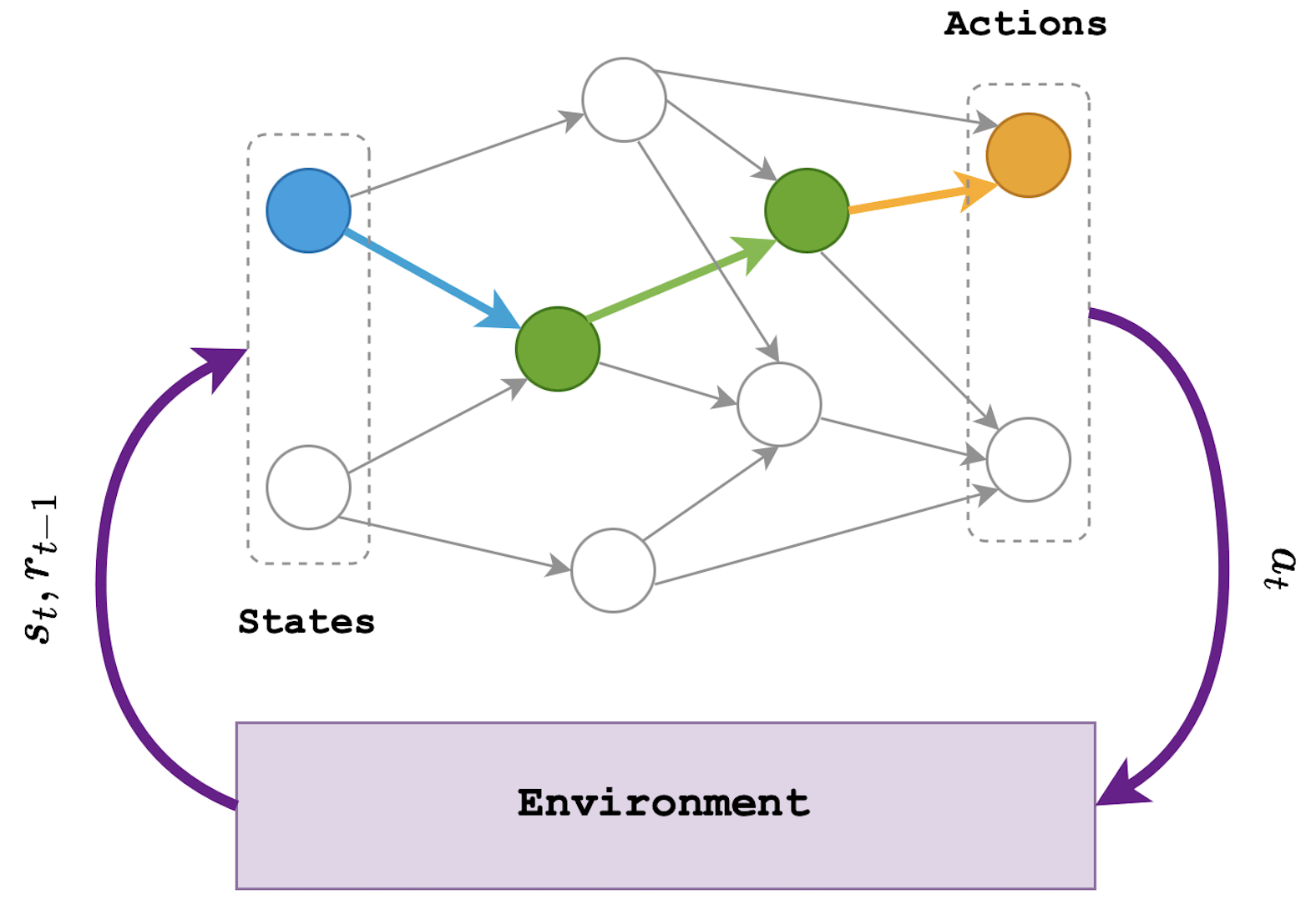
This naturally leads to a variational quantum algorithm:
- A parametrized quantum state encodes the displacement field,
- Measurements estimate the elastic energy,
- And a classical optimizer updates the parameters.
Results
A key challenge is efficient encoding. The displacement field lives on a very large mesh, and naive approaches would require too many qubits.
We address this by constructing an encoding where the full system is stored in quantum amplitudes and thus the number of qubits scales only polylogarithmically with the system size. This enables us to represent large elastic systems compactly on a quantum processor. Finally, instead of reconstructing the full solution, we directly measure local physical quantities relevant to fracture, such as indicators of crack propagation, which can be extracted with a small number of measurements.
The variational formulation successfully recovers the physical solution through energy minimization.
However, a central challenge of variational algorithms is the presence of barren plateaus, where optimization becomes ineffective [2].
To address this, we introduce a quantum remeshing strategy inspired by classical methods:
- solve the problem on a coarse mesh,
- refine the mesh,
- and warm start the new optimization using the previous solution.
By cascading this process, each optimization begins close to the solution, significantly improving convergence and avoiding the typical pitfalls of barren plateaus.
Why it matters
Fracture mechanics is a demanding test case: it involves large systems, evolving geometries, and highly localized effects. Our results show that quantum algorithms can: encode large physical systems efficiently, access only the information that matters and can avoid common difficulties on optimization.
This idea extends beyond fracture mechanics to many areas of scientific computing, where problems are multiscale, adaptive, and inherently dynamic.
In these settings, good quantum algorithms may be those that, unlike the physics they simulate, don’t start from scratch.
References
[1] Remond, U., Emeriau, P. E., Lysaght, L., Ruel, J., Mikael, J., & Kazymyrenko, K. (2025). Quantum remeshing and efficient encoding for fracture mechanics. arXiv preprint arXiv:2510.14746.
[2] Larocca, M., Thanasilp, S., Wang, S., Sharma, K., Biamonte, J., Coles, P. J., … & Cerezo, M. (2025). Barren plateaus in variational quantum computing. Nature Reviews Physics, 7(4), 174-189.