

Quantum advantage is often defined as solving problems faster than classical supercomputers. But speed alone is no longer enough in a world under growing energy constraints.. This article explains why energy efficiency may be the first quantum advantage with direct real-world impact, and how photonic quantum computing can help delivering it.
Introduction
When we talk about quantum advantage, we usually mean one and only one thing: speed. That is when a quantum computer solve a problem faster than the best classical supercomputer.
However, speed is only part of the picture. As energy costs rise and climate constraints intensify, another question emerges:
Can a quantum computer solve problems using less energy than a classical one?
Importantly, this is not a question we can afford to postpone. Energy efficiency is easiest to improve when a technology is still being designed.
If efficiency is ignored early on, systems might be locked into energy-intensive architectures for which it is hard to retrofit efficiency onto choices that were made for other goals. A good example is the recent boom in large AI models: performance scaled incredibly fast, but energy efficiency wasn’t a first-order design constraint and now the entire ecosystem is scrambling to reduce the footprint.
Energy efficiency in quantum technologies
This issue was clearly articulated by the physicist Alexia Auffèves in her perspective “Quantum technologies need a quantum energy initiative”.
Following this call, the Quantum Energy Initiative (QEI) was launched to bring together researchers and industry partners around a shared goal: developing methods to measure, compare, and reduce the physical resource costs of quantum computing.
This effort includes concrete methodological work such as “Optimizing resource efficiencies for scalable full-stack quantum computers”, which proposes ways to assess energy usage across the entire quantum stack, from hardware to algorithms.
Why Boson Sampling is a relevant benchmark
To study quantum energy efficiency in practice, the work focuses on Boson Sampling, a problem that is naturally implemented on photonic quantum computers.
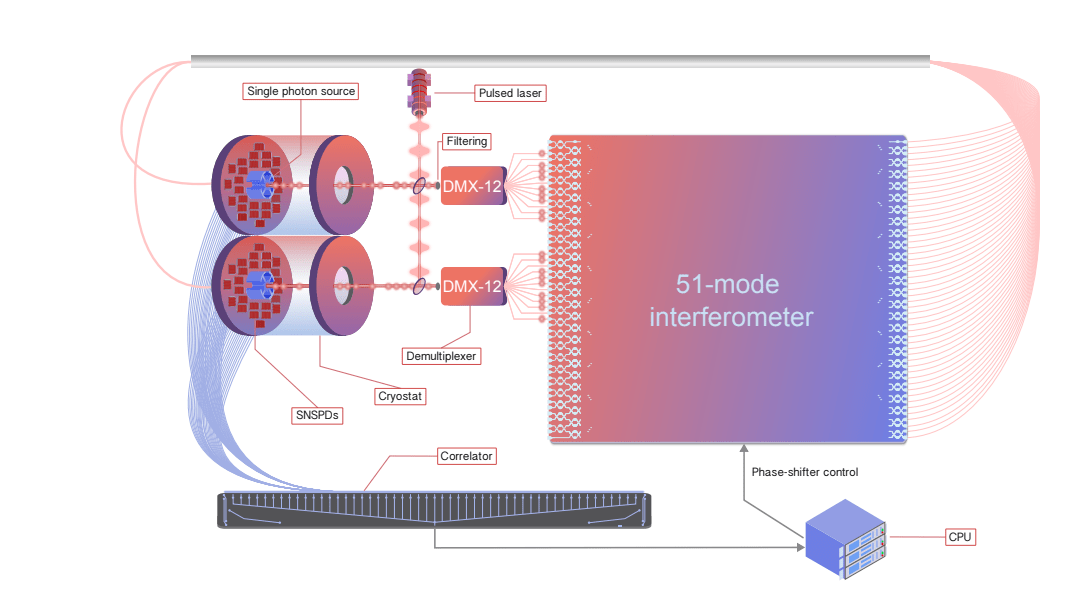
Boson Sampling involves sending single photons through an optical network and sampling their output distribution. A detailed explanation is available in Quandela’s glossary.
It’s an interesting test case for analysing the energy efficiency of a photonic device because:
- it becomes hard to simulate Boson Sampling on classical computers as system size grows,
- it is native to photonic hardware,
- it has already been used to demonstrate quantum computational speedups.
This makes it an ideal playground to study not only how fast quantum computers are, but also how efficiently they use energy.
How quantum and classical energy costs were compared
To ensure a fair comparison, the researchers adopted a full-stack energy analysis.
On the quantum side, they accounted for the electricity required to cool single-photon sources and detectors, as well as the power consumed by lasers, electronics, and control systems. On the classical side, they benchmarked against the most energy-efficient supercomputers listed in the Green500, using the best known classical algorithms for Boson Sampling.
Importantly, the comparison was deliberately conservative, systematically favouring classical computing whenever possible. This ensures that any observed advantage reflects genuine physical efficiency rather than optimistic assumptions.
Key result: energy advantage before speed advantage
The main result is striking. A photonic quantum computer can use less energy per sample than a classical supercomputer even before it becomes faster.
In practical terms, this means there exists a regime where a quantum machine is still slower, yet already more energy efficient. This challenges the common assumption that quantum advantage must first appear as a speed advantage.
Crucially, this result is not purely theoretical. The study shows that only modest improvements beyond today’s state of the art are required. An experimental demonstration of quantum energy advantage is therefore achievable with realistic photonic systems.
Of course, the result is task-dependent. By analysing other tasks, the researchers aim to identify broad regimes of energy advantage that arise before computational advantage. Importantly, energy efficiency remains a key metric even beyond computational advantage, as it directly affects scalability, cost, and sustainability.
Conclusion
For years, progress in quantum computing has been measured primarily in terms of raw computational power. This work suggests a broader perspective:
“The future of quantum computing isn’t just faster. It’s smarter, leaner, and more energy efficient.”
At Quandela, this vision guides the development of our photonic quantum technologies. By integrating energy efficiency as a first-class design criterion, photonic quantum computing offers a credible path toward scalable, high-performance, and efficient quantum machines.
The full paper is now available on Arxiv!
References
- Alexia Auffèves, Quantum technologies need a quantum energy initiative, PRX Quantum 3.2 (2022)
- Quantum Energy Initiative
- Marco Fellous-Asiani et al., Optimizing resource efficiencies for scalable full-stack quantum computers, PRX Quantum 4.4 (2023)
- Grégoire de Gliniasty et al., A spin-optical quantum computing architecture, Quantum 8 (2024)
- Soret, A., Dridi, N., Wein, S. C., Giesz, V., Mansfield, S., & Emeriau, P.-E. (2026). Quantum energetic advantage before computational advantage in boson sampling.