

While we have just introduced feedforward capabilities in Perceval 0.12, our open-source framework for photonic quantum computing, this new feature represents a significant milestone in our development roadmap, enabling users to simulate and experiment with adaptive quantum circuits while we work on implementing these capabilities in hardware. As the quantum computing community moves toward more sophisticated quantum protocols and fault-tolerant architectures, the ability to perform operations conditioned on measurement results becomes increasingly crucial. While implementing feedforward operations in photonic hardware presents unique challenges, having this capability in simulation allows developers to:
- Design and validate adaptive quantum protocols;
- Prototype error correction schemes;
- Prepare for future hardware capabilities;
- Explore the enhanced computational power enabled by feedforward control.
In this blog post, we’ll explain what feedforward operations are, why it matters for quantum computing, and how this new feature in Perceval helps bridge the gap between current capabilities and future photonic quantum computers.
What is a feedforward Operation?
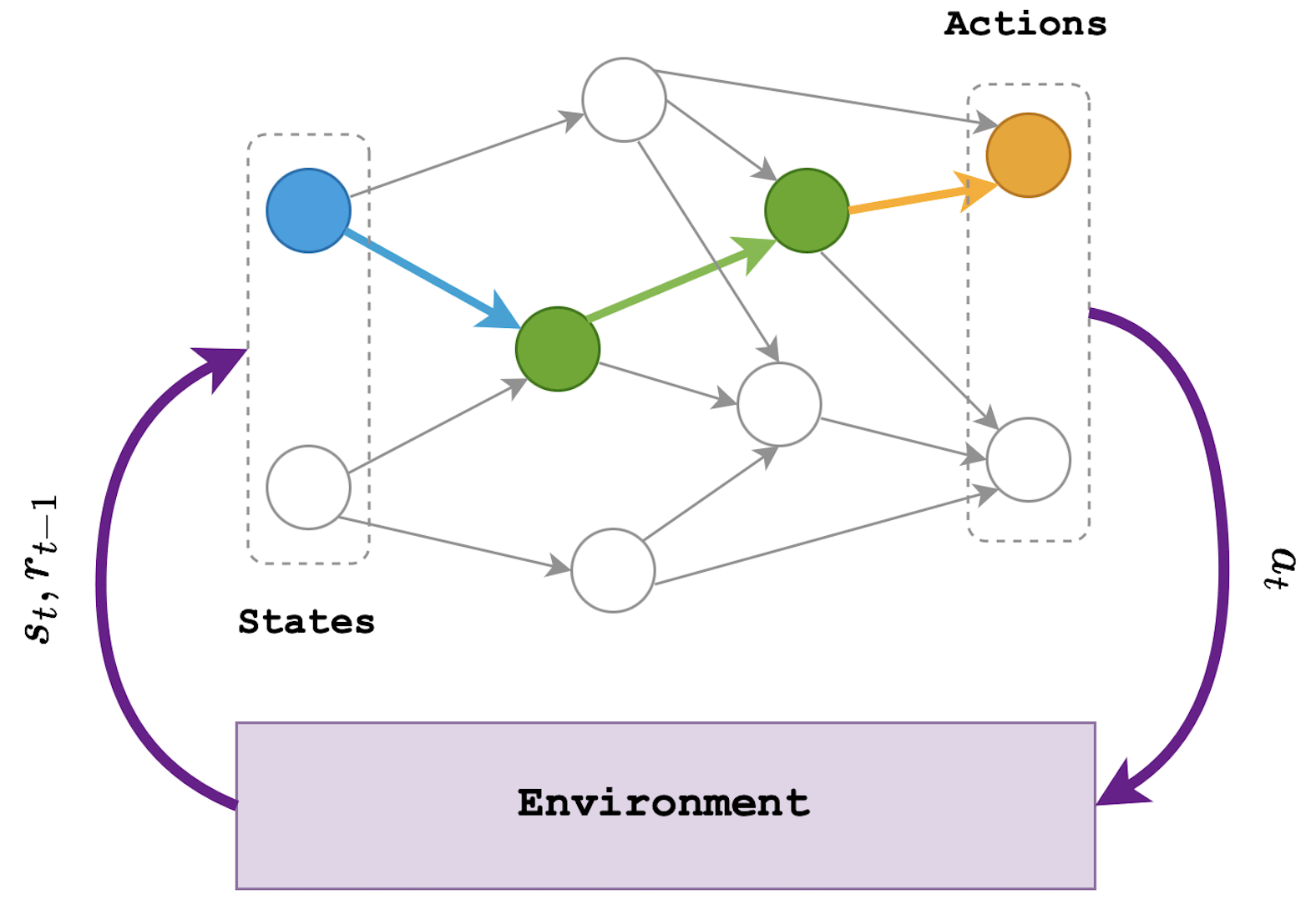
In quantum computing, feedforward operations refer to the ability to use classical measurement results to determine subsequent quantum operations in real-time. So feedforward influences future operations in the quantum circuit.
Consider a simple example: in a quantum circuit, we measure a qubit and based on whether we get a |0⟩ or |1⟩ result, we apply different operations to other qubits later in the circuit. This real-time decision making based on measurement outcomes is a feedforward control. Feedforward is also at the basis of the quantum teleportation protocol.
Comparison with Other Platforms
This capability is related to what other quantum computing platforms call “mid-circuit measurements” or “dynamic circuits”. For instance, superconducting quantum computers can measure qubits mid-circuit and use results to condition later gates.
The Photonic Challenge
Implementing feedforward in photonic systems presents unique challenges. Time management is critical across all quantum computing platforms, but manifests differently:
- Time Management Across Platforms:In superconducting systems, qubits remain stationary but face decoherence over time.In photonic systems, qubits are constantly in motion at the speed of light, requiring precise spatial and temporal control.Both platforms face a race against time, but for different reasons: decoherence vs. photon loss and synchronization
- Synchronization Requirements:We need to keep multiple photons alive and synchronized while:
- Detecting some photons
- Processing measurement results
- Reconfiguring optical elements This typically requires long optical delay lines or quantum memories
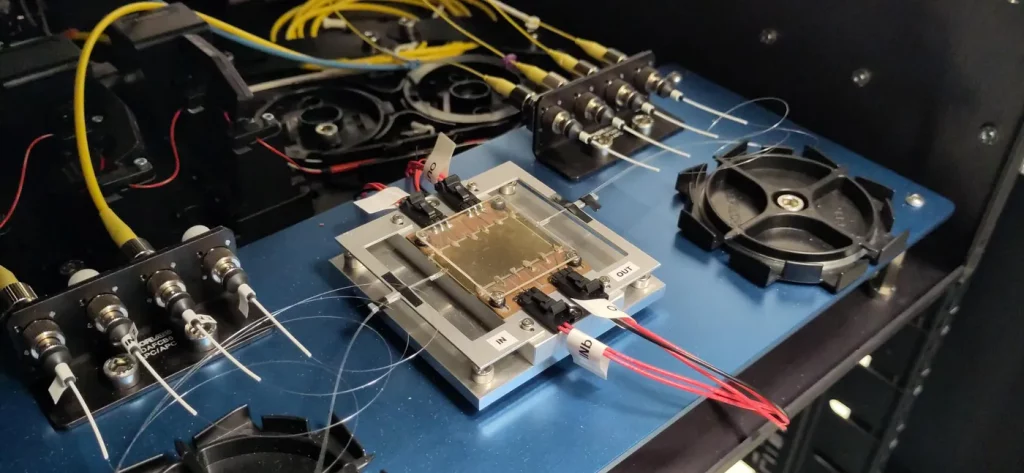
- Hardware Constraints:The implementation of feedforward operations in photonic systems requires several critical hardware components, each pushing the boundaries of current technology:
- Fast optical switching (nanosecond scale)
- Low-loss delay lines
- Precise timing control across all components
- Minimal latency in classical processing and control
Why Feedforward Matters
Feedforward operation is fundamental to several key quantum computing capabilities:
- Measurement-Based Quantum Computing: protocols where computation is performed on a resource state via single-qubit operation and – crucially – feedforward from the previous outcome results. This is the native route to quantum universality for photonic systems.
- Error Correction: In some quantum error correction scheme – notably in photonics – adaptive protocols are crucial for minimizing resource requirements.
As we can see, feedforward is crucial for implementing universal and error corrected quantum operations, especially in photonics. For instance, in our Spin-Optical Quantum Computing (SPOQC) architecture, introduced in “A Spin-Optical Quantum Computing Architecture” and refined here, feedforward operation plays a crucial role in:
- Adaptive Error Correction: applying appropriate operations based on measurement outcomes;
- Repeat-Until-Success operation: stopping the gate operation as soon as it has succeeded.
Even in the NISQ era, feedforward significantly expands the capabilities of photonic quantum computers. Recent works in photonic quantum computing show that feedforward enables computational capabilities beyond what static linear optics can achieve alone, as demonstrated in “Quantum machine learning with adaptive linear optics” and in “Towards quantum advantage with photonic state injection“.
Hardware Implementation
The implementation of feedforward in Perceval represents a key milestone in our roadmap toward SPOQC. Our hardware development plan includes:
- Integration of fast optical switches with low latency
- Development of real-time classical processing systems
- Implementation of the complete feedback loop from measurement to control
This follows our published roadmap to SPOQC, with feedforward capability being a crucial stepping stone toward full fault-tolerant operation.
Getting Started
Perceval now provides comprehensive support for experimenting with feedforward operations. Here’s a practical example implementing quantum teleportation:
import perceval as pcvl

# Create a processor with feedforward capability
p = pcvl.Processor("SLOS", 6)

# Configure X-gate feedforward
ff_X = pcvl.FFCircuitProvider(2, 0, pcvl.Circuit(2))
ff_X.add_configuration([0, 1], pcvl.PERM([1, 0]))

# Configure Z-gate feedforward
phi = pcvl.P("phi")
ff_Z = pcvl.FFConfigurator(2, 3, pcvl.PS(phi), {"phi": 0})
ff_Z.add_configuration([0, 1], {"phi": np.pi})
The complete example is available in our documentation.
Looking Forward
With feedforward support now available in Perceval, we open new possibilities for:
- Application Development: Creating and testing adaptive quantum algorithms
- Protocol Implementation: Experimenting with sophisticated quantum protocols
- Architecture Research: Developing and validating components of fault-tolerant architectures
We invite the quantum computing community to explore these new capabilities and develop novel applications leveraging feedforward operations. This feature provides the foundation for implementing more sophisticated quantum protocols and advancing toward fault-tolerant quantum computation.