
Quantum teleportation is a protocol that transfers an unknown quantum state from one particle to another distant particle, without physically sending the particle itself. It relies on shared entanglement, local operations and classical communication.
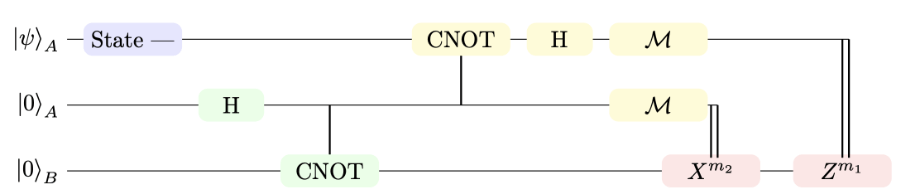
Let us suppose that Alice wants to send the state \( \ket{\psi}_A \) to Bob. The steps of the protocol are showed in the circuit.
- Alice and Bob share a pair of qubits prepared in a maximally entangled Bell state (Green).
- Alice measures her qubit of the entangled pair and the qubit to be teleported in the Bell basis, this measurement projects the system into one of the four Bell states (yellow).
- The outcome of the Bell measurement corresponds to two classical bits. Alice sends these bits to Bob via a classical channel.
- Using the classical bits from Alice, Bob applies the appropriate Pauli operator to his qubit. This operation transforms Bob’s qubit into \( \ket{\psi}_A \), completing the teleportation (red).
Frequently Asked Questions
- Can quantum teleportation beam objects like in science fiction?
No. Quantum teleportation is strictly a quantum phenomenon that transfers only the quantum state of a particle, not the particle itself. The original particle is destroyed, and only information is transferred. This process relies fundamentally on entanglement, which cannot exist in classical system.
- Does quantum teleportation violate the speed of light?
No. Classical communication of measurement outcomes is required to complete the protocol. The teleportation cannot transmit information faster than light.
- Can we teleport a qubit without destroying the original?
No. The Bell-state measurement does not copy the state but projects Alice’s qubits into a new state, meaning the original state no longer exists locally. This is consistent with the no-cloning theorem.
- Do Alice and Bob need to physically send the qubit?
No. Only classical bits and a pre-shared entangled pair are transmitted. The qubit itself never moves.
- What is the success probability of teleportation?
Ideal teleportation assumes perfect Bell-state measurement and entanglement, giving 100% success. In physical realizations, especially linear-optical systems, the success probability may be less than unity, reinforcing that teleportation is not deterministic without additional resources.