

Scalable photonic quantum computing requires multiple independent single-photon sources that behave as a unified quantum resource. In collaboration between the C2N (under the expertise of Pascale Senellart, Quandela’s Chief Scientific Officer) and our Device R&D teams, we demonstrate high-fidelity interference between photons emitted from independent quantum dot–cavity sources. We achieve 88 ± 1% indistinguishability without spectral filtering, establishing a scalable building block for multi-source photonic quantum architectures.
Introduction:
Photonic quantum computing leverages photons as carriers of quantum information, offering real advantages in speed and scalability. But for quantum operations to actually work, photons emitted from different sources must be nearly identical; in wavelength, timing, and other key properties. Achieving this level of indistinguishability across multiple independent emitters has been one of the field’s most stubborn technical challenges.
This is especially critical for the Spin-Optical Quantum Computing (SPOQC) architecture, where each photon source embeds a spin qubit that stores quantum information locally. High-fidelity entangling operations require photons from these spin-based sources to interfere indistinguishably; effectively allowing the spins to “talk to one another” and enabling scalable quantum computation.
The core difficulty is that solid-state emitters are not born equal. Their local environments introduce natural variations that make producing identical photons across independent sources surprisingly hard. Moving beyond single-source demultiplexing to true multi-source architectures has therefore remained a major bottleneck, until now.
In collaboration with C2N and drawing on Quandela’s device R&D expertise, we demonstrate a scalable strategy for generating indistinguishable photons from independent quantum dot–cavity sources. This is a meaningful step toward quantum processors that can grow in power.
Core Challenge: Matching Independent Quantum Light Sources
The main challenge isn’t just generating single photons, but ensuring photons from multiple sources are indistinguishable despite independent noise environments.
Even nominally identical quantum emitters exhibit variations in:
- Emission wavelength
- Spectral diffusion (random shifts in emission frequency)
- Temporal emission dynamics
- Environmental charge and interactions with lattice vibrations (phonons)
These differences reduce the visibility of quantum interference between photons from separate devices. Historically, this required spectral filtering or post-selection, which limits scalability.
Our work overcomes this by engineering uniformity both at the fabrication stage and through post-fabrication wavelength tuning.
Approach: Scalable Quantum Dot–Cavity Photon Sources
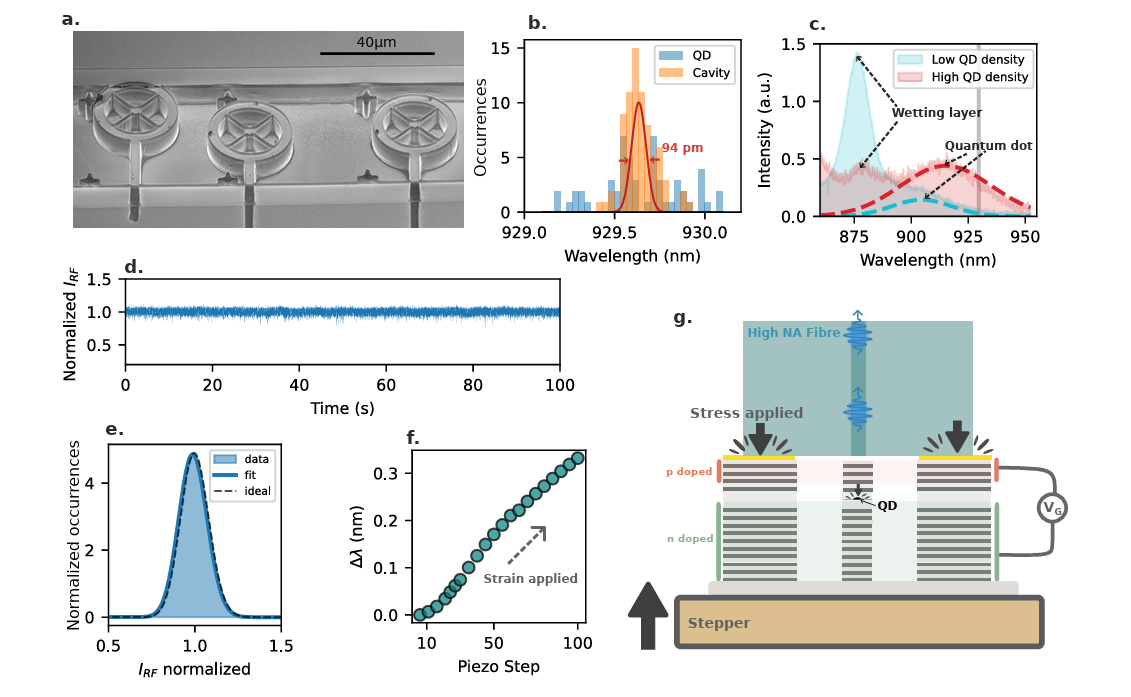
We use semiconductor InGaAs quantum dots embedded in micropillar cavities as deterministic single-photon emitters. The optical cavity enhances emission efficiency and provides strong control over photon extraction dynamics.
A large ensemble of devices is fabricated starting with a low-density quantum dot growth recipe via high-precision molecular beam epitaxy (MBE), which reduces charge noise by minimizing environmental charge fluctuations. Following growth, quantum dots are pre-selected during in-situ lithography based on their emission wavelengths, resulting in tightly controlled wavelength dispersion (~94 pm). This pre-selection process enables reproducible device properties across multiple independent sources.
Two complementary tuning mechanisms are then applied:
- strain tuning for coarse wavelength correction (hundreds of pm range)
- electric-field tuning for fine spectral alignment (~tens of pm range)
This dual-control approach enables deterministic spectral overlap between independent emitters.
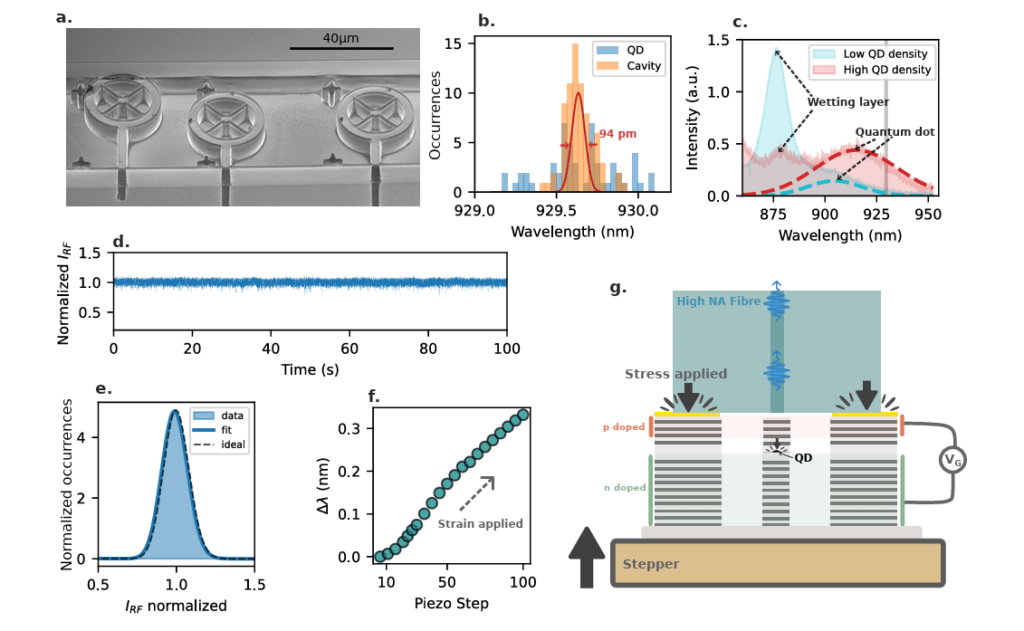
Fabrication of low-noise identical single-photon sources
Key Result: High Indistinguishability Between Independent Emitters
We measure two-photon interference using Hong–Ou–Mandel (HOM) experiments between photons emitted from spatially separated quantum dot–cavity sources.
The system achieves a mutual indistinguishability of 88 ± 1%, demonstrating strong quantum interference between independent devices.
Importantly, this performance is achieved:
- without spectral filtering
- without post-selection
- at high emission rates
The measured indistinguishability reaches the intrinsic limit of individual emitters and is primarily constrained by phonon-induced pure dephasing, a fundamental solid-state interaction rather than a fabrication imperfection.
This indicates that device-level variability is no longer the dominant bottleneck in this platform.
Why This Matters for Photonic Quantum Architectures and SPOQC
Currently, our quantum photonic units (QPUs) use a single photon source demultiplexed to produce multiple photons simultaneously. While effective, demultiplexing reduces the QPU clock rate and introduces optical losses.
Our multi-source indistinguishable photon generation eliminates the need for demultiplexing, improving throughput and reducing system complexity.
More importantly, this capability is fundamental for the SPOQC architecture. By enabling photons emitted from different spin-based sources to interfere, it allows the embedded spins to “talk to one another” through high-fidelity photon interference. This is essential for entangling operations and scalable quantum computation.
Our demonstration supports SPOQC’s modular, scalable design by removing the bottleneck of photon source mismatch. This enables parallel operation of spin-photon modules, simplifies photonic circuits, and advances fault-tolerant quantum computing
Key Takeaways
- Photonic quantum computing requires interference between indistinguishable photons.
- Independent quantum emitters naturally introduce spectral and temporal mismatches.
- High-precision fabrication achieves tight wavelength control (~94 pm dispersion).
- Dual tuning (electric + strain) enables deterministic spectral alignment.
- Ultra-low spectral noise ensures stable emission across independent devices.
- Two-photon indistinguishability of 88 ± 1% is achieved without filtering or post-selection.
- Performance is limited primarily by intrinsic phonon-induced dephasing.
- The result removes device mismatch as the main scalability bottleneck.
- The approach enables multi-source photonic architectures for quantum computing.
Conclusion
We demonstrate that independent quantum dot–cavity single-photon sources can emit highly indistinguishable photons with high efficiency and reproducibility. Developed through collaboration between the C2N and Quandela’s device R&D teams, this work establishes a scalable hardware foundation for multi-source photonic quantum computing architectures.
By pushing device performance near intrinsic limits, the bottleneck shifts from fabrication variability to fundamental material physics. This represents a crucial step toward modular, large-scale photonic quantum computing systems.
Future improvements in cavity design will further enhance indistinguishability, enabling even more complex photonic quantum processors.