

As quantum computing progresses beyond the lab, photonic approaches are moving from demonstrations toward deployable systems. Along with her Quandela co-founders Niccolò Somaschi and Valérian Giesz, Pascale Senellart, CNRS research director, has worked to turn advances in quantum optics and semiconductor physics into practical building blocks for photonic quantum computing. Featured in national French media such as Le Monde and awarded the CNRS Innovation Medal in December 2025, Senellart has also used her voice to argue for structural change in research culture, including as a signatory of the international Women for Quantum manifesto.
Introduction
Profiled in national French media outlets like Le Monde, and recently awarded the CNRS Innovation medal, Pascale Senellart, Quandela’s co-founder, is one of the prominent figures in France’s quantum computing landscape. Pascale, who is also a Research Director at France’s National Centre for Scientific Research (CNRS), the country’s leading public research organisation, has built her career at the intersection of quantum optics and semiconductor physics, focusing on the control of single photons for quantum technologies.
Her work and perspective reach well beyond the laboratory. On December 11, 2025, she delivered the Collège de France inaugural lecture “A Second Quantum Revolution.” More recently, she contributed to TERATEC’s 20th-anniversary publication, The Keys of the Digital World, outlining how quantum is beginning to integrate into high-performance computing through hybrid approaches.
Alongside a distinguished scientific career and a long list of achievements, she has also spoken out on the place of women in the scientific community, playing an active role in calling for structural change.
In 2024, she was among the women scientists who co-signed a manifesto calling for meaningful change in response to gender-based discrimination in research.
It started with a radio telescope: early influences on a Quantum physicist
Naturally curious, Pascale Senellart’s interest in science was sparked early on. Growing up near Orléans, she often passed the Nançay radio astronomy station during family trips, where the sight of its massive radio telescope left a lasting impression and eventually led her to choose the site for one of her first school internships.
“I am still as fascinated as I ever was by large-scale scientific facilities, which illustrate how advanced engineering enables scientific exploration. But I realised soon enough that astronomy wasn’t what interested me the most, because it focuses on distant objects and offers limited flexibility for scientists to rapidly change how the system is probed in response to new questions.”
Rather than looking farther into the universe, Pascale found herself drawn toward the opposite end of the scale. When it comes to quantum physics, bigger does not always mean better. Progress in quantum computing begins with mastering the smallest possible units of light and matter.
This is precisely the challenge Pascale has been tackling for more than two decades. Where astronomy studies distant and largely inaccessible objects, quantum physics allows scientists to zoom in, adjust experimental parameters and directly manipulate individual quantum systems under carefully controlled laboratory conditions. This ability to probe and control systems in detail would become central to her scientific approach.
Focusing her research on quantum phenomena at the nanoscale, in particular photons and quantum dots, semiconductor nanostructures capable of emitting single particles of light on demand, these systems now form the foundation of photonic quantum technologies.
Building at the quantum scale
In 1993, Pascale enrolled at École Polytechnique, one of France’s top engineering and science schools.
It was there that she deepened her interest in quantum optics and semiconductor physics, two
disciplines that would become central to her later work. After completing her PhD in 2001, she spent time in industry at Schlumberger and Thales, applying semiconductor technologies in more application-driven research environments.
She joined the French National Centre for Scientific Research in the early 2000s, fulfilling a long-held goal of building a career in fundamental research. It is within this setting that she began shaping a research programme at the crossroads of quantum optics and semiconductor nanostructures.
She conducts her research at the Centre de Nanosciences et de Nanotechnologies (C2N), a joint research unit between CNRS and Université Paris-Saclay.
A major focus of her CNRS work was the controlled generation of light from individual quantum emitters. By studying the behaviour of a single quantum dot inserted in an optical cavity, her team sought to control the photon emission, and eventually to make it efficient, directional and usable for downstream experiments. This approach was designed to control the interaction between a quantum emitter and its electromagnetic environment. By engineering how a single quantum dot interacts with its optical environment, her team could better control how photons are generated and collected in a semiconductor device, work that later informed the single-photon technologies developed at Quandela.
From laboratory research to quantum entrepreneurship
In 2017, having reached the point of the single photon source technology where it could accelerate the development of quantum technologies, Pascale co-founded Quandela with Niccolò Somaschi, a junior researcher and Valérian Giesz, then a PhD student at C2N. The company started by commercialising efficient single-photon sources.
“Quandela is one of the first French start-ups in quantum technologies. When it was first founded, the ecosystem was nothing like it is today. We had to explain quantum technologies to many French innovation and commercialisation bodies. At the time, there wasn’t much enthusiasm for this kind of effort, but I’m very surprised by how quickly things have evolved. I felt like an alien when we tried to create a start-up in 2015.”
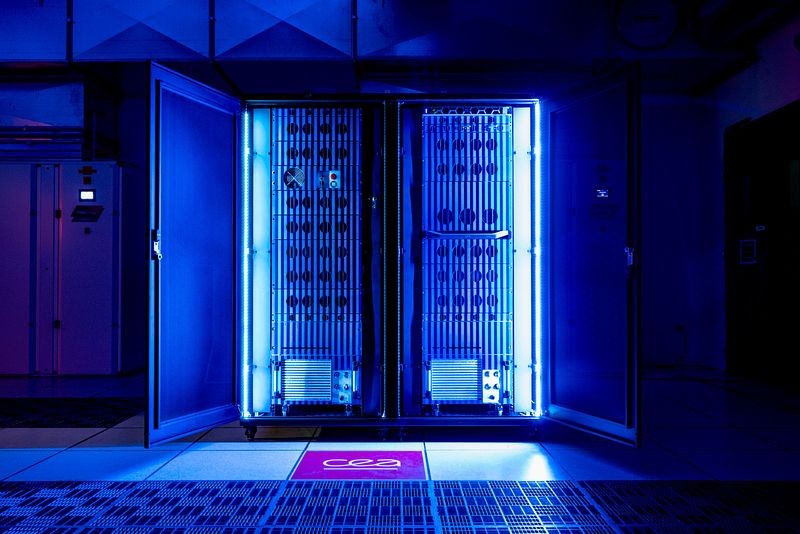
Since 2020, Quandela embarked on the development of photonic quantum computers, and welcomed Shane Mansfield, expert of quantum algorithms and Jean Senellart, expert in machine learning with 20 years industry experience. Quandela has since developed Lucy, considered to be the most powerful photonic quantum computer deployed to date in a European computing centre: a twelve-qubit system, installed in 2025 at the CEA’s Très Grand Centre de Calcul (TGCC). The system uses single photons as units of information, which are generated, controlled and measured to run quantum algorithms. Lucy is operated within a national high-performance computing environment, providing researchers and industrial users with access to a photonic quantum processor integrated into existing computing infrastructures.
- What is a single-photon source?
Single photons are individual particles of light that can be generated and controlled one at a time. Because they follow the principles of quantum mechanics, they can exist in superposition and become entangled, allowing information to be encoded and processed in ways that have no equivalent in classical systems. In quantum computing, single photons are reliable carriers of quantum information, where their reduced sensitivity to noise enable precise operations and scalable computing architectures.
Today, Pascale’s contributions to quantum optics and semiconductor-based single-photon technologies have been recognized across the full spectrum of scientific and technological impact— from fundamental research, with her election to the Académie des sciences (French Academy of Sciences) in 2022, to technological development, through her election to the Académie des technologies, and finally to innovation, with the recently-awarded CNRS Innovation Medal.
Beyond her own research and entrepreneurial work, Pascale has also been deeply involved in shaping the broader quantum ecosystem in France. As quantum technologies began to move from laboratory research toward industrial applications, she contributed to initiatives aimed at structuring and accelerating this transition, notably through programmes such as DIM SIRTEQ and QuantIP, which support the development and transfer of quantum technologies.
This engagement extends to the Paris-Saclay cluster, where she has been involved in bringing together academic and industrial actors within a shared framework, contributing to the emergence of a coordinated community through initiatives such as the Quantum Saclay centre. At the same time, she has supported the development of new training programmes, including ARTEQ, created with physicist Jean-François Roch, a professor at ENS Paris-Saclay and specialist in quantum optics, to help equip a new generation of scientists and engineers with the skills required in quantum technologies.
Beyond research: shaping a more inclusive scientific culture
This commitment to shaping the future of quantum technologies also extends to the conditions under which science is conducted. Beyond her work as a researcher and entrepreneur, Pascale has also played an active role in structuring the broader quantum ecosystem in France. She was among the scientists who co-signed the Women for Quantum manifesto in 2024, a collective initiative calling for structural change in research environments.
The text highlights persistent gender imbalances, barriers to career progression, and the need for more inclusive and collaborative models of scientific leadership.
Through this engagement, she contributes to ongoing efforts to improve representation and working conditions for women in quantum science.
Part of her engagement includes taking part in outreach activities promoting the place of women in science, notably by encouraging young women to pursue scientific careers. In 2026, she was invited as a guest of honour in the Sciences, un métier de Femmes programme, supported by the association Femmes & Sciences. This event brings together female scientists and high school students to challenge stereotypes and promote careers in science.