

Newsroom / Press release

Quantum meets AI

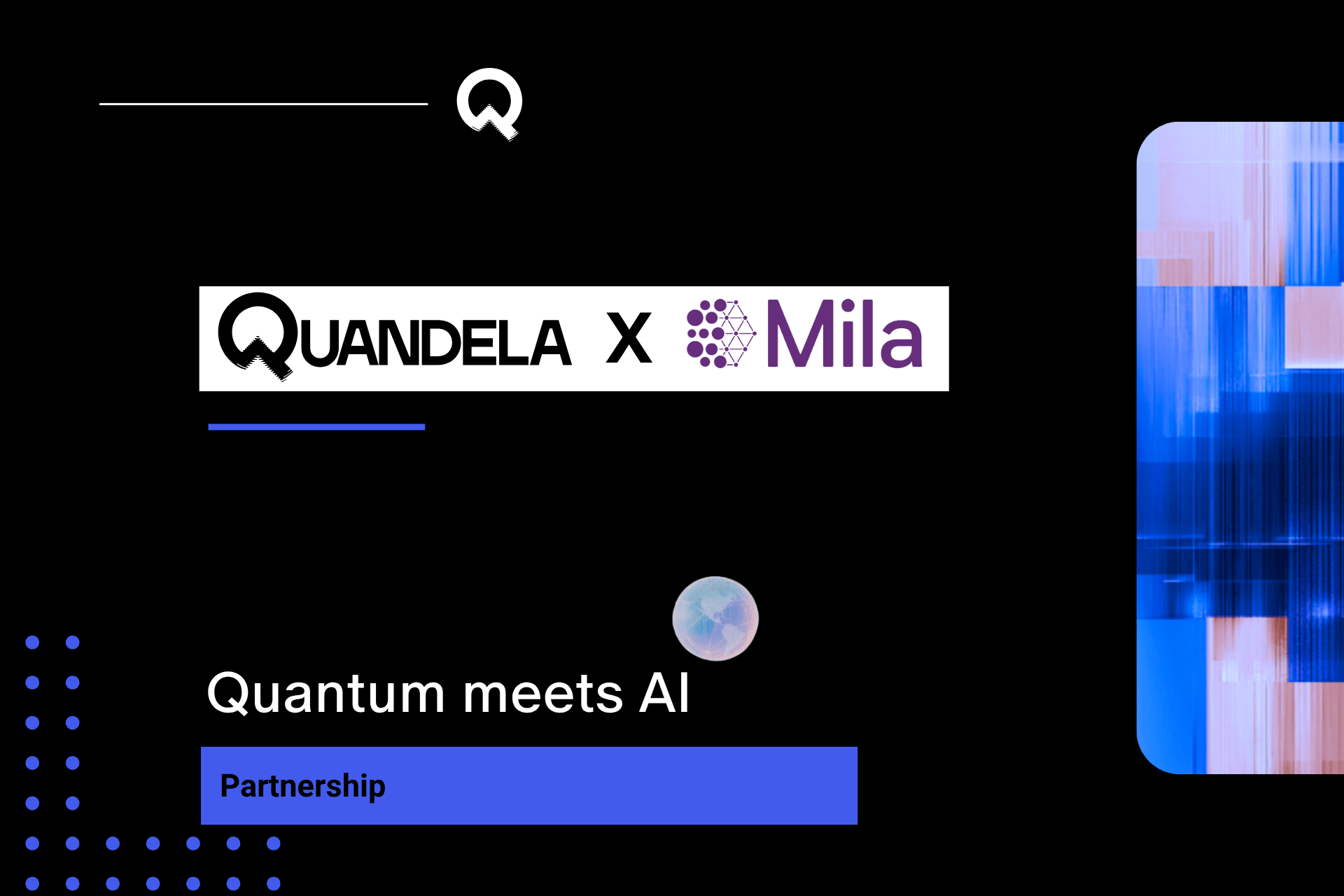
Quandela and Mila join forces to develop hybrid artificial intelligence and quantum computing technologies. [French version below] Montreal, Quebec and Paris, France – July 8, 2025 – Quandela, a European […]

Quandela and Mila join forces to develop hybrid artificial intelligence and quantum computing technologies. [French version below]

Montreal, Quebec and Paris, France – July 8, 2025 – Quandela, a European leader in photonic quantum computing, and Mila, the Quebec Artificial Intelligence Institute, announce a partnership to explore the potential of hybrid technologies combining machine learning and quantum computing.  

This strategic collaboration will focus on the development and evaluation of innovative quantum machine learning (QML) models, positioning both organizations at the forefront of this new technological frontier.  

“This partnership with Mila represents a crucial step in our mission to explore concrete applications of quantum computing in the field of artificial intelligence,” says Valérian Giesz, co-founder and COO of Quandela. “By combining our expertise in photonic quantum computing with Mila’s excellence in artificial intelligence, we are confident we can accelerate the development of solutions that will transform many sectors.”   

“The intersection of artificial intelligence and quantum computing represents a field with great potential,” said Guillaume Rabusseau, Core Academic Member at Mila and Assistant Professor at the Université de Montréal. “Our collaboration with Quandela is an opportunity to explore how quantum approaches can enrich and potentially revolutionize current machine learning paradigms.” 

Key objectives of the partnership

The collaboration between Quandela and Mila will focus on four main areas: 

1.Benchmarking: Comparing the performance of quantum machine learning (QML) models on structured data against classical approaches.

2.Identifying quantum advantages: Determining under which conditions quantum methods can offer significant advantages in terms of accuracy, resource utilization and scalability. 

3.Solving training challenges: Develop innovative solutions to overcome known challenges in training quantum models. 

4.Experimental validation: Integrating both simulation-based studies and experiments on real quantum hardware to assess the potential of QML in real-world applications.  

A stronger foothold in Canada

This partnership with Mila marks another step in Quandela’s expansion in Canada, following the recent installation of a quantum computer in Sherbrooke. This growing presence underscores Quandela’s commitment to actively contribute to the development of the Canadian quantum ecosystem, recognized worldwide for its excellence.  

“The implementation of our quantum technology in Sherbrooke, followed by this partnership with Mila, illustrates our long-term vision for Canada,” emphasizes Valérian Giesz. “We are impressed by the vitality of the Canadian innovation ecosystem and determined to play a significant role in it.”    
 
About Mila

Founded by Professor Yoshua Bengio of the University of Montreal, Mila is the world’s largest academic research center for deep learning, bringing together over 1,300 specialized researchers in machine learning. Based in Montreal and funded in part by the Government of Canada through the Pan-Canadian AI Strategy, Mila’s mission is to be a global center for scientific advancements that inspire innovation and the growth of AI for the benefit of all. Mila is a globally recognized non-profit organization for its significant contributions to deep learning, especially in the fields of language modeling, automatic translation, object recognition, and generative models. For more information, visit mila.quebec.    

——————————————————————————

Quandela et Mila s’associent pour développer des technologies hybrides combinant intelligence artificielle et informatique quantique 

Montréal, Québec et Paris, France – 8 juillet 2025 – Quandela, leader européen de l’informatique quantique photonique, et Mila, l’Institut québécois d’intelligence artificielle, annoncent un partenariat visant à explorer le potentiel des technologies hybrides combinant l’apprentissage automatique et l’informatique quantique.  

Cette collaboration stratégique se concentrera sur le développement et l’évaluation de modèles d’apprentissage automatique quantique (QML) innovants, positionnant les deux organisations à l’avant-garde de cette nouvelle frontière technologique.  

« Ce partenariat avec Mila représente une étape cruciale dans notre mission d’explorer les applications concrètes de l’informatique quantique dans le domaine de l’intelligence artificielle», déclare Valérian Giesz, cofondateur et directeur des opérations de Quandela. « En combinant notre expertise en informatique quantique photonique avec l’excellence de Mila en intelligence artificielle, nous sommes convaincus de pouvoir accélérer le développement de solutions qui transformeront de nombreux secteurs. » 

« L’intersection de l’intelligence artificielle et de l’informatique quantique représente un domaine avec un très grand potentiel, » a affirmé Guillaume Rabusseau, Membre académique principal de Mila et Professeur adjoint à l’Université de Montréal. « Notre collaboration avec Quandela sera une occasion d’explorer comment les approches quantiques peuvent enrichir et potentiellement révolutionner les paradigmes actuels d’apprentissage automatique. »  

Objectifs clés du partenariat
La collaboration entre Quandela et Mila s’articulera autour de quatre axes principaux : 

1.Évaluation comparative : Comparer les performances des modèles d’apprentissage automatique quantique (QML) sur des données structurées par rapport aux approches classiques. 

2.Identification des avantages quantiques : Déterminer dans quelles conditions les méthodes quantiques peuvent offrir des avantages significatifs en termes de précision, d’utilisation des ressources et d’extensibilité. 

3.Résolution des défis d’entraînement: Développer des solutions innovantes pour surmonter les défis connus liés à l’entraînement de modèles quantiques. 

4.Validation expérimentale : Intégrer à la fois des études basées sur des simulations et des expériences sur du matériel quantique réel pour évaluer le potentiel du QML dans des applications concrètes.  

Un ancrage renforcé au Canada

Ce partenariat avec Mila marque une nouvelle étape dans l’expansion de Quandela au Canada, après l’installation récente d’un ordinateur quantique à Sherbrooke. Cette présence croissante témoigne de l’engagement de Quandela à contribuer activement au développement de l’écosystème quantique canadien, reconnu mondialement pour son excellence.  « L’installation de notre technologie quantique à Sherbrooke, suivie de ce partenariat avec Mila, illustre notre vision à long terme pour le Canada », souligne Valérian Giesz. « Nous sommes impressionnés par la vitalité de l’écosystème d’innovation canadien et déterminés à y jouer un rôle significatif.»   

À propos de Mila

Fondé par le professeur Yoshua Bengio de l’Université de Montréal, Mila est le plus grand centre de recherche universitaire en apprentissage profond au monde, rassemblant plus de 1 300 chercheur·euse·s spécialisé·e·s dans le domaine de l’apprentissage automatique. Basé à Montréal et financé en partie par le gouvernement du Canada dans le cadre de la Stratégie pancanadienne en matière d’IA, Mila a pour mission d’être un pôle mondial d’avancées scientifiques qui inspire l’innovation et le développement de l’IA au bénéfice de tous·tes. Mila est une organisation à but non lucratif reconnue mondialement pour ses importantes contributions au domaine de l’apprentissage profond, en particulier dans les domaines de la modélisation du langage, de la traduction automatique, de la reconnaissance d’objets et des modèles génératifs. Pour en savoir plus, visitez mila.quebec. 
Explore More

Read more

OVH Cloud accelerates the European quantum industry with Quandela’s Belenos

×

Roubaix – April 17th 2026 – At the Quantum Defence Summit, OVHcloud, a global cloud player and the European cloud leader, and Quandela announce the availability of the Belenos computer on OVHcloud’s Quantum platform.

Unveiled last autumn, the OVHcloud Quantum Platform makes quantum computing, a breakthrough technology, more accessible through a Quantum-as-a-Service (QaaS) consumption model. With the addition of Belenos, OVHcloud continues to deploy its ambitious roadmap of quantum computers accessible through the cloud.  

Quandela Belenos leverages photonic quantum technology to offer a compute power of 12 qubits. It helps organisations to experiment with new algorithms in innovative domains such as image sorting and generation, accelerated AI calculus, or quantum machine learning (QML). New use cases in the fields of electromagnetic simulation, structural mechanics, engine combustion, material simulation, meteorology, and earth observation also benefit from the advances in quantum computing. 

Supporting the European quantum ecosystem since 2022, the Group offers the widest range of quantum emulators leveraging its infrastructures with over a thousand users. With 15 affordable quantum emulators (including Perceval and MerLin) starting at 0.03 euros per hour, the Group helps users to grow their familiarity with different quantum computing models.  

We are delighted to deliver on the promise of the Quantum Platform by adding a second reference quantum computer, Belenos from the French company Quandela. The quantum revolution accelerates and OVHcloud is taking its part as the European Cloud leader within the ecosystem,

said Miroslaw Klaba, R&D Director OVHcloud. 

The OVHcloud Quantum Platform gives access to full-fledged quantum computers, to support the acceleration and growing adoption of quantum computing within private organisations. The Belenos QPU is offered in a “as-a-service” mode and benefits from a pay-as-you-go billing with billing per second without commitment.

The integration of Belenos 12 qubits into the OVHcloud portfolio marks a decisive step for quantum in Europe. Accessible through the cloud, this photonic computer becomes a concrete tool for businesses. With OVHcloud we are offering data scientists and innovators alike the mean to develop their algorithms on a flexible and sovereign infrastructure

said Niccolò Somaschi, CEO and co-founder Quandela.  

About OVHcloud 

OVHcloud is a global cloud player and the leading European cloud provider operating over 500,000 servers within 46 data centers across 4 continents to reach 1,6 million customers in over 140 countries. Spearheading a trusted cloud and pioneering a sustainable cloud with the best performance-price ratio, the Group has been leveraging for over 20 years an integrated model that guarantees total control of its value chain: from the design of its servers to the construction and management of its data centers, including the orchestration of its fiber-optic network. This unique approach enables OVHcloud to independently cover all the uses of its customers so they can seize the benefits of an environmentally conscious model with a frugal use of resources and a carbon footprint reaching the best ratios in the industry. OVHcloud now offers customers the latest-generation solutions combining performance, predictable pricing, and complete data sovereignty to support their unfettered growth. 

About Quandela 

Quandela is a leading quantum computing company that designs, builds, and delivers cutting-edge quantum solutions for industry: ready-to-use quantum computers for data centres, cloud-accessible quantum processors, and algorithm access services for industrial clients. Quandela is committed to making quantum computing accessible to all in order to address the most complex industrial and societal challenges.

Contact- Media Relations

Read more

Strengthening Digital Sovereignty: Inauguration of “Lucy”, the Photonic Quantum Computer at CEA’s TGCC

×

Anne Le Hénanff, Minister Delegate for Artificial Intelligence and Digital Affairs, and Bruno Bonnell, Secretary General for Investment, today inaugurated the Lucy quantum computer. Procured by EuroHPC through GENCI as part of the EuroQCS-France consortium, and co-funded under France 2030’s national quantum strategy, it is hosted at CEA’s Très Grand Centre de Calcul (TGCC). Based on photonic technology developed by Quandela, with cryogenic systems supplied by its German partner Attocube, this new machine is the most powerful of its kind, marking a decisive milestone for the European ecosystem. Coupled with the Joliot-Curie supercomputer, Lucy is now freely accessible to research and industry stakeholders to tackle major scientific challenges.

Bruyères-le-Châtel, 14th April 2026 – Lucy, inaugurated today by Anne Le Hénanff, Minister Delegate for Artificial Intelligence and Digital Affairs, is the world’s most powerful quantum computer based on photonic technology. It is now coupled with the GENCI Joliot-Curie1 supercomputer, hosted and operated by the CEA at the TGCC. This hybrid “HPC-Quantum” architecture combines the computing power of classical high-performance computing with quantum processors, which function as accelerators to solve complex problems. This hybrid approach is central to Europe’s strategy to explore the potential of quantum computing. The system is now freely available to European academic and industrial users, who can submit research projects spanning logistics optimisation, machine learning, materials simulation, and the discovery of therapeutic molecules.

A sovereign quantum capacity at the heart of TGCC

Lucy is built by the Franco-European consortium formed by Quandela and Attocube, illustrating a strategic Franco-German industrial collaboration for the European quantum sector. Produced at Quandela’s facilities in Massy, near Paris, it expands the existing range of computing resources available at TGCC. Procured by EuroHPC Joint Undertaking as part of the EuroQCS-France consortium via GENCI, the system is based exclusively on European technological components. Its deployment under France’s national quantum strategy (HQI programme, France 2030) highlights the dynamism and expertise of French stakeholders while while supporting the competitiveness of the European ecosystem.

Photonics: a credible path to industrial deployment

Photonic technology, which uses light as the carrier of quantum information, is considered one of the most promising approaches for scaling quantum systems to industrial use. Unlike architectures that require processors to operate at temperatures close to absolute zero, photonics enables easier manipulation of qubits and smoother integration into existing data centre infrastructures.

Anne-Isabelle Étienvre, Chairwoman of the CEA:

“With Lucy, CEA is turning its long-standing commitment to quantum technologies into concrete reality. From pioneering work on early qubit development within our fundamental research teams — recognised at the highest level in recent years — to the deployment of advanced systems at TGCC, we are demonstrating the strength of an integrated research-to-operations model. This continuity allows us to turn scientific breakthroughs into sovereign industrial capabilities. Lucy is now available to our researchers, as well as to the wider European scientific and industrial community, to help push the boundaries of computing.”

Michaël Krajecki, CEO of GENCI:

“With Lucy, the EuroHPC Joint Undertaking, CEA and GENCI are delivering a unique sovereign hybrid quantum computing capability to European and French scientific and industrial communities. Freely available, Lucy is a pioneering sovereign resource for research and innovation. Powered by photonic technology from Quandela and hosted at TGCC, it brings the industrial scaling of the quantum era closer than ever. This is a major milestone for France and for Europe.”

Niccolo Somaschi, co-foudner and CEO of Quandela:

“With Lucy, we are reaching a major milestone in the industrialization of photonic quantum computing in Europe. Its installation at the TGCC and coupling with the Joliot-Curie supercomputer provide concrete evidence of our ambition: to bring about a sovereign, high-performance quantum capability that is accessible to both researchers and industry. This project is also the result of close cooperation with our German partner attocube, and fully embodies the Franco-German partnership in support of European technological sovereignty. This inauguration shows that cutting-edge quantum technologies designed and manufactured in Europe can already be integrated into the most advanced computing infrastructures to address high-impact scientific and industrial use cases.”

Anders Dam Jensen, Executive Director of the EuroHPC Joint Undertaking:

“Lucy is the fourth EuroHPC quantum computer to be inaugurated. It brings new quantum capabilities to Europe’s supercomputing ecosystem and marks another important milestone for our technological sovereignty. By bringing together quantum and high-performance computing, EuroHPC JU is enabling researchers and industry to tackle complex challenges and unlock new opportunities for innovation across strategic sectors.”


  1. Replaced in 2027 by Alice Recoque, the European exascale supercomputer that will combine HPC, AI, and quantum technologies for the academic and industrial communities.
About CEA

CEA is a public research organisation in France. It supports public decision-making and provides French and European companies, as well as public authorities, with scientific and technological capabilities to address four major societal transitions: energy, digital transformation, future healthcare, and defence and security. Its mission is to help ensure French and European leadership in science, technology and industry, while contributing to a safer, more controlled present and future for all. For more information: http://www.cea.fr

About GENCI

GENCI (Grand Équipement National de Calcul Intensif) was created by the French government in 2007. It is a major research infrastructure and public operator dedicated to democratising access to numerical simulation through high-performance computing (HPC), combined with artificial intelligence and emerging quantum computing technologies, in order to strengthen French scientific and industrial competitiveness.

GENCI pursues three main missions:

  • Implement the national strategy for high-performance computing, data storage and processing infrastructure, including AI and future quantum computing technologies, in support of open scientific research in France and Europe, relying on the country’s three national computing centres;
  • Support the development of an integrated national and European ecosystem;
  • Promote numerical simulation and high-performance computing among academic and industrial research teams engaged in open science.

GENCI is a civil company owned 49% by the French State (represented by the Ministry for Higher Education, Research and Space), 20% by CEA, 20% by CNRS, 10% by French universities represented by France Universités, and 1% by Inria.

About Quandela

Quandela is a leading quantum computing company that designs, builds, and delivers cutting-edge quantum solutions for industry: ready-to-use quantum computers for data centres, cloud-accessible quantum processors, and algorithm access services for industrial clients. Quandela is committed to making quantum computing accessible to all in order to address the most complex industrial and societal challenges. Discover our vision at www.quandela.com

Read more

SNU ISRC and Quandela Partner on Semiconductor-Based Quantum Manufacturing

×

Seoul, South Korea — April 3, 2026Quandela and Seoul National University’s Inter-University Semiconductor Research Center (ISRC) have signed a Memorandum of Understanding (MOU) to advance semiconductor-process-based quantum computing through an integrated end-to-end pipeline covering design, fabrication, and testing. The collaboration directly connects photonic quantum technologies with Korea’s semiconductor manufacturing infrastructure to accelerate the production of deployable quantum hardware and strengthen applied talent development.

Seoul National University’s Inter-University Semiconductor Research Center (ISRC) and Quandela have signed a Memorandum of Understanding (MOU) to jointly develop semiconductor-process-compatible photonic quantum computing systems and advance industrial-scale quantum hardware engineering.

Through this agreement with Quandela, SNU plans to further strengthen collaboration on a structured end-to-end pipeline within its semiconductor facilities, covering device design, semiconductor fabrication, and system-level validation. By integrating advanced semiconductor infrastructure with photonic quantum technologies, the collaboration is focused on accelerating the transition from laboratory-scale components to deployable quantum systems.

Engineering Scope of Work

The partnership focuses on engineering-driven execution across three core areas:

  • Co-development of quantum devices and systems using semiconductor fabrication processes
  • Integration of photonic quantum technologies into standard semiconductor manufacturing workflows
  • Joint training programs, internships, and applied research initiatives to develop quantum engineering talent
  • Access to fabrication and testing environments to support iterative hardware development and validation

From Lab Systems to Deployable Hardware

This collaboration is designed to operationalize photonic quantum computing within existing semiconductor infrastructure. It enables reproducible hardware development workflows, strengthens system integration capabilities, and accelerates the path from component-level research to deployable quantum systems.

By aligning photonic quantum architectures with semiconductor manufacturing processes, the partnership establishes a practical framework for scaling quantum hardware production.

The SNU ISRC–Quandela agreement establishes a concrete engineering pathway for semiconductor-based quantum hardware development. By directly linking photonic quantum computing with advanced fabrication capabilities, the collaboration shifts quantum development from experimental research toward deployable system engineering and industrial readiness.


About SNU:

Seoul National University (SNU) is one of Asia’s leading research universities, recognized globally for excellence in science, engineering, and technology innovation. Through its Inter-University Semiconductor Research Center (ISRC), SNU operates advanced semiconductor fabrication and research facilities that support collaborative industry–academic development. The university plays a central role in advancing South Korea’s semiconductor ecosystem while fostering the next generation of researchers and engineers in emerging fields, including quantum technologies.

About Quandela

Quandela develops and deploys photonic quantum computers designed for real-world environments, with room-temperature operation, data-center compatibility, and a full software stack for programming and running workloads via cloud and on-prem access. Beyond hardware, Quandela works with corporations, research teams, and public institutions to identify, prototype, and integrate quantum use cases through training, technical support, and joint pilot projects. Founded in Europe, Quandela pursues a progressive path from usable systems to fault-tolerant quantum computing.