

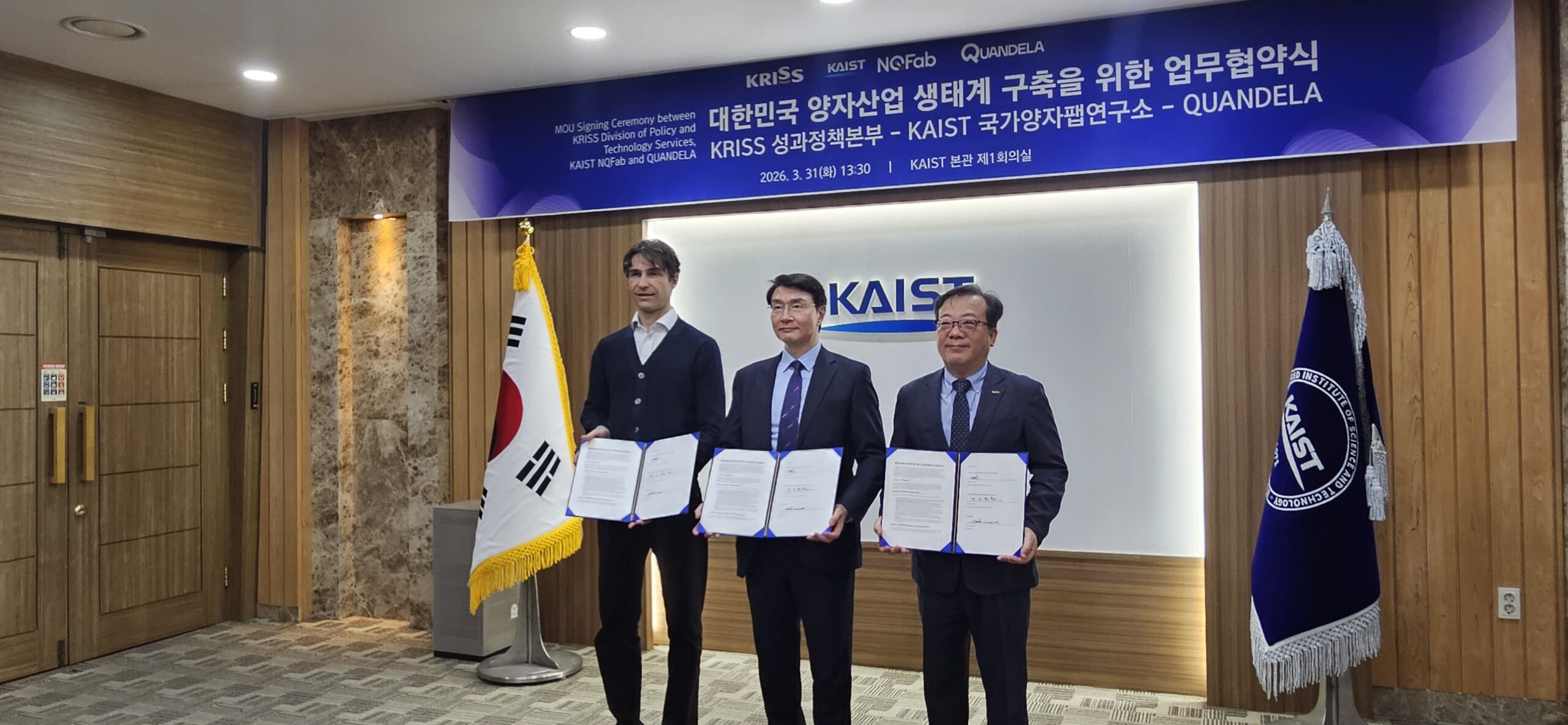
Quandela, KAIST (Korea Advanced Institute of Science and Technology), and KRISS (Korea Research Institute of Standards and Science) have signed a tripartite MOU to accelerate photonic quantum computing in South Korea. The collaboration builds a full value chain from research to industrial deployment, combining research excellence, precision metrology, and commercial quantum technologies. This partnership strengthens Korea’s position as a leading quantum hub in Northeast Asia.
Seoul, South Korea- 3rd April – Quandela, KAIST, and KRISS have signed a tripartite Memorandum of Understanding (MOU) to accelerate the development and deployment of photonic quantum computing technologies in South Korea.
This strategic collaboration brings together research excellence, precision metrology, and commercial quantum technologies to establish a fully integrated value chain—from fundamental research to industrial deployment.
Photonic quantum computing is emerging as one of the most promising approaches to scalable quantum systems, offering strong compatibility with existing semiconductor infrastructure. However, translating laboratory breakthroughs into deployable technologies requires close coordination across research institutions, standards bodies, and industry.
Against this backdrop, KAIST, KRISS, and Quandela have formed a partnership to advance Korea’s quantum capabilities and reinforce its position as a leading quantum hub in Northeast Asia.
A Fully Integrated Quantum Value Chain
The collaboration connects complementary strengths across the ecosystem:
- KAIST’s open National Quantum Fab
- KRISS’s expertise in precision metrology and standards
- Quandela’s commercial photonic quantum computing platforms and cloud services
Together, the partners aim to accelerate the transition from R&D to real-world applications while strengthening Korea’s role in global quantum supply chains.
Strategic Areas of Collaboration
The partnership will focus on three core areas:
- Co-development of quantum systems
Leveraging KAIST’s Quantum Fab and QX Scale-up Valley infrastructure - Joint research and technology transfer
Advancing photonic quantum computing and quantum communication - Talent and ecosystem development
Establishing training programs and fostering industry–academia collaboration for international applications
By combining their complementary capabilities, the partners aim to accelerate the transition of quantum technologies from laboratory-scale research to industrial deployment.
Building Korea’s Quantum Future
The KAIST–KRISS–Quandela partnership represents a concrete step toward establishing a scalable photonic quantum ecosystem in Korea. By linking research, standards, and commercial deployment, the collaboration is designed to accelerate adoption and integration into global quantum value chains.
About KAIST
KAIST (Korea Advanced Institute of Science and Technology) is South Korea’s leading science and technology university and a globally recognized hub for research, innovation, and entrepreneurship. Established in 1971 as the country’s first research-oriented institution in science and engineering, KAIST has played a central role in advancing Korea’s technological development and innovation ecosystem. Through interdisciplinary research, world-class facilities, and initiatives such as the National Quantum Fab and QX Scale-up Valley, KAIST is driving next-generation advancements in quantum science, semiconductors, and emerging technologies, while fostering talent that translates scientific discovery into real-world impact.
About KRISS
KRISS (Korea Research Institute of Standards and Science) is South Korea’s national metrology institute, responsible for establishing and maintaining the country’s measurement standards and advancing precision science across industry and research. KRISS plays a critical role in enabling emerging technologies by providing high-accuracy measurement capabilities, calibration services, and international standardization frameworks. In the field of quantum technology, KRISS develops advanced measurement and control techniques for quantum systems (including photonics, superconducting qubits, and atomic standards) supporting the reliability, interoperability, and commercialization of next-generation quantum devices.
About Quandela
Quandela develops and deploys photonic quantum computers designed for real-world environments, with room-temperature operation, data-center compatibility, and a full software stack for programming and running workloads via cloud and on-prem access. Beyond hardware, Quandela works with corporations, research teams, and public institutions to identify, prototype, and integrate quantum use cases through training, technical support, and joint pilot projects. Founded in Europe, Quandela pursues a progressive path from usable systems to fault-tolerant quantum computing.