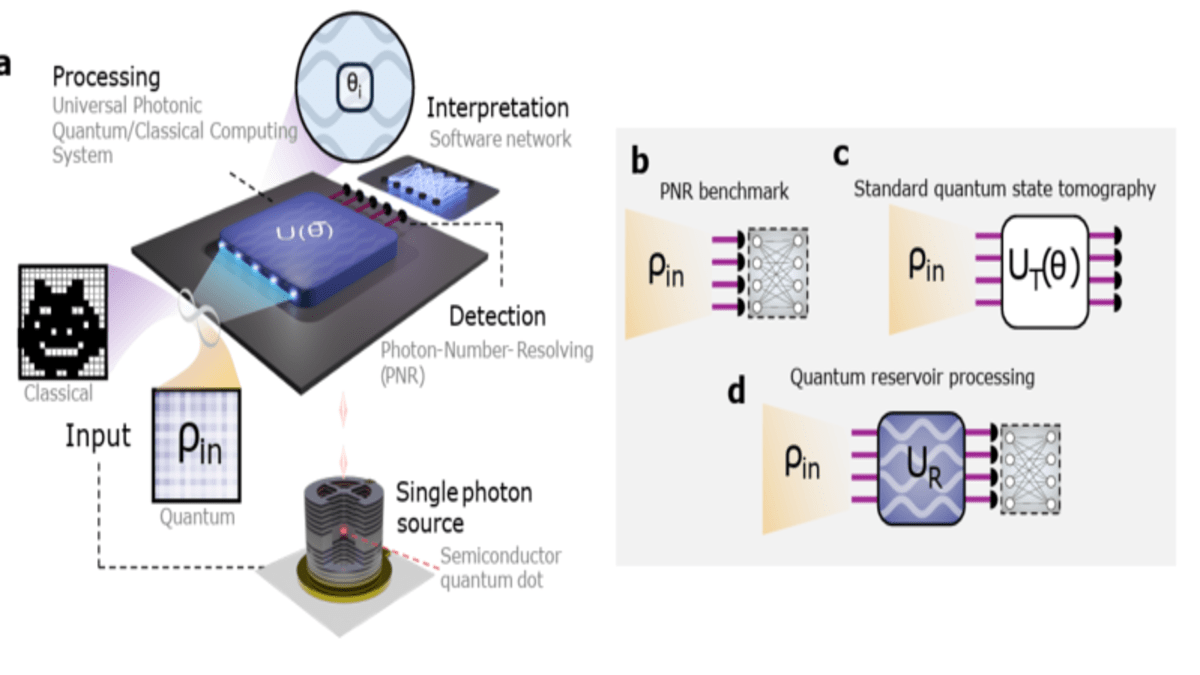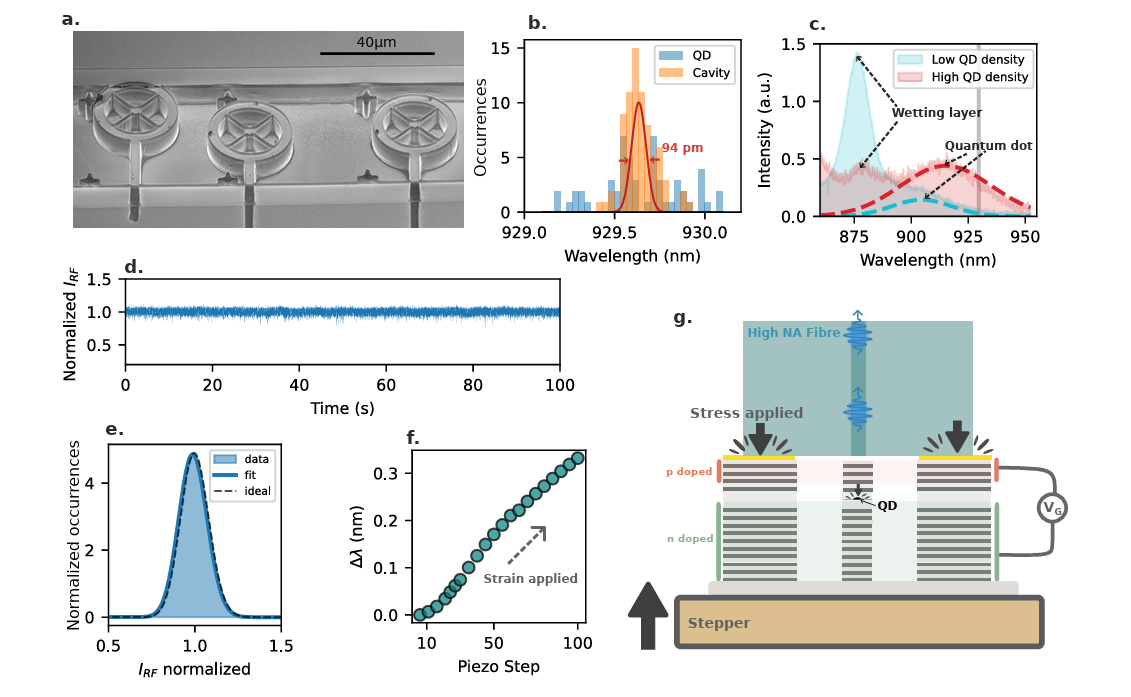



Scaling a quantum computer requires more than one high-performing qubit. It requires many high-quality qubit devices that can be fabricated reproducibly and perform as consistently as possible. For hybrid photonic quantum computing, those devices are spin–photon interfaces: semiconductor structures that generate efficient, highly indistinguishable single photons, connect one spin to multiple photons and preserve the spin long enough to perform useful operations. In a new arXiv preprint, researchers from Quandela, C2N and collaborating institutions report pilot-line fabrication of thousands of such devices and bring these capabilities together in one foundry-compatible III–V platform.
Scaling quantum hardware takes more than a few hero devices
Scalable photonic quantum computing requires qubit devices that can be produced reproducibly, maintain their quantum performance and work together across a larger architecture.
This challenge is particularly important for spin–photon interfaces, which connect stationary matter qubits with photons. These interfaces are central to hybrid photonic quantum computing, where photons transport quantum information while matter qubits provide local memory and control.
In the new preprint, researchers from Quandela, the Center for Nanosciences and Nanotechnologies (C2N) and collaborating institutions examine how semiconductor spin–photon interfaces can move beyond a small number of laboratory hero devices. They report the fabrication of thousands of spin–photon devices and evaluate, within the same study, the optical performance, spin properties and inter-device compatibility required for large-scale hybrid photonic architectures.
The paper reports industry-ready devices fabricated through a semiconductor pilot production line compatible with large-scale deployment. The process provides reproducible control of the parameters governing photon extraction, indistinguishability and compatibility between devices, while representative devices reach state-of-the-art quantum performance.
What does it take to scale a spin–photon interface?
Reproducible manufacturing, highly efficient and indistinguishable photons, sufficiently long spin coherence, spin–multi-photon entanglement and photons from independently fabricated devices that can interfere at the single-source performance limit.
What is a spin–photon interface?
A spin–photon interface links a stationary matter qubit to particles of light. The spin can store and process quantum information locally, while photons carry that information through optical circuits and networks.
In this work, the interface is based on a semiconductor quantum dot positioned inside a microscopic optical cavity. A quantum dot is a nanostructure that acts like an artificial atom in a semiconductor. Its confined charge provides a spin qubit, while its optical transitions allow it to emit individual photons.
The surrounding cavity enhances and directs the emitted light. For quantum computing, the interface must generate photons efficiently and with high quantum quality, while faithfully connecting the spin state to a sequence of photons.
How spin–photon interfaces accelerate scalable photonic quantum computing
Photons are well suited to carrying quantum information because they can travel through optical circuits and fibre networks while interacting only weakly with their environment. In fully photonic architectures, however, photon generation and entangling operations are probabilistic, increasing resource requirements.
Hybrid photonic quantum computing combines photons with stationary matter qubits. In the architecture explored in the paper, the spin acts as a local quantum memory, generates photons on demand and becomes entangled with successive photons. The photons then provide optical links between different elements of the system.
The spin–photon interface is therefore more than a photon source. It connects the matter-based and photonic layers of the quantum computer and supports photon generation, local memory and entanglement within the same semiconductor device.
Hybrid photonic quantum-computing architecture
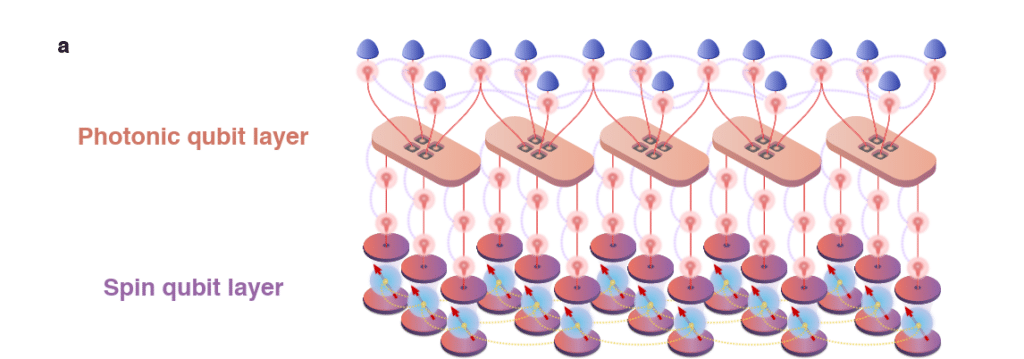
Schematic of a hybrid photonic quantum-computing architecture. A stationary spin-qubit layer is connected to a photonic-qubit layer through spin–photon interfaces, allowing computation to be distributed across both layers.
From laboratory fabrication to a semiconductor pilot line
Quantum-dot sources have already demonstrated high-quality single-photon generation and spin–photon entanglement. The key challenge for quantum computing is to reproduce these properties across many devices without sacrificing performance.
The paper reports a pilot production-line process used to fabricate thousands of monolithic III–V semiconductor quantum-dot–cavity devices. The process locates individual quantum dots, aligns optical cavities around selected emitters and controls the parameters governing photon extraction, indistinguishability and compatibility between devices.
Across successive device generations, the best first-lens efficiency, the probability of collecting an emitted photon at the device output, rose from below 30% to 80% by the end of 2025. The paper identifies this 80% result as a new state of the art for monolithic semiconductor devices. Mean photon indistinguishability reached 95%, with the best devices reaching 98% without spectral filtering. These values already approach or exceed the error-correction benchmarks cited in the paper for photons emitted successively by one source.
The achievement is therefore not simply the production of more devices. It is the systematic improvement of fabrication quality and optical performance within a process designed for repeatability and scale.
Improving quantum performance as fabrication scales
Producing thousands of devices matters only if their quantum properties also move toward the values required for scalable computation. The paper evaluates that combined requirement directly.
For photons to interfere reliably, their quantum state must remain pure and stable despite fluctuations in the solid-state environment. The authors therefore go beyond standard efficiency and interference measurements by reconstructing the photons’ Wigner function, a detailed representation of an optical quantum state.
The experiment measured a mode overlap of 0.944(2) between the emitted photons and a reference laser, stable over 30 minutes, together with a Wigner-function negativity of −0.330(9) under resonant excitation. The paper reports this as a record single-photon Wigner-function negativity. To the authors’ knowledge, it is also the first reconstruction of the Wigner function of optical quantum light generated by a solid-state emitter, with a negativity larger than the record value reported for on-demand atom-based single-photon sources.
For a non-specialist reader, the significance is clear: the emitted photons combine high efficiency with near-unity quantum purity that remains stable over tens of minutes.
Connecting one spin qubit to multiple photons
Scalable hybrid photonic quantum computing also requires the interface to connect one spin coherently to a sequence of photons. In the reported experiment, repeated excitation causes the quantum dot to emit photons one after another. A spin gate between emissions allows the spin to become entangled with each new photon.
The authors demonstrate seven-partite spin–multi-photon entanglement involving one spin and six photons. Their model and direct measurements also support photonic cluster states of up to six photons, tripling the number achieved in previous deterministic quantum-dot demonstrations, with a per-cycle spin–photon entangling fidelity of 93.5(3)%.
Using dynamical decoupling, the researchers extended the effective spin-coherence time from about 20 nanoseconds to 1.94(17) microseconds, a two-orders-of-magnitude increase. The paper describes this microsecond-scale coherence as close to the regime required for the targeted fault-tolerant gate schemes.
Can independently fabricated devices work together?
A large processor will require many spins connected through the photons entangled with them. Photons from independent devices must therefore be similar enough to interfere reliably.
The researchers tuned two independently fabricated quantum-dot sources and measured a mutual indistinguishability of 88(1%), without spectral filtering, temporal post-selection or active stabilisation. The remote-source result lies very close to the upper bound set by each source’s own indistinguishability. In the paper’s words, photons from distant sources are as indistinguishable as photons emitted successively by a single source.
This is the ideal scaling behaviour: device-to-device reproducibility is not the dominant limitation. Improving the single-source coherence should directly improve interference between independently fabricated devices.
What the results demonstrate about reproducibility and scale
The global significance of the work lies in bringing several demanding requirements together within one production-oriented semiconductor platform:
- pilot-line fabrication of thousands of spin–photon interfaces;
- state-of-the-art single-photon generation efficiency;
- record photon-state reconstruction with minute-scale quantum-purity stability;
- seven-partite spin–multi-photon entanglement;
- spin coherence extended into the microsecond regime;
- remote-source interference at the limit set by individual-source coherence.
The paper’s fault-tolerance analysis is equally concrete. Optimised single-source performance indicates that the 2.3% indistinguishability-error threshold can be reached; the pilot-line process with improved doping approaches the 6.4% optical-loss threshold; and microsecond spin coherence is close to the regime required for fast repeat-until-success gates.
Rather than claiming that every metric has already crossed its target, the strongest accurate conclusion is that the platform combines record and state-of-the-art results with a clear, actionable route below the remaining thresholds for fault-tolerant hybrid photonic quantum computing.
Why this research matters for scalable quantum computing
For quantum hardware to scale, manufacturing and quantum performance cannot be treated as separate problems. A scalable architecture needs many devices with predictable characteristics, compatible outputs and performance sustained through a repeatable fabrication process.
This study evaluates those requirements together. It shows that foundry-compatible III–V quantum-dot devices can deliver the core light–matter capabilities required for scalable hybrid photonic quantum computing. As the paper concludes, the challenge is shifting from proving the viability of the spin–photon interface to optimising and integrating it at system scale for fault-tolerant computation.
A collaborative effort across Quandela and research partners
The work brings together researchers from Quandela, Université Paris-Saclay and the Centre for Nanosciences and Nanotechnologies (C2N), alongside collaborators from institutions in Singapore, Denmark, Germany, Italy and France.
Quandela researchers contributed to device development and characterisation, advanced measurements, theoretical and numerical modelling, project supervision and manuscript preparation. The author-contribution statement reflects the breadth of the collaboration behind the results.
Conclusion
This work combines pilot-line fabrication of thousands of devices with state-of-the-art efficiency, record photon-state reconstruction, seven-partite spin–multi-photon entanglement, microsecond spin coherence and interference between independent sources at the single-source limit. By bringing manufacturing reproducibility and multiple leading quantum capabilities together in one foundry-compatible III–V platform, the results establish a scalable foundation for hybrid photonic quantum computing.
The manufacturing capabilities and performance roadmap provide a concrete basis for modular spin-optical prototypes.