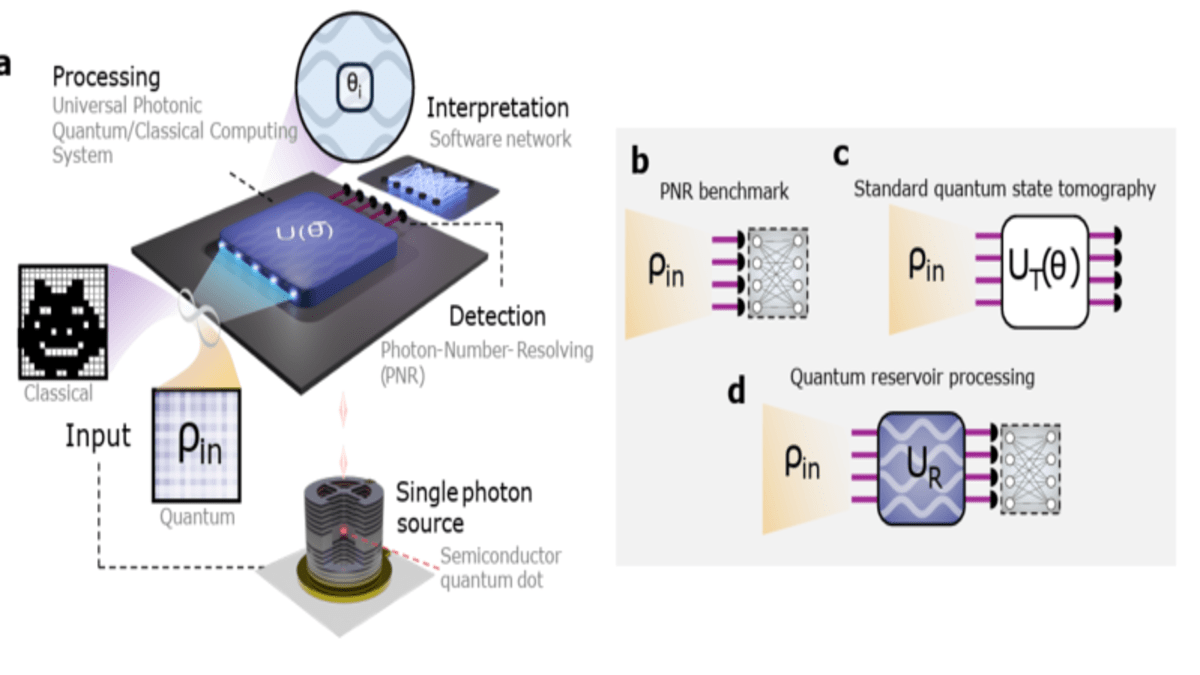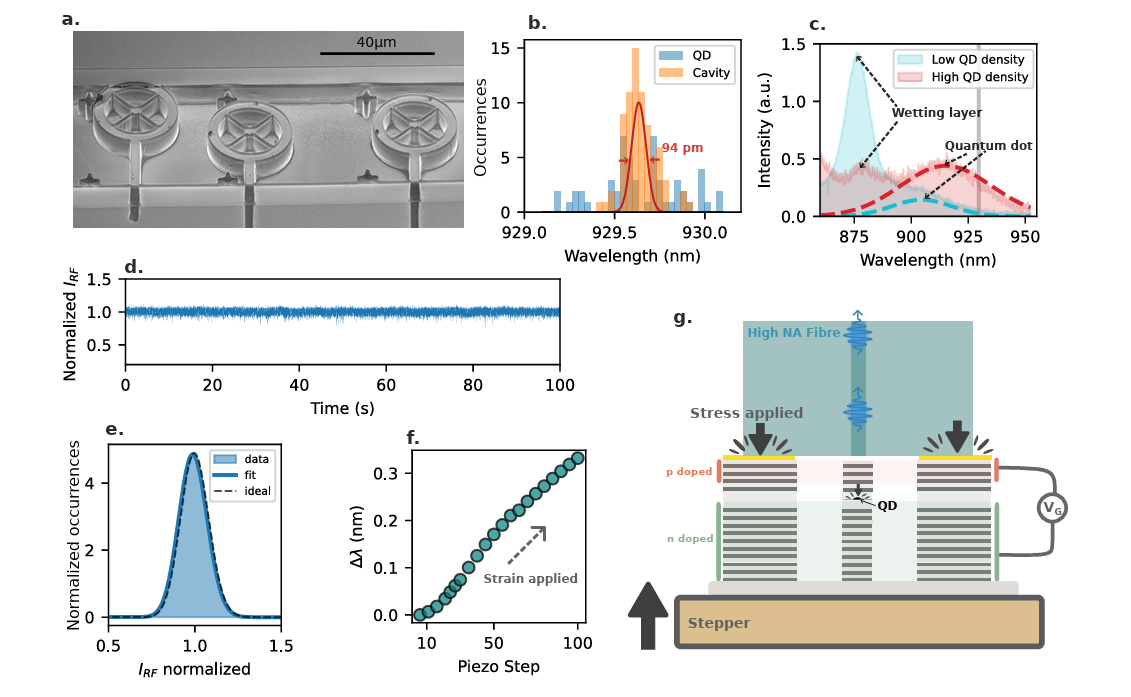


Simulating the Fermi–Hubbard model is one of the most important problems in materials science, yet it quickly becomes intractable for classical computers. In a new study, Quandela and Walrus Computing show how a fault-tolerant spin-optical quantum computer could simulate a commercially relevant Fermi–Hubbard system in approximately two hours. The work provides one of the most detailed resource estimates to date for large-scale spin-optical quantum computing and highlights the advantages of the biplanar spin-optical quantum computing, aka SPOQC, architecture.
Introduction
Many of the technologies that shape modern society, from advanced batteries to next-generation semiconductors, depend on understanding how electrons behave inside materials. Accurately simulating these interactions remains one of the hardest challenges in computational physics.
The Fermi–Hubbard model is a widely used framework for studying these systems. While it captures essential material properties, it rapidly becomes too complex for classical computers as system size grows. Quantum computers offer a promising alternative, but only if they can operate reliably at scale.
In a new collaboration, Quandela and Walrus Computing present a detailed resource estimate showing how a biplanar version of the SPOQC architecture could tackle the challenge of simulating the 8×8 Fermi–Hubbard model.
Why the Fermi–Hubbard Problem Matters
The Fermi–Hubbard model is a central tool for studying strongly correlated electron systems. These systems play an important role in fields such as high-temperature superconductivity, quantum magnetism, and the design of novel quantum materials
The difficulty is that classical simulation methods become increasingly expensive as interactions grow stronger and the system size increases. This computational barrier limits researchers’ ability to explore materials with potentially valuable properties. As a result, the Fermi–Hubbard model has long been considered a leading candidate for demonstrating practical quantum advantage.
What’s New
The study provides the first end-to-end resource estimate for solving a commercially relevant Fermi–Hubbard problem using Quandela’s spin-optical quantum computing approach. Instead of placing qubits encoding both spin-up and spin-down electrons on the same processor plane, the biplanar architecture assigns them to two quantum processor planes connected by transversal operations..
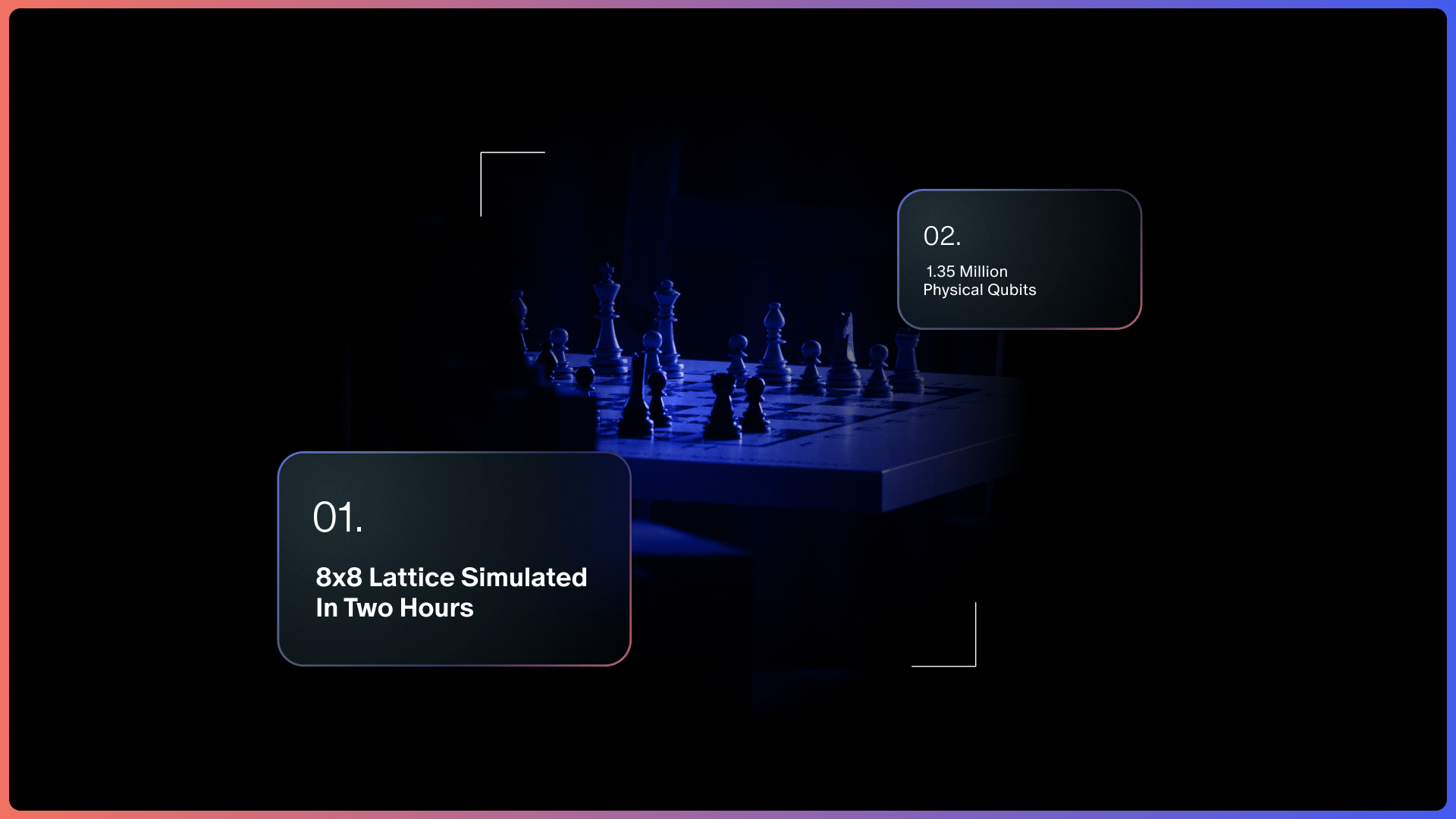
The analysis shows that an 8×8 lattice with strong interactions could be simulated in approximately two hours using around 1.35 million physical qubits. Rather than focusing only on algorithmic performance, the work combines hardware assumptions, error correction requirements, operation timings, and fault-tolerant resource costs into a single framework.
This makes the result more than a theoretical proposal. It offers a realistic assessment of what would be required to perform a useful quantum simulation on future large-scale spin-optical systems.
The Role of the Biplanar SPOQC Architecture
A key contribution of the work is the use of a biplanar version of the SPOQC architecture.
In conventional approaches, all fermionic states are mapped onto a single processor plane. This creates additional overhead because qubits must be repeatedly rearranged during computation. The biplanar design instead separates spin-up and spin-down electrons across two interconnected quantum processor planes.
This arrangement eliminates a large number of fermionic swap operations and significantly reduces circuit depth. The study reports nearly a twofold reduction in logical timesteps per simulation step, helping lower overall runtime and resource requirements.
Why Spin-Optical Quantum Computing Is Well Suited
Spin-Optical quantum computing offers several advantages for large-scale fault-tolerant systems. First, photonic platforms can operate using optical technologies that integrate naturally with existing photonics and semiconductor manufacturing ecosystems. Second, optical interconnects enable long-range communication between qubits, reducing connectivity constraints that affect many other quantum computing approaches: here, it allows transversal connections between the two planes. Finally, the architecture is designed to work efficiently with the honeycomb Floquet error-correcting code used in the study. Together, these characteristics help reduce the overhead associated with fault-tolerant quantum computation.
Why It Matters
This work shows how to estimate the end-to-end resource required to simulate a quantum system on a large-scale, fault-tolerant quantum computer using a dynamical code and a biplanar structure.
The study also identifies the next major challenge: scaling rotation synthesis efficiently as problem sizes increase. By clearly exposing this bottleneck, the work provides a concrete target for future research in algorithms and compilation techniques.
Most importantly, the results show how co-designing algorithms, error correction, and hardware architecture can substantially reduce the cost of fault-tolerant quantum computation.
Key Takeaways
- The Fermi–Hubbard model remains one of the most important targets for practical quantum computing.
- Quandela and Walrus Computing developed a detailed end-to-end resource estimate for a fault-tolerant implementation on the SPOQC architecture.
- The study estimates that an 8×8 strongly correlated system could be simulated in approximately two hours using 1.35 million physical qubits.
- The biplanar SPOQC architecture reduces circuit depth by eliminating fermionic swap operations.
Conclusion
Useful quantum computing will require more than powerful algorithms—it will require architectures that can support fault tolerance at scale. This study shows how spin-optical quantum computing, combined with hardware-aware algorithm design and advanced error correction, can significantly reduce the resources needed for challenging materials simulations.
While important engineering challenges remain, the work moves the discussion from theoretical possibility toward practical implementation. By quantifying both the opportunities and the remaining bottlenecks, it provides a clearer path toward large-scale quantum applications in materials science.
References
[1] Bourdoncle, B., Derks, P.-J., Dessertaine, T., & Frank, J. (2026). “Two Layers, No Swaps: Biplanar SPOQC Architecture Improves Runtime of Fermi-Hubbard Simulation.” arXiv:2605.05315 [quant-ph]. https://arxiv.org/abs/2605.05315
[2] Hastings, M. B., & Haah, J. (2021). “Codes and Lattices for Topologically Ordered States.” Quantum, 5, 564.
[3] Campbell, E. T. (2021). “Early Fault-Tolerant Quantum Computing without Qubit Reset.” Quantum Science and Technology, 7, 015007.
[4] Derby, C., Klassen, J., Bausch, J., & Cubitt, T. (2021). “Compact Fermion-to-Qubit Mapping.” Physical Review B, 104, 035118.
[5] de Gliniasty, G., Hilaire, P., Emeriau, P.-E., Wein, S. C., Salavrakos, A., & Mansfield, S. (2024). “Spin-Optical Quantum Computing.” Quantum, 8, 1423.
[6] Gidney, C., Newman, M., & McEwen, M. (2022). “Benchmarking Quantum Error Correction on the Honeycomb Floquet Code.” Quantum, 6, 813.