

Can a photonic quantum processor help machine learning make better use of limited data? Recent research explores how quantum optical reservoir computing can enrich data representations and support hybrid quantum-classical machine learning.
FROM THE QUANDELA COMMUNITY
This article provides a broader perspective on research originally shared by Markus Rambach on the Quandela Hub Community Blog. The original research paper explores the work in greater technical detail.
Machine learning performance depends not only on the model being trained, but also on how effectively data can be represented before a prediction is made.
This becomes particularly important when high-quality labelled data is scarce, expensive to obtain or unevenly distributed across different classes.
Can a photonic quantum processor help?
Recent research from Markus Rambach, University of Queensland in Brisbane, and collaborators explores this question through Quantum Optical Reservoir Computing (QORC), a hybrid quantum-classical approach that uses boson sampling on a photonic quantum processor to transform data before it reaches a classical machine-learning model.
The study points to a specific potential role for quantum computing in machine learning: not replacing classical models, but providing an additional computational layer that can enrich how data is represented.
Using a photonic Quantum Processing Unit (QPU) as a machine-learning accelerator
Reservoir computing is a machine-learning approach in which data passes through a complex but fixed system, called a reservoir, before a simpler model is trained on the resulting representation.
QORC brings this idea into quantum computing.
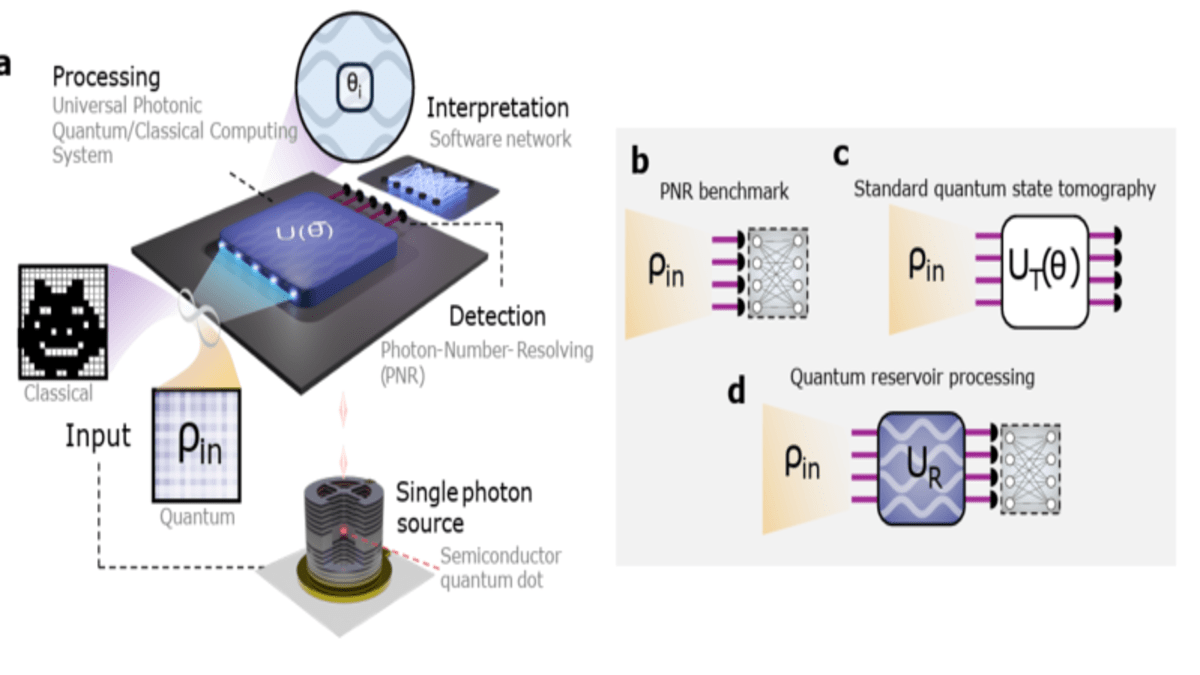
In the approach investigated by the researchers, classical data is first compressed and encoded into a photonic quantum circuit. Multiple photons then travel through the optical network and interfere with one another.
The resulting detection patterns create a richer representation of the original data, described by the researchers as a “quantum fingerprint.” This representation is then passed to a classical classifier, which performs the final prediction.
The workflow therefore remains hybrid:
- Classical data is prepared and compressed.
- The information is encoded into a photonic quantum circuit.
- Photon interference generates a richer representation of the data.
- A classical machine-learning model uses these features to make the final classification.
The quantum processor is not trained like a conventional neural network. Instead, it acts as a fixed transformation layer, while only the classical classifier is trained to distinguish between the different classes.
Why boson sampling?
At the centre of QORC is boson sampling, a photonic computation in which multiple photons propagate through an optical circuit and interfere.
Boson sampling is well known because reproducing its output becomes increasingly difficult for classical computers as systems scale. In this research, however, computational complexity is not treated as the goal in itself.
The researchers instead investigate whether these complex photonic output distributions can be turned into useful features for machine learning.
In other words, the question shifts from “Can a quantum processor perform something difficult to simulate classically?” to “Can that quantum computation contribute something useful to a broader computational workflow?”
That distinction is important when considering how quantum processors could eventually operate alongside classical computing infrastructure.
What happens when training data is limited?
One of the most relevant findings concerns data efficiency.
The researchers evaluated QORC on image-classification tasks, including handwritten digits and biomedical images. They also deliberately tested conditions that are common outside ideal machine-learning benchmarks, including limited training data, strongly imbalanced datasets and imperfect photon sources.
Across the scenarios investigated, the quantum reservoir improved the performance of the linear classifier used as the main baseline.
The quantum processor is not trained like a conventional neural network. Instead, it acts as a fixed transformation layer, while only the classical classifier is trained to distinguish between the different classes.
This was not demonstrated only through numerical simulations. The researchers also ran the workflow on Quandela’s Ascella photonic QPU and observed the same overall training-data advantage on physical quantum hardware.
The result is particularly interesting because collecting and labelling data can itself be one of the major constraints in machine learning. In areas such as biomedical imaging, for example, relevant data may naturally be scarce or unevenly distributed across different classes.
Testing beyond ideal datasets
The researchers also examined how QORC behaves when datasets are imbalanced.
In many practical machine-learning problems, some categories are much more common than others. Fraud detection may contain far more legitimate transactions than fraudulent ones. Medical datasets may contain far more common cases than rare conditions.
Models can therefore perform well overall while still struggling with the minority classes that matter most.
The study tested both artificially imbalanced datasets and naturally imbalanced biomedical imaging datasets. QORC improved a score that gives more weight to correctly identifying rare categories, rather than mainly rewarding performance on the most common ones.
The authors describe the biomedical results as promising but preliminary. They nevertheless provide an important direction for further investigation: whether quantum-enhanced representations could be particularly useful in machine-learning settings where the structure or availability of data creates limitations for simpler classical models.
From simulation to photonic hardware
Another important aspect of the work is that the researchers tested the approach on a physical photonic QPU.
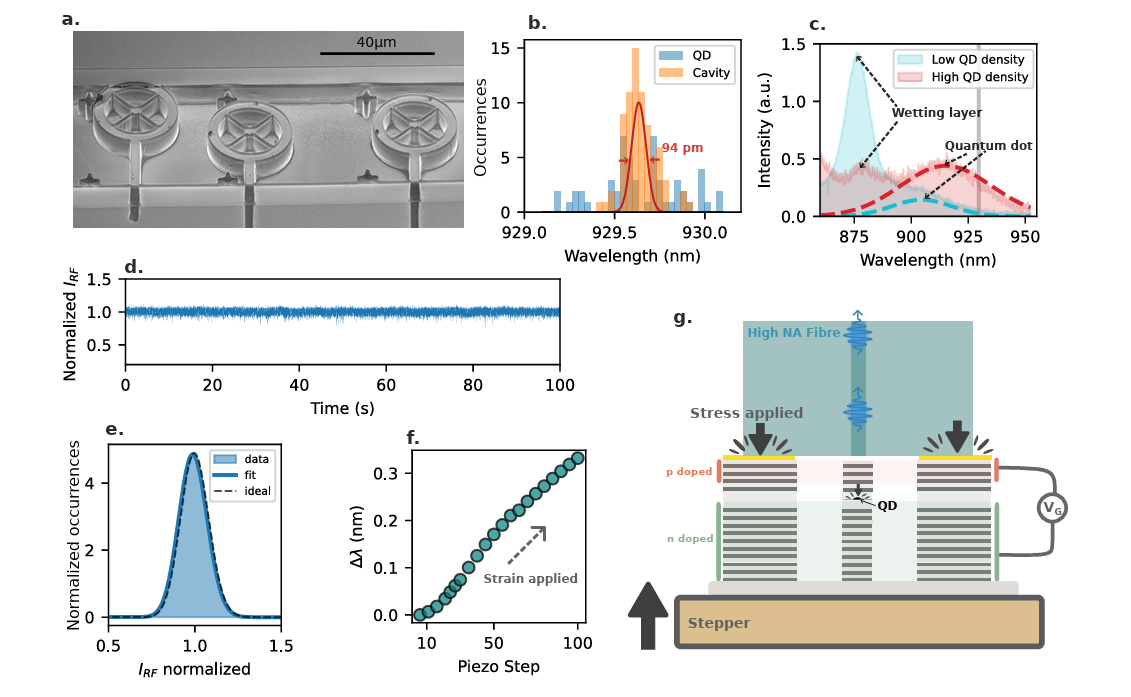
Using Quandela’s Ascella processor, they compared the quantum fingerprints generated experimentally with those predicted by numerical simulation and found a high level of agreement.
They also investigated the role of photon quality. Better-quality photons improved the results further, but the approach still provided benefits even when photon quality was reduced.
Connecting machine-learning performance to the physical behaviour of the photons is an important step toward understanding not only whether a quantum algorithm works theoretically, but how it behaves on actual hardware.
A hybrid approach, not a replacement for classical machine learning
The study does not suggest that photonic QPUs should replace classical machine-learning architectures.
The benefit of QORC was strongest when it was combined with relatively simple classical classifiers and shallow networks. As the classical neural network became more sophisticated, the additional benefit of the quantum reservoir decreased. For the optimised deep neural network tested in the study, adding the reservoir slightly reduced performance.
The researchers also benchmarked QORC against classical feature-mapping approaches. One classical method, Random Fourier Features, achieved similar accuracy improvements on the main MNIST benchmark.
These comparisons help define what the result does, and does not, demonstrate.
The opportunity is not that quantum computing universally outperforms classical machine learning. Instead, this research explores whether a photonic QPU can become a useful specialised component within a hybrid workflow, particularly under constraints such as limited or imbalanced training data.
Exploring where quantum resources add value
Quantum machine learning is still an active field of research. Larger systems, broader datasets and continued comparison with strong classical methods will be necessary to determine where quantum approaches can deliver meaningful computational advantages.
But research such as QORC illustrates an important shift in how those opportunities can be explored.
The question does not have to be whether a quantum computer can replace an entire classical machine-learning system.
It can instead be more specific: which part of the workflow could benefit from quantum resources?
Here, the photonic QPU acts as a feature transformation layer. Photons and their interference generate new representations of the data, while classical computing performs the final learning task.
This type of hybrid architecture offers a concrete way to investigate how photonic quantum processors could complement existing computing and machine-learning infrastructure as the technology scales.
For the full technical explanation, methodology and research context, read the original article on Quandela Hub.