Quandela et OVHcloud unissent leurs forces pour démocratiser le machine learning quantique avec MerLin
Quandela et OVHcloud annoncent un partenariat visant à rapprocher l’intelligence artificielle et l’informatique quantique autour de MerLin, l’environnement de machine learning quantique développé par Quandela. Cette collaboration permet aux chercheurs […]
Quandela et OVHcloud annoncent un partenariat visant à rapprocher l’intelligence artificielle et l’informatique quantique autour de MerLin, l’environnement de machine learning quantique développé par Quandela. Cette collaboration permet aux chercheurs et aux entreprises de concevoir et simuler des modèles hybrides sur GPU, avant de les tester sur les ordinateurs quantiques photoniques de Quandela, accessibles via la plateforme cloud d’OVHcloud.
Paris et Roubaix — 25 novembre 2025 — Quandela, spécialiste européen de l’informatique quantique photonique, et OVHcloud, acteur majeur du cloud en Europe, annoncent que MerLin (premier environnement dédié au machine learning quantique) sera disponible sur la plateforme OVHcloud à partir de mi-2026. Cette intégration vise à accélérer le développement d’applications hybrides dans un environnement cloud souverain.
Un pont entre IA et quantique
Présenté à l’été 2025, MerLin s’impose comme une brique technologique clé pour une nouvelle génération d’outils de machine learning quantique (QML), compatibles avec des frameworks d’IA tels que PyTorch ou scikit-learn.
Grâce à son intégration dans l’environnement OVHcloud, les utilisateurs peuvent concevoir, simuler et tester des modèles hybrides IA–quantique dans un cadre unifié, s’appuyant sur des GPU NVIDIA.
Cette approche simplifie le passage du prototypage à l’expérimentation : les modèles sont d’abord simulés sur GPU, puis exécutés sur les ordinateurs quantiques photoniques de Quandela, opérés au sein de l’infrastructure OVHcloud.
Une stratégie quantique structurée
Dans le cadre de ce partenariat, OVHcloud a présenté sa stratégie quantique, qui prévoit l’intégration des systèmes de Quandela sur sa plateforme à partir de mi-2026. Les premiers systèmes incluront BELENOS (processeur photonique de 12 qubits) et CANOPUS (24 qubits).
Ce déploiement marque une étape clé dans l’intégration du calcul quantique au cloud, en ouvrant la voie à un accès souverain et opérationnel à l’échelle européenne.
Vers un écosystème quantique européen
En combinant leurs expertises — photonique et algorithmes hybrides pour Quandela, infrastructure cloud pour OVHcloud, accélération via GPU — les partenaires contribuent à structurer un écosystème quantique européen.
L’objectif est d’accélérer le développement d’applications hybrides dans des secteurs tels que la cybersécurité, la finance, l’énergie, la santé ou encore la logistique.
Quanova has selected Quandela’s MosaiQ quantum computer—the first to be deployed in Vietnam—to build a leading quantum education and research ecosystem at Quang Trung University (QTU), with the support of Nam A Bank. Ho Chi Minh City (Vietnam) / Paris (France), 22 October 2026 – Quandela, a European leader in photonic quantum computing, announces a…
Read more
Quandela and Quanova partner to deploy Vietnam’s first quantum computer and launch the Quantum Innovator Residency Program
×
Quanova has selected Quandela’s MosaiQ quantum computer—the first to be deployed in Vietnam—to build a leading quantum education and research ecosystem at Quang Trung University (QTU), with the support of Nam A Bank.
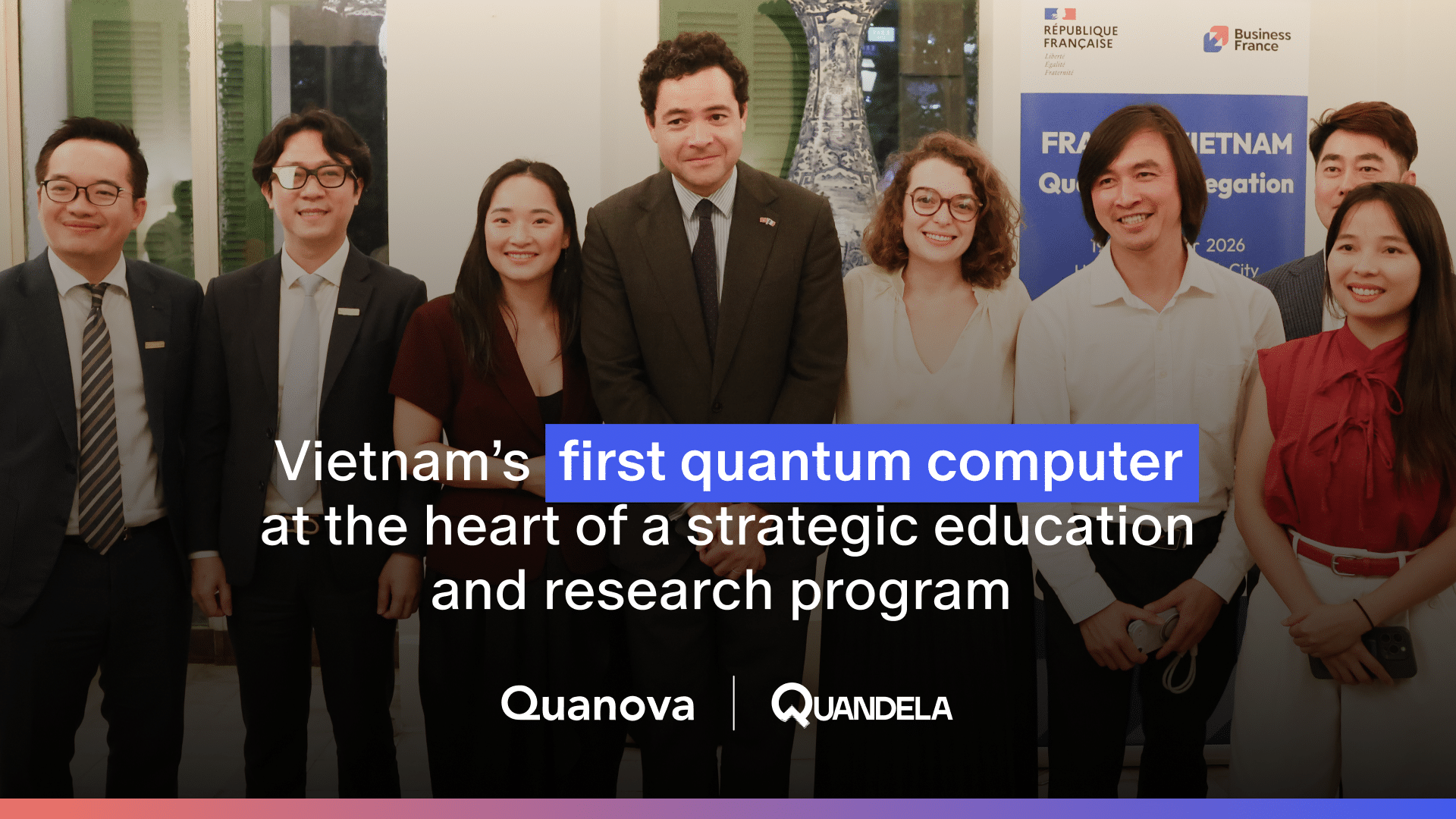
Ho Chi Minh City (Vietnam) / Paris (France), 22 October 2026 – Quandela, a European leader in photonic quantum computing, announces a major milestone in its expansion in Southeast Asia. Quanova, a Vietnamese quantum company, has selected Quandela’s MosaiQ solution as the foundation of a new quantum research, innovation, service and entrepreneurship (quantum-RISE) program at Quang Trung University (QTU) in Quy Nhơn, Gia Lai. The project marks the first France–Vietnam collaboration in quantum computing and will lead to the deployment of Vietnam’s first quantum computer, with the support of Nam A Bank.
Vietnam’s first quantum computer at the heart of a strategic education and research program
This long-term partnership, developed with Quanova, Quandela’s strategic local partner in Vietnam, will provide Quang Trung University with a comprehensive platform for education, research and innovation. Nam A Bank is supporting the initiative as part of its commitment to advanced technologies. As Võ Hoàng Hải, Deputy CEO of Nam A Bank, explained: “Nam A Bank invests in core technologies, including quantum technology, to help build high-tech capabilities in Vietnam through strong and effective cooperation with French organizations.” The program includes:
Deployment of the MosaiQ photonic quantum computer;
Faculty training and development of dedicated curricula;
Provision of the software suite and support for the creation of a Quantum Experience Center and launch of the Quantum Innovator Residency Program;
Organization of technology events and hackathons.
A landmark France–Vietnam quantum collaboration
The project builds on the strategic agreement signed by Quandela and Quanova in Paris during the France–Vietnam Leaders Forum, in the presence of General Secretary President Tô Lâm and French President Emmanuel Macron. It is the first France–Vietnam collaboration dedicated to quantum computing and reflects the growing technological cooperation between the two countries.
For Marine Xech-Gaspa, Director of Institutional Affairs & Public Policy at Quandela, the announcement shows how quickly the partnership is translating into concrete action: “Quandela is very proud to see its strategic partnership with Quanova already materialize in the first France–Vietnam quantum computing project and the deployment of Vietnam’s first quantum computer. We sincerely thank Quang Trung University and Nam A Bank for their trust. Together, we are laying the foundations for a lasting quantum ecosystem that will support education, research and innovation in Vietnam.”
Officialized in Ho Chi Minh City
The partnership and the deployment project were officially announced in Ho Chi Minh City on the evening of 21 October 2026, in the presence of representatives of the Centre for the Fourth Industrial Revolution (C4IR).
Welcoming the announcement, Étienne Ranaivoson, Consul General of France in Ho Chi Minh City, said: “As part of the first French delegation dedicated to quantum technologies in Vietnam, I welcome Quandela’s commitment, which is enabling Vietnam to acquire its first quantum computer—a symbol of the trust uniting our two countries in the technologies of the future.”
The event highlighted the shared commitment of French and Vietnamese partners to develop sovereign capabilities in quantum technologies, education and research.
Building long-term quantum capacity in Vietnam
Beyond the installation of MosaiQ, the partnership is designed to build lasting local expertise. The Quantum Innovator Residency Program will bring together students, researchers, educators and technology innovators around practical uses of quantum computing, while faculty training, dedicated curricula and access to Quandela’s software environment will support the emergence of a new generation of quantum talent in Vietnam.
Rossy Nguyen Hoang Hong Nhung, CEO of Quanova, summarized the partnership approach: “To co-create new technologies, we must first build trusted partnerships and train the next generation. That is why we are developing the Quantum Innovator Residency Program with Quandela, Quang Trung University and Nam A Bank.”
About Quandela
Quandela is a leading quantum computing company that designs, builds, and delivers cutting-edge quantum solutions for industry: ready-to-use quantum computers for data centres, cloud-accessible quantum processors, and algorithm access services for industrial clients. Quandela is committed to making quantum computing accessible to all in order to address the most complex industrial and societal challenges. Discover our vision at: https://www.quandela.com/
About Quanova:
Quanova, a young startup committed to building Vietnam’s Quantum Future by connecting knowledge, innovating technology, and shaping the future with breakthrough research in quantum physics. For more information: www.quanova.org
About Quang Trung University
Cultivating people of Service for society – professionally competent, ethically grounded, and driven by the aspiration to give back. For more information: www.qtu.edu.vn
About Nam A Bank
Nam A Bank is a pioneering bank in advancing the development of quantum technology and Vietnam’s quantum human resources, operating efficiently and continuously contributing to socio-economic development. For more information: https://www.namabank.com.vn
The two companies will explore cooperation across quantum research, cloud computing, education and talent development, as well as future applications for industry and government. Hanoi, Vietnam / Massy, France – 19 October 2026 – Quandela, a European leader in photonic quantum computing, and FPT Corporation, Vietnam’s largest private information technology and telecommunications services company, announced…
Read more
FPT Corporation and Quandela sign Memorandum of Understanding to advance quantum technology collaboration in Vietnam
×
The two companies will explore cooperation across quantum research, cloud computing, education and talent development, as well as future applications for industry and government.
Hanoi, Vietnam / Massy, France – 19 October 2026 – Quandela, a European leader in photonic quantum computing, and FPT Corporation, Vietnam’s largest private information technology and telecommunications services company, announced today the signing of a two-year Memorandum of Understanding aimed at developing cooperation in quantum technologies and supporting the development of the quantum ecosystem in Vietnam.
The two-year agreement establishes a framework through which FPT and Quandela will explore joint initiatives combining FPT’s engineering, research and understanding of the Vietnamese market with Quandela’s expertise in photonic quantum computing, including hardware, software and cloud infrastructure.
The collaboration will focus on several areas :
Combining expertise to advance quantum research and innovation
First, the companies intend to explore joint research and technology development, including potential work on quantum algorithms, quantum communications, cybersecurity-related applications and other areas of common interest.
FPT and Quandela will also explore cooperation around cloud-based quantum computing. Under the framework, Quandela may provide FPT researchers with access to its cloud-based quantum computing infrastructure, while FPT intends to establish a dedicated research group conduct experimentation and identify potential applications of quantum computing.
A third pillar will focus on education, training and talent development. The companies will explore opportunities to contribute to FPT’s university and high-school programs, including through access to quantum learning environments and open-source tools, expert training, seminars and potential exchanges between researchers and engineers.
Supporting a growing quantum ecosystem
The MoU also provides a framework for broader cooperation with universities, research institutions, technology partners and industrial stakeholders, with the objective of identifying new quantum use cases and strengthening collaboration between the Vietnamese and European quantum ecosystems. The parties may ultimately explore joint advisory activities for enterprises and public-sector organisations, as well as international deployments additional market opportunities.
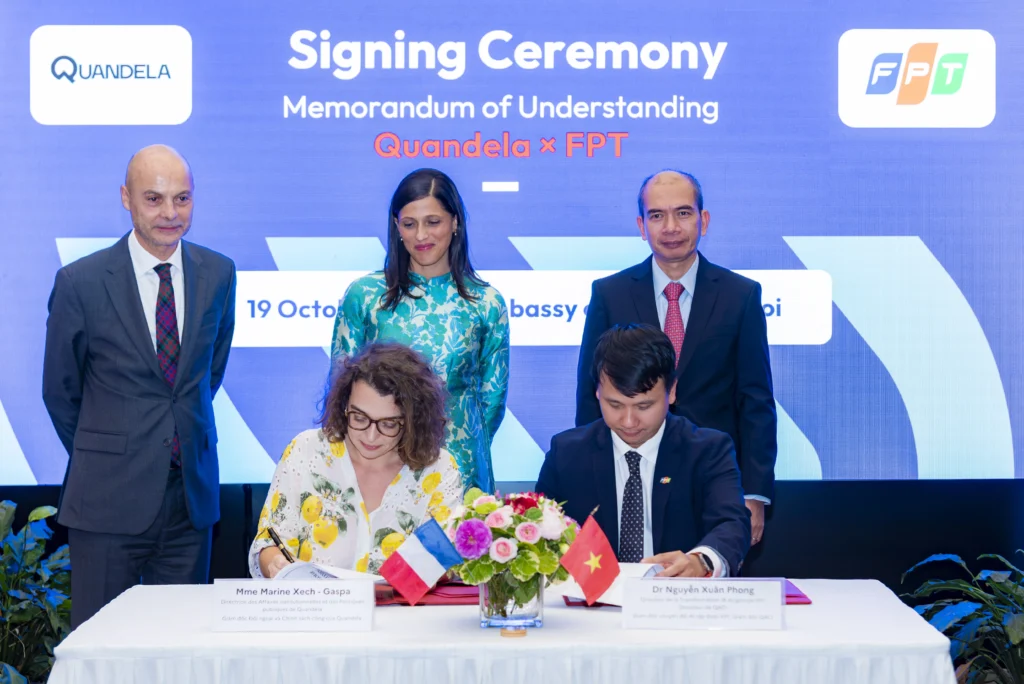
Marine Xech-Gaspa, Director of Institutional Affairs and Public Policy at Quandela, signs the agreement alongside Dr. Nguyen Xuan Phong, Chief AI Transformation Officer of FPT Corporation and Director of the Quantum AI & Cyber Security Institute (QACI), and, from left to right, Didier Le Bret, Ambassador of France to Vietnam; Éléonore Caroit, Minister Delegate for Francophonie, International Partnerships and French Nationals Abroad; and Prof. Dr. Tran Tuan Anh, Vice President of the Vietnam Academy of Science and Technology.
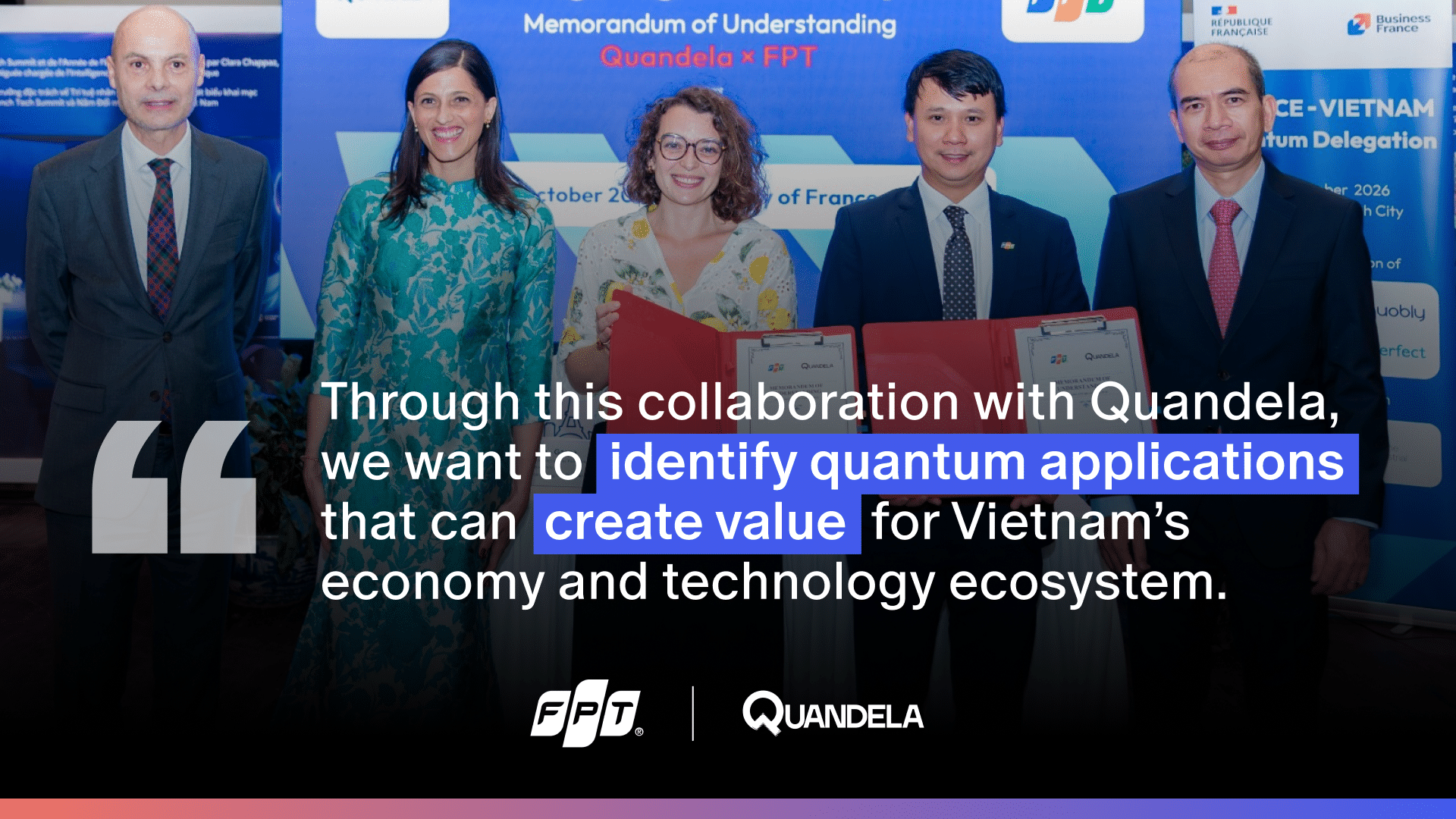
“Quantum technologies are becoming an increasingly important component of the future computing landscape. Through this collaboration with Quandela, we want to strengthen our internal capabilities, give our researchers access to advanced technologies and progressively identify applications that can create value for Vietnam’s economy and technology ecosystem,” said Dr. Nguyen Xuan Phong, Chief AI Transformation Officer of FPT Corporation and Director of the Quantum AI & Cyber Security Institute.
“Establishing a robust quantum ecosystem requires far more than technological access. It demands research, expertise, infrastructure, and the capacity to align quantum computing with real-world applications. By joining forces with FPT, we are combining these key pillars to deliver impactful projects together in Vietnam,” stated Marine Xech-Gaspa, Director of Institutional Affairs and Public Policy at Quandela.
About Quandela
Quandela is a global leader in quantum computing, designing, building, and delivering cutting-edge quantum solutions for research and industry: providing the most energy-efficient quantum computers for computing centers, comprehensive quantum computing solutions accessible via the cloud, and algorithm access services for academic and industrial customers. Quandela follows a pragmatic and progressive roadmap, deploying industrial systems since 2023 while developing future generations of fault-tolerant quantum computers capable of scaling by integrating thousands of photonic components. Quandela is committed to making quantum computing accessible to all in order to tackle the most complex industrial and societal challenges.
FPT Corporation (FPT) is Vietnam’s leading technology corporation, pioneering digital transformation and providing consulting, technology services, solutions, and implementation for businesses and organizations worldwide. Operating across two core sectors—Technology and Education—FPT partners with customers in more than 30 countries and territories, helping them achieve their business objectives and long-term growth through technology.
Committed to mastering strategic technologies, FPT continues to drive innovation across industries. The Corporation is dedicated to strengthening Vietnam’s position on the global technology map while delivering world-class AI-enabled solutions and digital transformation services to enterprises worldwide.
FPT reported a total revenue of USD 2.66 billion (FY2025) and a workforce of over 44,000 employees across its core businesses. For more information, please visit https://fpt.com/en
Retenue dans la promotion 2026, Quandela poursuit pour une troisième année consécutive sa participation au programme de l’État français dédié aux technologies stratégiques.
MASSY, France, le 16 octobre 2026 – Quandela annonce sa sélection pour la promotion 2026 de French Tech 2030. L’entreprise fait ainsi partie du programme pour la troisième année consécutive depuis son lancement en 2023.
Cette nouvelle promotion réunit 80 entreprises réparties dans huit secteurs technologiques stratégiques. Porté par la Mission French Tech, le programme accompagne des entreprises françaises à fort potentiel qui développent des technologies de rupture, avec un soutien personnalisé de l’État pour accélérer leur croissance en France et à l’international.
Cette nouvelle année d’accompagnement soutiendra Quandela dans le développement et l’industrialisation de ses technologies de calcul quantique photonique, en lien avec ses priorités de croissance.
La présence renouvelée de Quandela dans French Tech 2030 illustre son ambition de transformer l’excellence de la recherche française en capacités industrielles capables de rayonner à l’international. Elle souligne également la richesse de l’écosystème français d’innovation et l’importance d’un soutien public durable pour faire émerger des projets scientifiques et industriels ambitieux.
Quandela remercie la Mission French Tech pour sa confiance renouvelée et félicite l’ensemble des entreprises retenues dans la promotion 2026.
À propos de Quandela
Quandela est un leader mondial du calcul quantique qui conçoit, construit et fournit des solutions quantiques de pointe pour la recherche et l’industrie : en fournissant les ordinateurs quantiques les plus efficaces en consommation d’énergie pour les centres de calcul, des solutions complètes de calcul quantique accessibles via le cloud, et des services d’accès aux algorithmes pour les clients académiques et industriels. Quandela suit une trajectoire pragmatique et progressive, en installant des systèmes industriels depuis 2023 et en développant les futures générations d’ordinateurs quantiques tolérants aux erreurs, capables de passer à l’échelle en intégrant des milliers de composants photoniques. Quandela s’engage à rendre l’informatique quantique accessible à tous pour relever les défis industriels et sociétaux les plus complexes. Pour en savoir plus : https://www.quandela.com/
Quandela sélectionnée pour la troisième année consécutive au programme French Tech 2030
×
Selected for the 2026 cohort, Quandela renews its participation in the French government’s programme supporting strategic technologies.
MASSY, France, 16 October 2026 – Quandela today announces its selection for the 2026 French Tech 2030 cohort, marking its third consecutive year of participation in the programme since its launch in 2023.
The new cohort brings together 80 companies across eight strategic technology sectors. Led by Mission French Tech, the programme supports high-potential French companies developing breakthrough technologies, providing tailored government assistance to accelerate their growth in France and internationally.
This renewed participation will accompany Quandela’s continued development and industrialisation of photonic quantum computing technologies. Through the programme, the company will benefit from a further year of support addressing its development priorities.
Quandela’s participation reflects its commitment to transforming French scientific research into industrial capabilities with international reach. The company recognises the strength and diversity of France’s innovation ecosystem and the importance of sustained public support for ambitious scientific and industrial projects.
Quandela thanks Mission French Tech for its continued support and congratulates all companies selected for the 2026 cohort.
About Quandela
Quandela is a leading quantum computing company that designs, builds, and delivers cutting-edge quantum solutions for industry: ready-to-use quantum computers for data centres, cloud-accessible quantum processors, and algorithm access services for industrial clients. Quandela is committed to making quantum computing accessible to all in order to address the most complex industrial and societal challenges. Discover our vision at: Quandela | Leading Photonic Quantum Computing Solutions