Newsroom / Press release

Quandela delivers Lucy, the most advanced photonic quantum computer worldwide, to EuroHPC and GENCI at CEA’s TGCC.

Paris, France – October 23 – Quandela, GENCI and CEA today announced the delivery of Lucy, a 12-qubit universal digital photonic quantum computer, to the Très Grand Centre de calcul […]

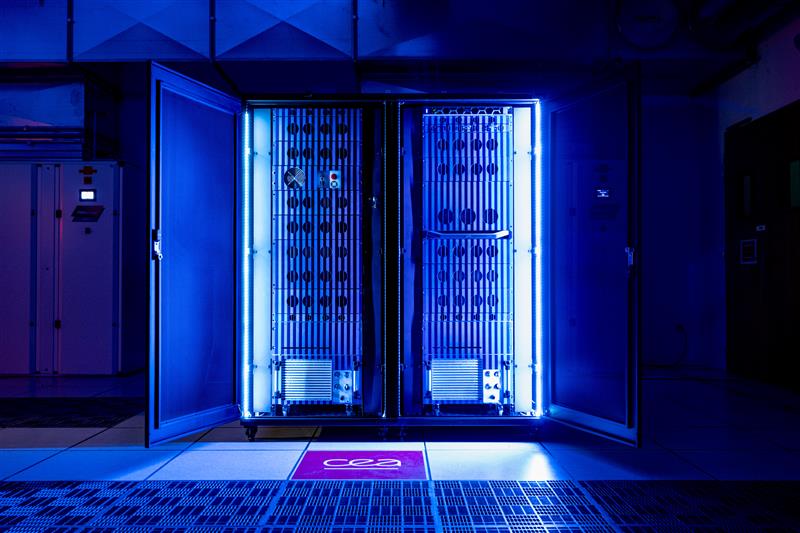
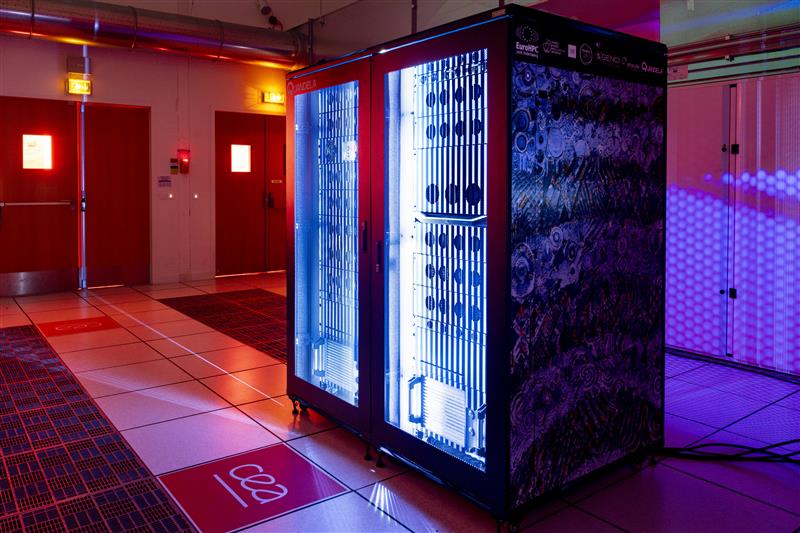
Paris, France – October 23 – Quandela, GENCI and CEA today announced the delivery of Lucy, a 12-qubit universal digital photonic quantum computer, to the Très Grand Centre de calcul (TGCC) of CEA. The system, delivered by the French-German consortium Quandela – attocube systems AG, was procured by the EuroHPC Joint Undertaking in the context of the consortium EuroQCS-France.

A new European quantum capability

Lucy, the most powerful photonic quantum computer ever deployed in a European computing centre, has just been delivered to the TGCC. Equipped with 12 photonic qubits, the system offers researchers and industrial users an unprecedented platform to experiment with quantum algorithms, explore hybrid HPC–quantum workflows and develop early-stage applications in fields such as optimization, chemistry, and machine learning.

Lucy is strongly focused on end-user engagement. Hosted and operated at CEA’s TGCC, where it will be coupled to the Joliot-Curie supercomputer, Lucy will be made accessible to a wide community of European users. Initial application areas include energy grid optimization and renewable integration, financial portfolio optimization and risk modelling, logistics and supply chain management, as well as aerospace design, materials, and trajectory optimization.

By enabling these use cases, Lucy strengthens Europe’s position at the forefront of quantum research while preparing industry for future breakthroughs.

A quantum computer made in EU

Lucy was acquired by EuroHPC in the context of the consortium EuroQCS-France.[1] Building on the successful deployments at OVHcloud in 2023 and Exaion’s datacentres in Canada in 2024, it marks a new milestone in Europe’s quantum journey. Assembled in just twelve months at Quandela’s facilities, the system showcases the strength of European collaboration: cryogenic modules engineered by attocube systems AG near Munich, quantum devices manufactured in Quandela’s semiconductor pilot line in Palaiseau, and final integration at Quandela’s factory in Massy. With 80% of its components sourced in Europe – including all of its critical parts – Lucy exemplifies Europe’s capacity to design and deliver sovereign quantum technologies.

Early remote access to drive adoption

The system has entered an acceptance phase before its opening to European researchers at the beginning of 2026. To accelerate adoption and enable the European research community to prepare for this new capability ahead of Lucy’s full deployment, EuroHPC and GENCI have already provided remote access to other Quandela photonic quantum processors hosted in Massy, with computing resources granted by the GENCI’ eDARI web portal[1]. Users can program and run algorithms directly using Quandela’s Perceval and MerLin (tailored to address Quantum Machine Learning problems) environments, ensuring a smooth transition to on-premises access when Lucy becomes fully operational.

In parallel, GENCI, CEA and Quandela are already delivering webinars[2] and dedicated training sessions to prepare user communities. These initiatives cover practical access to the cloud QPU (Quantum Processing Unit), quantum machine learning use cases, and hands-on training on Lucy at TGCC. By combining early access with training, the objective is to foster a broad adoption of quantum computing across academia and industry.

Lucy will be the second QPU integrated in the TGCC supercomputing environment, emphasising CEA’s expertise in mastering the complexity of large computing infrastructures. This is a major step in enabling hybrid quantum computing for high performance applications.

Quotes

QUANDELA

“The delivery of Lucy is not just a new milestone – it is a key building block for Europe’s hybrid computing future. In collaboration with attocube systems, we built a photonic quantum processor that will interface with the Joliot-Curie supercomputer, enabling real hybrid HPC-quantum workflows. By providing this capability to a broad community of European researchers and industrial users, we are empowering them to explore new frontiers in simulation, optimization, and machine learning. This achievement strengthens Europe’s technological sovereignty and demonstrates the power of cross-border collaboration to shape the next generation of computing.”
 Niccolo Somaschi, Co-founder & CEO, Quandela

GENCI

“In the global race to develop quantum computers, the delivery to the CEA of Lucy, Europe’s most powerful photonic quantum computer, manufactured by the French company Quandela, represents a major step forward in French and European quantum ambitions. GENCI and the HQI program are particularly proud to have contributed to EuroHPC’s acquisition of this sovereign technology, which will then be connected to the Joliot-Curie supercomputer and, in 2026, to Alice Recoque, the Franco-European exascale supercomputer, in order to multiply the synergies between HPC environments and quantum computing, all in the service of world-class research for academic and industrial researchers” declared Philippe Lavocat, CEO and President, GENCI

CEA

“As a key player in quantum computing, from the most fundamental research to system implementation, CEA is pleased to welcome a second Quantum Processing Unit to its computing centre. This milestone is a new step on the road to Fault Tolerant Quantum Hybrid Computing. It marks the progress of the HQI platform, entrusted to the CEA as part of France’s national quantum strategy. The Lucy machine integrates into the shared HPC and quantum computing environment of the TGCC, bringing a rapidly advancing photonic-qubit technology with strong future potential. The CEA is eager to make Lucy available to researchers and industry, and proud to continue supporting leading French start-ups in their development” said Jean-Philippe Verger, Director of the CEA DAM Ile de France center.

About

GENCI

Created by the public authorities in 2007, GENCI (Grand Équipement National de Calcul Intensif) is a major research infrastructure. This public operator aims to democratise the use of digital simulation through high performance computing associated with the use of artificial intelligence, and quantum computing to support French scientific and industrial competitiveness.

GENCI is in charge of three missions:

  • To implement the national strategy for the provision of high-performance computing resources, storage, massive data processing associated with Artificial Intelligence technologies and quantum computing, for the benefit of French scientific research, in conjunction with the 3 national computing centres (CEA/TGCC, CNRS/IDRIS, France Universités/CINES).
  • Supporting the creation of an integrated ecosystem on a national and European level
  • Promoting digital simulation and supercomputing to academic research and industry

GENCI is a civil company 49% owned by the State represented by the Ministry in charge of Higher Education and Research, 20% by the CEA, 20% by the CNRS, 10% by the Universities represented by France Universités and 1% by Inria.

CEA

The CEA is a public research organization that supports public policy decision-making and equips French and European businesses and communities with the scientific and technological means to better navigate four major societal transitions: energy transition, digital transition, future healthcare, and national/global security. Its mission is to ensure France and Europe maintain scientific, technological, and industrial leadership, contributing to a more secure and controlled present and future for all. The CEA is guided by three core values: curiosity, cooperation, and a strong sense of responsibility.
Learn more at: www.cea.fr/english

France 2030

The French part of this acquisition is supported by the Secrétariat Général pour l’Investissement (SGPI) via the France 2030 program in the context of the French National Quantum Strategy. GENCI and CEA, together with Inria, have set up a hybrid HPC-Quantum computing infrastructure called HQI (France Hybrid HPC Quantum Initiative) in which various quantum technologies will be coupled to the Joliot Curie supercomputer hosted and operated at TGCC (project HQI-Acquisitions ref. ANR-22-PNCQ-0001).


[1] Led by GENCI with CEA, the University of Bucharest (UPC), ICHEC and Forschungszentrum Juelich (FZJ)

[1] www.edari.fr

[2] https://www.canal-u.tv/chaines/genci/webinaire-access-the-quandela-cloud-via-genci

Explore More

Read more

Quandela and OVHcloud join forces to democratize quantum machine learning with MerLin

×

At the international Adopt AI event in Paris, Quandela and OVHcloud announce a strategic initiative to bring closer AI and quantum computing thanks to MerLin, Quandela’s quantum machine learning environment. This collaboration will enable researchers and companies to prototype and simulate hybrid models on NVIDIA GPUs before testing them on Quandela’s photonic quantum computers, directly accessible from OVHcloud’s cloud platform.

Paris, Roubaix (France), November 25, 2025 – Quandela, European leader in photonic quantum computing, and OVHcloud, a major European cloud provider, announce that MerLin – the first programming language and environment dedicated to quantum machine learning – will be made available on OVHcloud’s platform starting mid-2026. This unified approach will accelerate the development of hybrid applications within a sovereign cloud environment.

A bridge between AI and quantum

Unveiled in summer 2025, MerLin lays the groundwork for a new generation of Quantum Machine Learning (QML) tools, integrated into standard AI frameworks such as PyTorch and scikit-learn.
Now, thanks to its integration into the OVHcloud platform, users will be able to design, simulate, and test their hybrid AI-Quantum neural networks in a unified cloud environment powered by NVIDIA GPUs, a shared partner of both companies.

This approach will accelerate the development of industrial quantum applications: users will first be able to run their simulations on GPUs, then test and validate their models on Quandela’s photonic quantum computers, hosted and operated within OVHcloud.

A clear quantum roadmap

As part of this partnership, OVHcloud has published its quantum roadmap, announcing that Quandela’s quantum computers will become available on its cloud platform in mid-2026. The first systems to be offered will be BELENOS, a 12-qubit photonic processor, and CANOPUS, a 24-qubit photonic processor.

This deployment will be a major milestone in integrating quantum computing into the cloud, paving the way for democratized and sovereign access to European quantum power.

This partnership with OVHcloud perfectly embodies our vision: to make quantum accessible and useful for AI experts. With MerLin, we provide a seamless environment – from GPU to quantum processor – allowing the exploration of new hybrid algorithms and accelerating the journey from concept to real-world application,” says Jean Senellart, Chief Product Officer at Quandela.

With MerLin, data scientists finally have an accessible framework that does not require quantum computing skills – an actual tool that democratizes its use for the most innovative function in companies: data science,” says Fanny Bouton, Quantum Lead and Product Manager at OVHcloud.

Toward a sovereign European quantum cloud

By combining their expertise – photonics and hybrid algorithms for Quandela, cloud and sovereign infrastructure for OVHcloud, GPU acceleration for NVIDIA – the two partners are laying the foundations of a competitive and open European quantum ecosystem. An ecosystem expected to foster the emergence of hybrid applications in fields such as cybersecurity, finance, energy, healthcare, and logistics.

Read more

Quandela Accelerates Quantum Spin-Photon Simulationby 20,000x with NVIDIA CUDA-Q

×

Quandela and NVIDIA have achieved a transformative 20,000x acceleration in quantum photonics simulation using NVIDIA CUDA-Q the GPU-accelerated platform for hybrid quantum-classical computing. This breakthrough dramatically reduces development cycles for quantum optical hardware from months to hours, advancing Quandela’s Spin–Photonic Quantum Computing (SPOQC) architecture for fault-tolerant quantum computing while also creating new opportunities for hybrid quantum–classical computing approaches that combine the strengths of both paradigms.

The advance builds on Quandela’s Zero-Photon Generator (ZPG)method, which reformulates complex photon-mediated dynamics into parallelizable master equations, CUDA-Q’s master equation solver enhanced in v0.12 with support for custom superoperators andbatched Liouvillian evolution, make it possible to run hundreds of open-system simulations simultaneously on a single NVIDIA Hopper GPU, reaching an acceleration of four orders of magnitude compared to existing simulation tools. Together, these advances turn previously intractable light–matter simulations into a real-time engineering tool.

Dr. Jean Senellart, Chief Product Officer of Quandela, said: “This collaboration with NVIDIA represents a paradigm shift in how we approach quantum hardware development. What once took weeks of computation can now be done in minutes, enabling us to explore thousands of design variations and accelerate our roadmap to fault-tolerant photonic quantum processors.

The collaboration demonstrates how GPU acceleration is now redefining quantum research. CUDA-Q v0.12.0 introduces the new superoperator and batching features developed through this joint effort, now publicly available for researchers and developers.

Sam Stanwyck, Group Product Manager for quantum computing at NVIDIA, commented: “Development of larger and more performant quantum hardware requires increasingly more complex simulations. Quandela’s work with CUDA-Q shows how GPU-accelerated simulations are compressing months of quantum hardware development into hours, and accelerating the development of useful accelerated quantum supercomputers.

This milestone sets a new benchmark for simulating distributed spin–photon quantum gates, supporting Quandela’s broader mission to build fault-tolerant photonic quantum processors. Detailed benchmarks and implementation resources are available in the Quandela technical blog.

Read more

Conclusions from the Franco-German Dialogue of Quantum Technology Players 2025

×

Quantum Technologies hold great economic potential. That is why it is in Europe’s interest to secure a leading position in their development and industrial application.

The French German Dialogue of Quantum Technology Players on September 23, 2025 in Paris and Massy (France), was organized by the Quantum Technology and Application Consortium (QUTAC), Le lab Quantique, Quandela, CEA, Fraunhofer, with support from the French embassy in Germany and the German embassy in France. The dialogue brought together more than 60 experts, managers and decision-makers from innovation, corporates, research and public authorities from France and Germany.

Following the dialogue, participants identified the following key challenges for building Europe’s quantum future:

  1. Use Cases: A concrete, industry-driven pipeline of end-to-end use cases should be developed, aligned with realistic expectations and a clear definition of what constitutes a “quantum advantage”.
  2. Success Stories: Successful examples that translate scientific achievements into businesses cases with tangible return on investment and operational impact should act as references across sectors.
  3. Benchmarking and management of expectations: A focus should be given to benchmarking our progress toward error-corrected and fault-tolerant systems. These will determine the long-term viability and sovereignty of European quantum technologies.
  4. European champions: Champions at the European level should be nurtured to build scale and reduce fragmentation, all while connecting national strengths, particularly in strategic domains.
  5. Trust / Intellectual Property: Intellectual property rules in both countries should be clarified and harmonized, while patents should continue to be incentivized.
  6. European strategies: Joint roadmaps and funding strategies should be developed across countries to avoid duplicating efforts and promote shared projects with long-term impact.
  7. Funding: Investment funds and private capital should be mobilised to stimulate industrial co-development and adoption of quantum solutions. Public funding programs should expand, and public authorities and funding agencies should streamline cross-border funding through a single-entry point.
  8. Talents: Talent training should be prioritised, for example by developing shared talent platforms and joint doctoral schools and study schemes.
  9. Gathering of ecosystems among France and Germany: Creative formats of collaboration across countries should be developed, such as cross invitations at meetings, events, technology fairs, dedicated learning expeditions, and others.
  10. Dialogue governance: The Franco-German dialogue of quantum technology players should be followed up and expanded. Governance mechanisms should be supported jointly by France and Germany to ensure continuity, coordination, accountability, alignment with national strategies and dissemination of results and increased impact.

To master these challenges, participants have formulated concrete actions. You can find these in the complete version of our conclusion document, which you can download here