
Newsroom / Press release

Quandela and Seoul Metropolitan Government Sign MoU to Support a Quantum Technology Development Center in Seoul

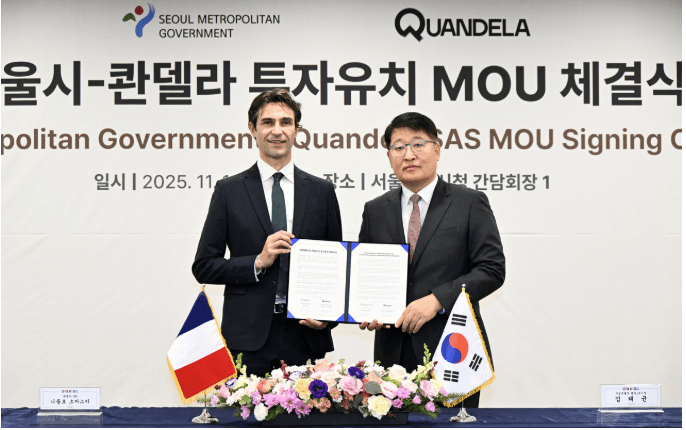
On November 12, 2025, Quandela entered into a Memorandum of Understanding (MoU) with the Seoul Metropolitan Government (SMG) to support the establishment of a Quantum Technology Development Center in Seoul. Under the MoU framework, SMG outlined an investment plan of up to ₩80 billion, subject to applicable review, approval, and administrative processes.

Building on Seoul’s efforts to strengthen its position as a global quantum hub, Quandela entered into a MoU with the Seoul Metropolitan Government (SMG) to support the establishment of a Quantum Technology Development Center in Seoul.

The signing took place at Seoul City Hall on November 12, 2025, and the MoU was signed by Kim Tae-Kyun, Administrative First Deputy Mayor of Seoul, and Niccolo Somaschi, CEO of Quandela. Under the MoU framework, SMG outlined an investment plan of up to ₩80 billion, subject to applicable review, approval, and administrative processes, to support the center and related initiatives.

The ceremony was attended by Philippe Bertoux, French Ambassador to Korea, and Kim Yoo-seok, head of Quandela Korea.

Under the agreement, Quandela plans to build a public–private, academia-linked R&D network in Seoul to support quantum talent development and the local ecosystem, including component manufacturers and startups in the quantum sector.

“This MoU is a major milestone in Quandela’s global strategy,” said Niccolo Somaschi, CEO of Quandela. “Our goal is to help create an ecosystem in Seoul where innovation, research, and industrial applications of quantum technologies are closely connected and made accessible.”

Kim Tae-Kyun, Administrative First Deputy Mayor of Seoul, stated that the city will provide comprehensive support to global companies investing in Seoul, including Quandela.

About Quandela

Quandela develops and deploys photonic quantum computers designed for real-world environments: room-temperature operation, data‑center compatibility, and a full software stack for programming and running workloads (cloud and on‑prem access). Beyond hardware, Quandela helps corporations, research teams and public institutions identify, prototype and integrate quantum use cases through training, technical support and joint pilot projects. Founded in Europe, Quandela pursues a progressive path from usable systems to fault‑tolerant quantum computing.

Explore More

Read more

Quandela and Seoul Metropolitan Government Sign MoU to Support a Quantum Technology Development Center in Seoul

×

Building on Seoul’s efforts to strengthen its position as a global quantum hub, Quandela entered into a MoU with the Seoul Metropolitan Government (SMG) to support the establishment of a Quantum Technology Development Center in Seoul.

The signing took place at Seoul City Hall on November 12, 2025, and the MoU was signed by Kim Tae-Kyun, Administrative First Deputy Mayor of Seoul, and Niccolo Somaschi, CEO of Quandela. Under the MoU framework, SMG outlined an investment plan of up to ₩80 billion, subject to applicable review, approval, and administrative processes, to support the center and related initiatives.

The ceremony was attended by Philippe Bertoux, French Ambassador to Korea, and Kim Yoo-seok, head of Quandela Korea.

Under the agreement, Quandela plans to build a public–private, academia-linked R&D network in Seoul to support quantum talent development and the local ecosystem, including component manufacturers and startups in the quantum sector.

“This MoU is a major milestone in Quandela’s global strategy,” said Niccolo Somaschi, CEO of Quandela. “Our goal is to help create an ecosystem in Seoul where innovation, research, and industrial applications of quantum technologies are closely connected and made accessible.”

Kim Tae-Kyun, Administrative First Deputy Mayor of Seoul, stated that the city will provide comprehensive support to global companies investing in Seoul, including Quandela.

About Quandela

Quandela develops and deploys photonic quantum computers designed for real-world environments: room-temperature operation, data‑center compatibility, and a full software stack for programming and running workloads (cloud and on‑prem access). Beyond hardware, Quandela helps corporations, research teams and public institutions identify, prototype and integrate quantum use cases through training, technical support and joint pilot projects. Founded in Europe, Quandela pursues a progressive path from usable systems to fault‑tolerant quantum computing.

Read more

Quandela and OVHcloud join forces to democratize quantum machine learning with MerLin

×

At the international Adopt AI event in Paris, Quandela and OVHcloud announce a strategic initiative to bring closer AI and quantum computing thanks to MerLin, Quandela’s quantum machine learning environment. This collaboration will enable researchers and companies to prototype and simulate hybrid models on NVIDIA GPUs before testing them on Quandela’s photonic quantum computers, directly accessible from OVHcloud’s cloud platform.

Paris, Roubaix (France), November 25, 2025 – Quandela, European leader in photonic quantum computing, and OVHcloud, a major European cloud provider, announce that MerLin – the first programming language and environment dedicated to quantum machine learning – will be made available on OVHcloud’s platform starting mid-2026. This unified approach will accelerate the development of hybrid applications within a sovereign cloud environment.

A bridge between AI and quantum

Unveiled in summer 2025, MerLin lays the groundwork for a new generation of Quantum Machine Learning (QML) tools, integrated into standard AI frameworks such as PyTorch and scikit-learn.
Now, thanks to its integration into the OVHcloud platform, users will be able to design, simulate, and test their hybrid AI-Quantum neural networks in a unified cloud environment powered by NVIDIA GPUs, a shared partner of both companies.

This approach will accelerate the development of industrial quantum applications: users will first be able to run their simulations on GPUs, then test and validate their models on Quandela’s photonic quantum computers, hosted and operated within OVHcloud.

A clear quantum roadmap

As part of this partnership, OVHcloud has published its quantum roadmap, announcing that Quandela’s quantum computers will become available on its cloud platform in mid-2026. The first systems to be offered will be BELENOS, a 12-qubit photonic processor, and CANOPUS, a 24-qubit photonic processor.

This deployment will be a major milestone in integrating quantum computing into the cloud, paving the way for democratized and sovereign access to European quantum power.

This partnership with OVHcloud perfectly embodies our vision: to make quantum accessible and useful for AI experts. With MerLin, we provide a seamless environment – from GPU to quantum processor – allowing the exploration of new hybrid algorithms and accelerating the journey from concept to real-world application,” says Jean Senellart, Chief Product Officer at Quandela.

With MerLin, data scientists finally have an accessible framework that does not require quantum computing skills – an actual tool that democratizes its use for the most innovative function in companies: data science,” says Fanny Bouton, Quantum Lead and Product Manager at OVHcloud.

Toward a sovereign European quantum cloud

By combining their expertise – photonics and hybrid algorithms for Quandela, cloud and sovereign infrastructure for OVHcloud, GPU acceleration for NVIDIA – the two partners are laying the foundations of a competitive and open European quantum ecosystem. An ecosystem expected to foster the emergence of hybrid applications in fields such as cybersecurity, finance, energy, healthcare, and logistics.

Read more

Quandela Accelerates Quantum Spin-Photon Simulationby 20,000x with NVIDIA CUDA-Q

×

Quandela and NVIDIA have achieved a transformative 20,000x acceleration in quantum photonics simulation using NVIDIA CUDA-Q the GPU-accelerated platform for hybrid quantum-classical computing. This breakthrough dramatically reduces development cycles for quantum optical hardware from months to hours, advancing Quandela’s Spin–Photonic Quantum Computing (SPOQC) architecture for fault-tolerant quantum computing while also creating new opportunities for hybrid quantum–classical computing approaches that combine the strengths of both paradigms.

The advance builds on Quandela’s Zero-Photon Generator (ZPG)method, which reformulates complex photon-mediated dynamics into parallelizable master equations, CUDA-Q’s master equation solver enhanced in v0.12 with support for custom superoperators andbatched Liouvillian evolution, make it possible to run hundreds of open-system simulations simultaneously on a single NVIDIA Hopper GPU, reaching an acceleration of four orders of magnitude compared to existing simulation tools. Together, these advances turn previously intractable light–matter simulations into a real-time engineering tool.

Dr. Jean Senellart, Chief Product Officer of Quandela, said: “This collaboration with NVIDIA represents a paradigm shift in how we approach quantum hardware development. What once took weeks of computation can now be done in minutes, enabling us to explore thousands of design variations and accelerate our roadmap to fault-tolerant photonic quantum processors.

The collaboration demonstrates how GPU acceleration is now redefining quantum research. CUDA-Q v0.12.0 introduces the new superoperator and batching features developed through this joint effort, now publicly available for researchers and developers.

Sam Stanwyck, Group Product Manager for quantum computing at NVIDIA, commented: “Development of larger and more performant quantum hardware requires increasingly more complex simulations. Quandela’s work with CUDA-Q shows how GPU-accelerated simulations are compressing months of quantum hardware development into hours, and accelerating the development of useful accelerated quantum supercomputers.

This milestone sets a new benchmark for simulating distributed spin–photon quantum gates, supporting Quandela’s broader mission to build fault-tolerant photonic quantum processors. Detailed benchmarks and implementation resources are available in the Quandela technical blog.