Newsroom / Press release

Quandela Validates Low-Latency Photonic QPU Integration with NVIDIA Accelerated Computing​

Hamburg, Germany – June 22, 2026 – Quandela today announced that it has experimentally validated a low-latency integration path between photonic quantum processors and NVIDIA ​AI​​ infrastructure, marking an important […]

Hamburg, Germany – June 22, 2026 – Quandela today announced that it has experimentally validated a low-latency integration path between photonic quantum processors and NVIDIA ​AI​​ infrastructure, marking an important milestone toward bringing quantum processing units directly into high-performance computing environments. Results presented at ISC 2026 demonstrate a path toward accelerator-style integration of photonic quantum processors in GPU-driven HPC environments.

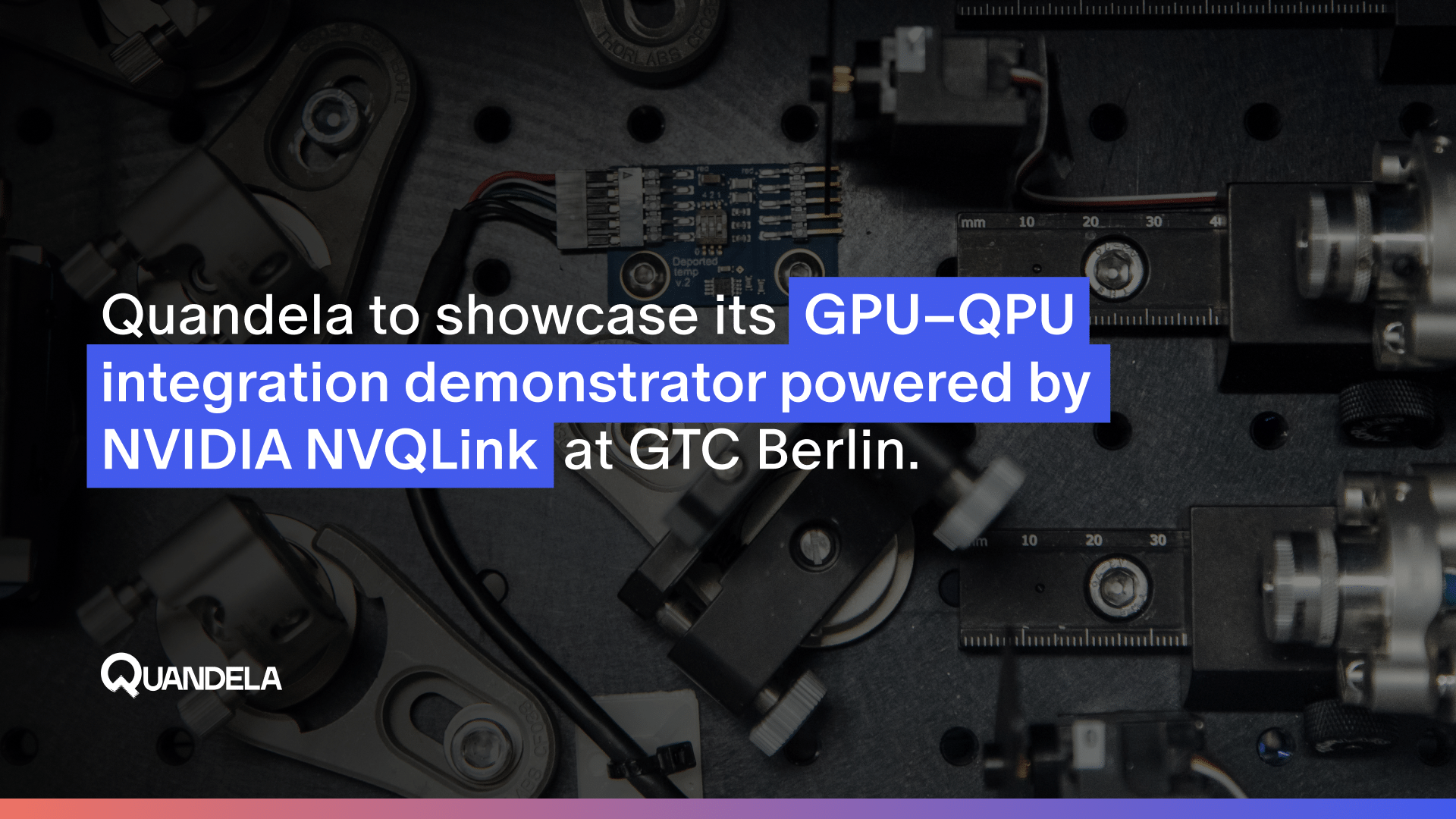
The results show how a Quandela photonic QPU can be integrated with an NVIDIA GPU host and an FPGA-based Quantum System Controller through ​​NVIDIA NVQLink. More than a simple interconnect, NVQLink provides a hardware-and-software architecture for low-latency, real-time communication between GPU supercomputing infrastructure ​and quantum system controllers. The validation supports a new execution model for hybrid quantum-classical computing: moving beyond remote quantum access toward collocated quantum acceleration inside HPC infrastructure.

Today, most quantum processors are accessed through cloud APIs, job queues and orchestration layers. This approach remains valuable for experimentation and batch execution, but its asynchronous nature introduces latency that limits workflows requiring real-time responses inside AI or HPC pipelines.

Quandela’s results address this bottleneck. By measuring low-latency communication between GPU infrastructure and the FPGA-based Quantum System Controller, the company has validated a practical route for photonic QPUs to participate more directly in GPU-driven workloads.

“This is not just a demonstration of connectivity,” said Jean Senellart, Chief Technology & Product Officer at Quandela. “This validation confirms a technical path toward integrating photonic QPUs into the HPC accelerator stack. For the HPC community, the important shift is that quantum processors can start to be treated less like remote experimental instruments and more like accelerators deployed alongside GPUs.”

The validation is based on a collocated architecture combining NVIDIA accelerated computing and networking ​with an FPGA-based Quantum System Controller connected to a Quandela photonic QPU. In this model, existing HPC schedulers remain responsible for reservation, allocation and accounting, while the active GPU–QPU session is designed to avoid repeated traversal of the full cloud-style orchestration path.

The first target workloads are in photonic Quantum Machine Learning, including quantum reservoir computing, quantum feature maps and hybrid neural-network architectures. These workloads are particularly well suited to the architecture because many photonic circuits can remain configured during inference, while new data points require only lightweight updates before measurement.

This is where photonics offers a distinctive advantage. For selected QML workloads, the same optical configuration can be reused across many inference calls, while new data points require only lightweight updates before measurement. Combined with fast photonic sampling, this makes system-level latency – not only quantum execution time – a decisive factor in performance, which is why​ the low-latency interaction model enabled by NVQLink is​ crucial for successful operation​.

Quandela’s MerLin framework provides the software environment used to design, simulate, benchmark and validate these hybrid photonic QML workflows. The work also builds on Quandela’s MosaiQ photonic quantum computing platform, whose current systems are designed with FPGA-based control capabilities aligned with the Quantum System Controller model defined by NVIDIA​ ​NVQLink.

​For HPC centers, sovereign AI and quantum programs, advanced research organizations and industrial users, the validation points toward a future deployment model in which a customer-owned photonic QPU could be installed on-premise or in a dedicated data center environment and connected to NVIDIA accelerated computing infrastructure​.​

“​Tightly integrating quantum systems with accelerated computing is proving hugely impactful for quantum research,” said Sam Stanwyck, Director of Quantum Product at NVIDIA. “Quandela’s work with NVQLink shows how quantum-GPU supercomputing systems will fundamentally transform how we are able to think about computing applications when information can be passed seamlessly between different processors.”​

This announcement marks a technical validation milestone toward low-latency GPU–QPU integration, paving the way for future NVQLink-enabled MosaiQ deployments.

Beyond near-term hybrid AI and QML workloads, the same integration principles are relevant to future quantum computing architectures, where QPUs, FPGA-based control systems and GPU-accelerated infrastructure will need to operate in tightly coordinated environments. Low-latency GPU–QPU integration is therefore both a near-term enabler and a foundation for future hybrid quantum-classical computing systems.

Quandela will present these results at ISC High Performance 2026 in Hamburg on 23 June 2026.

About Quandela

Quandela is a global leader in quantum computing, designing, building, and delivering cutting-edge quantum solutions for research and industry. Its offerings include the most energy-efficient quantum computers for data centers, full-stack quantum computing solutions accessible via the cloud, and algorithm access services for academic and industrial customers. Following a pragmatic, step-by-step roadmap, Quandela has been deploying industrial-grade systems since 2023 while developing future generations of fault-tolerant quantum computers capable of scaling through the integration of thousands of photonic components. Quandela is committed to making quantum computing accessible to all in order to address the most complex industrial and societal challenges.

Learn more at: Quandela | Leading Photonic Quantum Computing Solutions

Media Relations

Maarc PR agency

En savoir plus

Read more

Quandela Validates Low-Latency Photonic QPU Integration with NVIDIA Accelerated Computing​

×

Hamburg, Germany – June 22, 2026 – Quandela today announced that it has experimentally validated a low-latency integration path between photonic quantum processors and NVIDIA ​AI​​ infrastructure, marking an important milestone toward bringing quantum processing units directly into high-performance computing environments. Results presented at ISC 2026 demonstrate a path toward accelerator-style integration of photonic quantum processors in GPU-driven HPC environments.

The results show how a Quandela photonic QPU can be integrated with an NVIDIA GPU host and an FPGA-based Quantum System Controller through ​​NVIDIA NVQLink. More than a simple interconnect, NVQLink provides a hardware-and-software architecture for low-latency, real-time communication between GPU supercomputing infrastructure ​and quantum system controllers. The validation supports a new execution model for hybrid quantum-classical computing: moving beyond remote quantum access toward collocated quantum acceleration inside HPC infrastructure.

Today, most quantum processors are accessed through cloud APIs, job queues and orchestration layers. This approach remains valuable for experimentation and batch execution, but its asynchronous nature introduces latency that limits workflows requiring real-time responses inside AI or HPC pipelines.

Quandela’s results address this bottleneck. By measuring low-latency communication between GPU infrastructure and the FPGA-based Quantum System Controller, the company has validated a practical route for photonic QPUs to participate more directly in GPU-driven workloads.

“This is not just a demonstration of connectivity,” said Jean Senellart, Chief Technology & Product Officer at Quandela. “This validation confirms a technical path toward integrating photonic QPUs into the HPC accelerator stack. For the HPC community, the important shift is that quantum processors can start to be treated less like remote experimental instruments and more like accelerators deployed alongside GPUs.”

The validation is based on a collocated architecture combining NVIDIA accelerated computing and networking ​with an FPGA-based Quantum System Controller connected to a Quandela photonic QPU. In this model, existing HPC schedulers remain responsible for reservation, allocation and accounting, while the active GPU–QPU session is designed to avoid repeated traversal of the full cloud-style orchestration path.

The first target workloads are in photonic Quantum Machine Learning, including quantum reservoir computing, quantum feature maps and hybrid neural-network architectures. These workloads are particularly well suited to the architecture because many photonic circuits can remain configured during inference, while new data points require only lightweight updates before measurement.

This is where photonics offers a distinctive advantage. For selected QML workloads, the same optical configuration can be reused across many inference calls, while new data points require only lightweight updates before measurement. Combined with fast photonic sampling, this makes system-level latency – not only quantum execution time – a decisive factor in performance, which is why​ the low-latency interaction model enabled by NVQLink is​ crucial for successful operation​.

Quandela’s MerLin framework provides the software environment used to design, simulate, benchmark and validate these hybrid photonic QML workflows. The work also builds on Quandela’s MosaiQ photonic quantum computing platform, whose current systems are designed with FPGA-based control capabilities aligned with the Quantum System Controller model defined by NVIDIA​ ​NVQLink.

​For HPC centers, sovereign AI and quantum programs, advanced research organizations and industrial users, the validation points toward a future deployment model in which a customer-owned photonic QPU could be installed on-premise or in a dedicated data center environment and connected to NVIDIA accelerated computing infrastructure​.​

“​Tightly integrating quantum systems with accelerated computing is proving hugely impactful for quantum research,” said Sam Stanwyck, Director of Quantum Product at NVIDIA. “Quandela’s work with NVQLink shows how quantum-GPU supercomputing systems will fundamentally transform how we are able to think about computing applications when information can be passed seamlessly between different processors.”​

This announcement marks a technical validation milestone toward low-latency GPU–QPU integration, paving the way for future NVQLink-enabled MosaiQ deployments.

Beyond near-term hybrid AI and QML workloads, the same integration principles are relevant to future quantum computing architectures, where QPUs, FPGA-based control systems and GPU-accelerated infrastructure will need to operate in tightly coordinated environments. Low-latency GPU–QPU integration is therefore both a near-term enabler and a foundation for future hybrid quantum-classical computing systems.

Quandela will present these results at ISC High Performance 2026 in Hamburg on 23 June 2026.

About Quandela

Quandela is a global leader in quantum computing, designing, building, and delivering cutting-edge quantum solutions for research and industry. Its offerings include the most energy-efficient quantum computers for data centers, full-stack quantum computing solutions accessible via the cloud, and algorithm access services for academic and industrial customers. Following a pragmatic, step-by-step roadmap, Quandela has been deploying industrial-grade systems since 2023 while developing future generations of fault-tolerant quantum computers capable of scaling through the integration of thousands of photonic components. Quandela is committed to making quantum computing accessible to all in order to address the most complex industrial and societal challenges.

Learn more at: Quandela | Leading Photonic Quantum Computing Solutions

Media Relations

Maarc PR agency

Paris, 18 juin 2026 – Signé ce jeudi dans le cadre de Vision Golfe – forum économique franco-golfique organisé par Business France sous le haut patronage du Président de la République, au Ministère de l’Économie, des Finances et de la Souveraineté Industrielle et Numérique –, ce partenariat marque l’entrée de Mekdam dans l’informatique quantique et renforce la présence de Quandela au Qatar et sur les marchés stratégiques du Moyen-Orient.

Quandela, leader européen de l’informatique quantique photonique, et Mekdam Holding Group (QSE : MKDM), groupe technologique qatari coté au Qatar Stock Exchange, ont signé ce jeudi un Memorandum of Understanding (MoU) au Ministère de l’Économie, des Finances et de la Souveraineté Industrielle et Numérique, dans le cadre de Vision Golfe. Cet accord vise à explorer et déployer des solutions d’informatique quantique à destination des marchés du Golfe, positionnant les deux partenaires parmi les premiers acteurs à introduire cette technologie dans la région.

Ce partenariat s’inscrit en pleine cohérence avec la Qatar National Vision 2030 et les grandes stratégies nationales de souveraineté numérique et d’intelligence artificielle portées par les États du Golfe.

De gauche à droite : Bara’ Sami, General Group Manager de Mekdam Holding Group, et Xavier Pereira, Chief Growth Officer de Quandela, lors de la signature de l’accord ce jeudi à Bercy.

Des expertises complémentaires pour un marché stratégique

Mekdam Holding Group, premier groupe technologique qatari coté en bourse, affiche une trajectoire de croissance soutenue avec un chiffre d’affaires de 681,1 millions de riyals qataris (environ 161 millions d’euros), en hausse de plus de 20% en 2025, et un carnet de commandes de 3,1 milliards de riyals (734 millions d’euros). Actif dans l’intelligence artificielle, le cloud, la cybersécurité, l’IoT, les infrastructures de données et les systèmes intelligents, le Groupe a identifié l’informatique quantique comme un pilier stratégique de son développement dans les technologies émergentes.

Quandela apporte son expertise de premier plan en informatique quantique photonique, en calcul tolérant aux fautes (FTQC) et en apprentissage automatique quantique (QML). Ensemble, les deux partenaires entendent identifier et développer des cas d’usage à forte valeur pour les secteurs prioritaires de la région : énergie, gouvernement, infrastructures critiques, santé et éducation.

Vers un écosystème quantique régional

Au-delà des applications immédiates, le partenariat vise à structurer un écosystème durable : accès cloud aux ordinateurs quantiques photoniques de Quandela, développement de compétences locales, programmes de formation et de certification, et création d’un centre d’excellence quantique Quandela–Mekdam au service des pays du Conseil de coopération du Golfe (CCG).

Cette volonté s’inscrit dans les différentes initiatives étatiques de la région, telle que la Qatar National Vision 2030, mais aussi Saudi Vision 2030 et UAE National Quantum Strategy.

« Basé à Doha et acteur technologique de premier plan au Moyen-Orient, Mekdam nous permet d’accélérer dans une région dynamique, innovante et essentielle pour l’avenir de l’informatique quantique. C’est un atout solide pour servir les ambitions mondiales de Quandela », déclare Xavier Pereira, Chief Growth Officer de Quandela.

« Ce partenariat marque l’entrée de Mekdam dans l’informatique quantique et notre volonté d’en être un acteur de premier plan dans la région. Aux côtés de Quandela, nous entendons concrétiser des cas d’usage à forte valeur pour les secteurs stratégiques du Golfe et bâtir un écosystème de compétences locales, en pleine cohérence avec la Qatar National Vision 2030 », déclare Bara’ Sami, General Group Manager de Mekdam Holding Group.

A propos de Quandela

Quandela est un leader mondial du calcul quantique qui conçoit, construit et fournit des solutions quantiques de pointe pour la recherche et l’industrie : en fournissant les ordinateurs quantiques les plus efficaces en consommation d’énergie pour les centres de calcul, des solutions complètes de calcul quantique accessibles via le cloud, et des services d’accès aux algorithmes pour les clients académiques et industriels. Quandela suit une trajectoire pragmatique et progressive, en installant des systèmes industriels depuis 2023 et en développant les futures générations d’ordinateurs quantiques tolérants aux erreurs, capables de passer à l’échelle en intégrant des milliers de composants photoniques. Quandela s’engage à rendre l’informatique quantique accessible à tous pour relever les défis industriels et sociétaux les plus complexes.
Pour en savoir plus: www.quandela.com

A propos de Mekdam Holding Group

Mekdam Holding Group Q.P.S.C. (QSE : MKDM) est un groupe qatari coté en bourse, spécialisé dans les technologies et les services, dont le siège est situé à Doha. Il figure parmi les pionniers des entreprises technologiques qatariennes cotées à la Bourse du Qatar. Fondé en 2018, Mekdam est devenu l’un des principaux groupes technologiques du Qatar, enregistrant une croissance de son chiffre d’affaires de 21,9 % sur un an au cours de l’exercice 2025, avec un portefeuille de contrats en cours d’exécution d’une valeur de 3,1 milliards de riyals qataris (QAR).

À travers ses filiales spécialisées — Mekdam Technology, Mekdam Software Services, Mekdam Technology Solutions, Mekdam Technical Services et Mekdam CAMS — le Groupe intervient dans les domaines de l’intelligence artificielle (IA), du cloud, de la cybersécurité, de l’Internet des objets (IoT), des technologies de l’information et de la communication (ICT), des centres de données, des infrastructures intelligentes et des systèmes de sécurité. Mekdam accompagne des clients issus des secteurs public, de l’énergie, des TIC et des infrastructures critiques, de la santé et de l’éducation, en soutenant des projets de transformation numérique à grande échelle. Le Groupe étend désormais ses activités au-delà du Qatar, en développant ses expertises technologiques et ses activités liées aux technologies émergentes dans l’ensemble de la région du Golfe.

En cohérence avec la Vision nationale du Qatar 2030, Mekdam a identifié l’informatique quantique comme un pilier stratégique de ses capacités technologiques, déjà intégré à son portefeuille de technologies émergentes. Ce partenariat avec Quandela concrétise cet engagement en le faisant évoluer d’une capacité fondatrice vers une mise en œuvre opérationnelle, positionnant Mekdam parmi les premiers acteurs de la région à commercialiser les technologies quantiques.

Siège social : Doha, Qatar
Fondation : 2018
Cotation boursière : Bourse du Qatar (QSE : MKDM)
Activités principales : Intelligence artificielle (IA), cloud, cybersécurité, Internet des objets (IoT), technologies de l’information et de la communication (ICT), centres de données, infrastructures intelligentes et systèmes de sécurité.

Contacts presse

Agence Maarc

Read more

Quandela et le Qatari Mekdam Holding Group s’associent pour accélérer le déploiement de l’informatique quantique dans la région du Golfe

×

Paris, June 18th, 2026 – Signed this Thursday during Vision Golfe – the Franco-Gulf economic forum organized by Business France under the high patronage of the French President, at the Ministry for the Economy, Finance and Industrial and Digital Sovereignty – this partnership marks Mekdam’s entry into quantum computing and strengthens Quandela’s presence in Qatar and strategic Middle Eastern markets.

Quandela, a European leader in photonic quantum computing, and Mekdam Holding Group (QSE: MKDM), a Qatari technology group listed on the Qatar Stock Exchange, signed a Memorandum of Understanding (MoU) this Thursday at the French Ministry for the Economy, Finance and Industrial and Digital Sovereignty, as part of Vision Golfe. The agreement aims to explore and deploy quantum computing solutions for Gulf markets, positioning both partners among the first organizations to introduce this technology to the region.

This partnership is fully aligned with Qatar National Vision 2030 and the major national strategies for digital sovereignty and artificial intelligence being implemented across Gulf countries.

From left to right: Bara’ Sami, General Group Manager of Mekdam Holding Group, and Xavier Pereira, Chief Growth Officer at Quandela, during the signing ceremony held this Thursday at the French Ministry of the Economy.

Complementary Expertise for a Strategic Market

Mekdam Holding Group, the first publicly listed technology group in Qatar, has demonstrated sustained growth, with revenues reaching QAR 681.1 million (approximately €161 million), an increase of more than 20% in 2025, and an order backlog of QAR 3.1 billion (€734 million). Active in artificial intelligence, cloud computing, cybersecurity, IoT, data infrastructure and smart systems, the Group has identified quantum computing as a strategic pillar of its development in emerging technologies.

Quandela brings world-class expertise in photonic quantum computing, fault-tolerant quantum computing (FTQC), and quantum machine learning (QML).

Together, the two partners intend to identify and develop high-value use cases for the region’s priority sectors: energy, government, critical infrastructure, healthcare, and education.

Toward a Regional Quantum Ecosystem

Beyond immediate applications, the partnership aims to build a sustainable ecosystem through cloud access to Quandela’s photonic quantum computers, local skills development, training and certification programs, and the creation of a Quandela–Mekdam Quantum Center of Excellence serving countries of the Gulf Cooperation Council (GCC).

This ambition aligns with various government-led initiatives across the region, including Qatar National Vision 2030, Saudi Vision 2030, and the UAE National Quantum Strategy.

“Based in Doha and a leading technology player in the Middle East, Mekdam enables us to accelerate our development in a dynamic, innovative, and strategically important region for the future of quantum computing. It is a strong asset in supporting Quandela’s global ambitions,” says Xavier Pereira, Chief Growth Officer at Quandela.

“This partnership marks Mekdam’s entry into quantum computing and reflects our ambition to become a leading player in the field across the region. Together with Quandela, we aim to deliver high-value use cases for the Gulf’s strategic sectors and build a strong local skills ecosystem, fully aligned with Qatar National Vision 2030,” says Bara’ Sami, General Group Manager of Mekdam Holding Group.

About Quandela 

Quandela is a global leader in quantum computing, designing, building, and delivering cutting-edge quantum solutions for research and industry. Its offerings include the most energy-efficient quantum computers for data centers, full-stack quantum computing solutions accessible via the cloud, and algorithm access services for academic and industrial customers. Following a pragmatic, step-by-step roadmap, Quandela has been deploying industrial-grade systems since 2023 while developing future generations of fault-tolerant quantum computers capable of scaling through the integration of thousands of photonic components. Quandela is committed to making quantum computing accessible to all in order to address the most complex industrial and societal challenges.
Learn more at www.quandela.com

About Mekdam Holding Group (Q.P.S.C.)

Mekdam Holding Group Q.P.S.C. (QSE: MKDM) is a publicly listed Qatari technology and services group headquartered in Doha, and a pioneer among Qatari technology companies listed on the Qatar Stock Exchange. Founded in 2018, Mekdam has grown into one of Qatar’s leading technology groups, delivering 21.9% year-on-year revenue growth in FY2025, with contracts under execution valued at QAR 3.1 billion.

Through its specialized subsidiaries — Mekdam Technology, Mekdam Software Services, Mekdam Technology Solutions, Mekdam Technical Services, and Mekdam CAMS — the Group delivers across artificial intelligence (AI), cloud, cybersecurity, IoT, ICT, data-center, smart infrastructure, and security systems. Mekdam serves clients across government, energy, ICT and critical infrastructure, healthcare, and education, supporting large-scale digital transformation. The Group is now extending its capability beyond Qatar, scaling its technology and emerging-technology businesses across the wider Gulf.

Aligned with Qatar National Vision 2030, Mekdam has identified quantum computing as a strategic capability pillar — already part of its emerging-technology portfolio. This partnership with Quandela advances that commitment from foundational capability to active execution, positioning Mekdam among the region’s first movers in bringing quantum technology to market.

Headquarters: Doha, Qatar
Founded: 2018
Stock Exchange: Qatar Stock Exchange (QSE: MKDM)
Core Activities: Artificial Intelligence (AI), Cloud, Cybersecurity, IoT, ICT, Data-Center, Smart Infrastructure, and Security Systems.

Media Relations

Maarc PR agency

L’architecture de calcul quantique spin-photon de Quandela intègre le programme de la DARPA qui évalue des systèmes quantiques tolérants aux fautes à l’échelle industrielle.

WASHINGTON, D.C., 16 juin 2026 — Quandela annonce aujourd’hui sa sélection par l’agence américaine Defense Advanced Research Projects Agency (DARPA) pour participer à la phase A de la Quantum Benchmarking Initiative (QBI), un programme en plusieurs phases visant à évaluer si une architecture de calcul quantique peut fonctionner à « l’échelle utile » d’ici 2033.

Dans le cadre de la phase A, Quandela présentera un concept détaillé d’ordinateur quantique tolérant aux fautes, accompagné d’éléments techniques étayant sa faisabilité à court terme. Pour la DARPA, « l’échelle utile » désigne des systèmes dont la valeur computationnelle dépasse leur coût. Le programme QBI vise à évaluer rigoureusement les approches du calcul quantique pratique et à donner aux pouvoirs publics une base plus claire pour apprécier les technologies susceptibles de passer à l’échelle.

« Notre sélection pour la phase A du programme QBI reflète les progrès et la maturité de notre approche », déclare Yoni Elmalem, General Manager de Quandela Federal. « Elle souligne la pertinence croissante des architectures photoniques et hybrides spin-photon pour des systèmes quantiques évolutifs et tolérants aux fautes. Notre objectif est de traduire des principes scientifiques validés en voies d’ingénierie pour le déploiement. »

Quandela développe une architecture de calcul quantique spin-photon qui combine les avantages naturels des photons en matière de connectivité et de modularité avec la rapidité des opérations logiques et l’efficacité en ressources des technologies de spin sur semi-conducteurs. L’entreprise estime que cette approche peut ouvrir la voie à des systèmes quantiques modulaires, performants et conçus pour le passage à l’échelle.

« QBI instaure un cadre structuré pour évaluer les approches du calcul quantique à l’aune de critères clairs de performance et de passage à l’échelle », déclare Niccolò Somaschi, CEO de Quandela. « Ce cadre correspond étroitement à notre méthodologie d’ingénierie, qui met l’accent, dès le départ, sur des progrès mesurables, une architecture clairement définie et le passage à l’échelle. »

Les entreprises qui auront mené à bien la phase A pourront accéder aux phases suivantes du programme QBI, consacrées à la planification de la R&D, à la réduction des risques et à la validation indépendante des performances système.

À propos de Quandela

Quandela est un leader mondial de l’informatique quantique, concevant, construisant et fournissant des solutions quantiques de pointe pour la recherche et l’industrie. Son offre comprend les ordinateurs quantiques les plus économes en énergie pour les centres de données, des solutions d’informatique quantique « full-stack » accessibles via le cloud, ainsi que des services d’accès à des algorithmes pour les clients universitaires et industriels. Quandela s’engage à rendre l’informatique quantique accessible afin de relever les défis industriels et sociétaux les plus complexes.

Pour en savoir plus, rendez-vous sur : www.quandela.com

Contacts presse
Read more

La DARPA sélectionne Quandela pour la phase A de la Quantum Benchmarking Initiative

×

Quandela’s spin-photon quantum computing architecture advances into DARPA program evaluating utility-scale, fault-tolerant quantum systems

WASHINGTON, D.C., June 16, 2026 — Quandela today announced it has been selected by the U.S. Defense Advanced Research Projects Agency (DARPA) to participate in Stage A of the Quantum Benchmarking Initiative, a multi-stage program designed to assess whether any quantum computing architecture can achieve utility-scale operation by 2033.

Under Stage A, Quandela will present a detailed concept for a utility-scale, fault-tolerant quantum computer, along with technical evidence supporting its near-term feasibility. Within DARPA’s framework, utility-scale refers to systems whose computational value exceeds their cost.
The QBI program is intended to rigorously evaluate approaches to practical quantum computing and provide government with a clearer basis for assessing which technologies can realistically scale.

“Selection for Stage A of the QBI program reflects the progress and maturity of our approach,” said Yoni Elmalem, General Manager of Quandela Federal. “It highlights the growing relevance of photonic and spin-photon hybrid architectures in addressing the requirements for scalable, fault-tolerant quantum systems. Our focus is on translating validated scientific principles into engineering pathways that can support practical deployment.”

Quandela is developing a spin-photon quantum computing architecture that combines the natural connectivity and modularity advantages of photons with the high-speed logic operations and resource efficiency of semiconductor spin-based technologies. The company believes this approach can enable modular, high-performance quantum systems designed for scalability.

“QBI establishes a structured framework for evaluating quantum computing approaches against clear performance and scalability criteria,” said Niccolo Somaschi, CEO of Quandela. “This aligns closely with our engineering methodology, which emphasizes measurable progress, architectural clarity and system-level scalability from the outset.”

Companies that successfully complete Stage A may advance to subsequent QBI phases focused on research and development planning, risk reduction, and independent validation of system performance.

About Quandela

Quandela is a global quantum computing company that designs, builds and delivers quantum solutions for research and industry. Its offerings include energy-efficient quantum computers for data centers, full-stack quantum computing solutions accessible through the cloud, and quantum algorithm services for academic and industrial customers. Quandela’s mission is to make quantum computing accessible in order to address complex industrial and societal challenges.

For more information, visit: www.quandela.com

Media Relations