


When data is scarce and structures are complex, can quantum computing help predict how materials behave? The PolyT project explored quantum machine learning for polymer stability, bringing together Quandela, TotalEnergies, Alysophil, and MBDA to tackle a major industrial challenge. The team explored polymer thermal stability, running experiments on real quantum hardware and producing results towards quantum-assisted materials evaluation. Here’s what they built, what they learned, and why it matters.
The industrial challenge: Knowing how materials behave before you make them
Polymers are the backbone of many industrial materials, from plastics and rubbers to adhesives and fibers. Their performance under heat and stress is critical, and for industries like energy, defense, packaging, and pharmaceuticals, predicting material behavior early in development is essential.
But polymers are structurally complex, and conventional computational methods struggle as complexity grows. On top of that, labelled experimental data is scarce and expensive. Engineers often need reliable predictions without having thousands of lab experiments at hand. A smarter approach is required—one that can extract more from limited data.
Four partners, one shared goal
At Quandela, our goal was to determine whether quantum computing could deliver practical value in materials design or performance evaluation. Through the PolyT project, we joined forces with:
- TotalEnergies – a major polymer producer with a focus on performance and sustainability.
- Alysophil – providing AI-assisted chemistry and molecular design expertise.
- MBDA – a European defense leader seeking high-performance materials for extreme conditions.
Phase 1b built on the foundations of Phase 1a with a clear objective: investigate what quantum computing could bring by combining quantum chemistry, quantum machine learning, and quantum sensing to predict polymer thermal stability.
The approach: A hybrid quantum-classical workflow
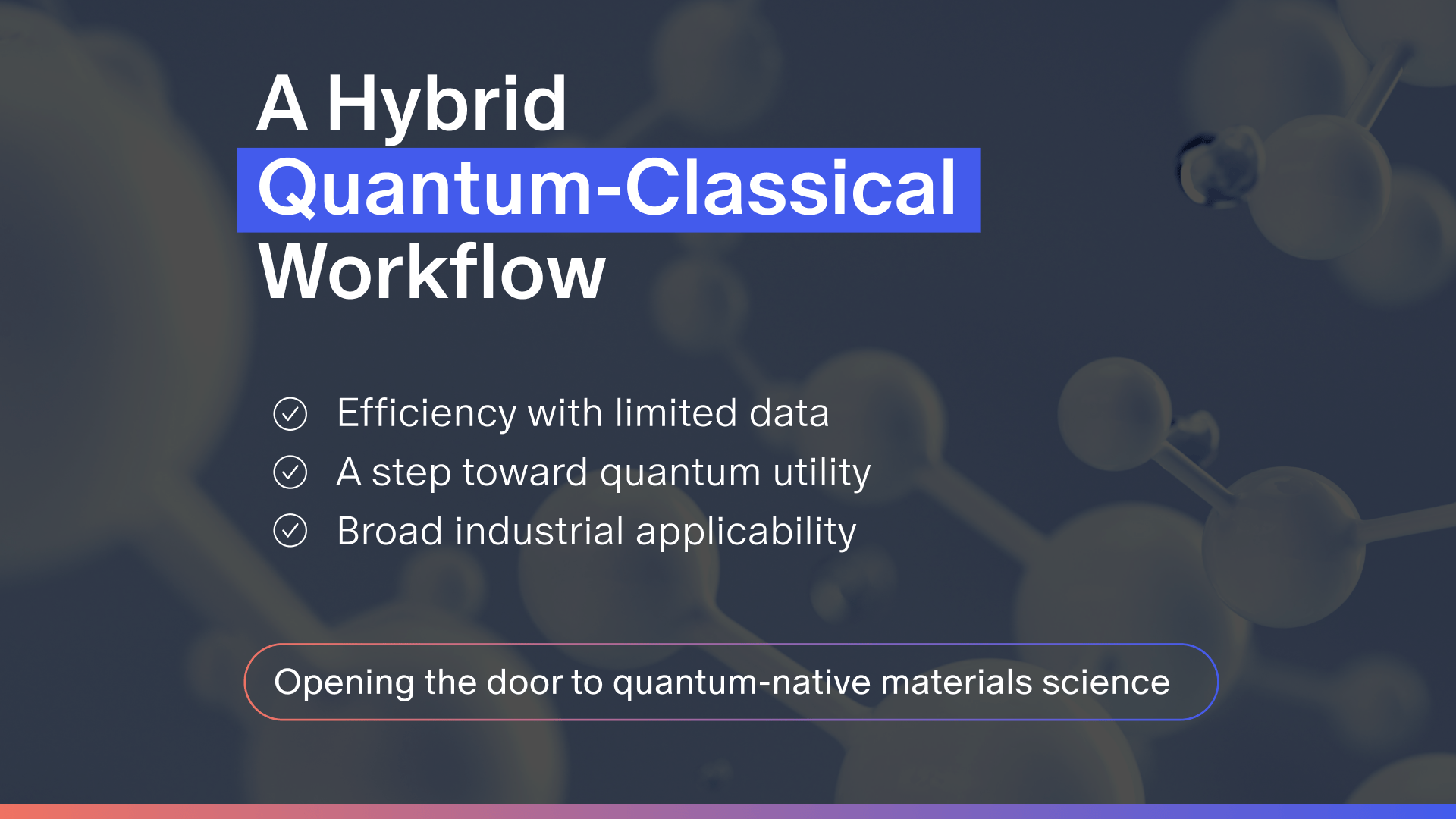
Rather than replacing classical methods, the team implemented a hybrid model combining classical pattern recognition with quantum simulation capabilities.
- A classical neural network encodes polymer data into a compact representation.
- The representation is fed into a quantum classifier running on Quandela’s Ascella photonic quantum processor (QPU), which outputs polymer thermal behavior predictions.
The chosen algorithm, a data re-uploading classifier, is optimized for current hardware: faster runtimes make it practical to run today’s photonic QPUs.
Why photonic QPUs?
Quandela’s QPU uses photons instead of electrons, atoms, ions etc, offering stability and scalability advantages critical for industrial deployment.
“Technology is an enabler, not an end in itself. Quantum computing carries tremendous potential, but what gives it direction is collaboration with industrial partners. Working with organisations like TotalEnergies, MBDA, and Alysophil allows us to ground that potential in real problems — and start building the tools of tomorrow, now.”
– Arno Ricou, Algorithms & Applications Team Lead, Quandela
Real-world tests implying photonic hardware
The team conducted five experiments on the Ascella processor, navigating hardware noise, limited QPU access, and cloud constraints. The results were encouraging:
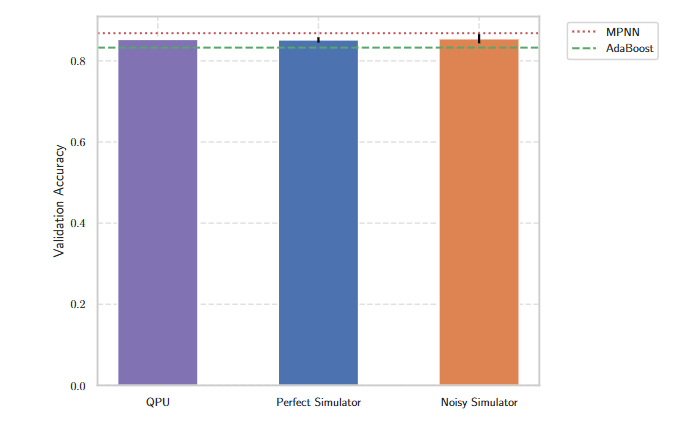
- Competitive performance: Hybrid model achieved 84–85% accuracy, on par with leading classical methods (MPNN) and better than AdaBoost.
- Robust to noise: Real QPU performance closely matched noise-free simulations, demonstrating practical reliability.
- Reproducibility: All five runs produced stable results, indicating the approach is consistent, not a one-off success.
Summary of results:
- ~84–85% classification accuracy on polymer thermal behaviour
- QPU performance on par with noise-free simulation results
- Stable results across five independent hardware runs
- Competitive with classical state-of-the-art (MPNN)
“The collaboration with Alysophil, Quandela and MBDA has been highly engaging and technically insightful, on a complex algorithmic topic combining quantum machine learning and materials science. The close, hands-on collaboration enabled TotalEnergies to identify key R&D questions to be addressed in progressing towards quantum advantage in practical machine learning applications.”
– Jérémie Messud, Quantum Computing Project Leader and Jean-Patrick Mascomere, Research & Capability Manager, TotalEnergies
Why this matters for industry
Efficiency with limited data:
Quantum-enhanced approaches can deliver reliable predictions even when experimental datasets are small—a key advantage in industrial R&D where thousands of lab experiments aren’t feasible.
A step toward quantum utility:
Executing real materials classification on photonic hardware, with results matching simulation, marks an important milestone from theory to practice.
Broad industrial applicability:
The same hybrid framework can be extended to:
- Energy: sustainable polymer design
- Defense: lightweight, heat-resistant materials
- Pharma and cosmetics: molecules with scarce experimental data
- Tires, sealing, structural materials: mechanical and thermal stress modeling
The project also explored using quantum data representations (molecular wavefunctions) as richer inputs for learning models, and investigated quantum sensing to improve experimental data quality. These approaches pave the way toward a fully quantum-integrated pipeline for material and molecular discovery.
“MBDA is proud to take part in this pioneering project. Collaborating with leading experts from Alysophil, Quandela and TotalEnergies allowed us to push the boundaries of innovation at the intersection of AI, chemistry, and quantum computing. This initiative reflects our commitment to leveraging breakthrough technologies to address complex scientific challenges and shape future defense capabilities.”
– Denis Gardin, Director of Innovation and Future Technologies, MBDA
Opening the door to quantum-native materials science
Beyond classifying polymer thermal stability, the team explored more advanced directions that hint at the future of materials science. One avenue is quantum data representations: instead of relying solely on classical molecular descriptors, molecular wavefunctions derived from quantum chemistry calculations were used as inputs to quantum learning models. Early results suggest that these quantum-enriched representations contain signals that correlate with polymer properties like thermal stability, offering richer information for predictive modeling.
“PolyT is meaningful because it combines quantum-enhanced modelling, machine learning, and deep chemistry knowledge on a real problem. This precisely aligns with Alysophil’s mission, and our collaboration with TotalEnergies, MBDA, and Quandela showcases the innovative potential of that synergy.”
– Bogdan Penkovsky, R&D Director, Alysophil
Another area is quantum sensing, which may provide quantum data as input to quantum machine learning processes, potentially reducing or bypassing the classical-to-quantum encoding step in some applications.
Together, these explorations support a long-term vision of a fully quantum pipeline for materials design, where data acquisition, molecular representation, and predictive modeling operate within a unified quantum framework.
Looking ahead
Phase 1b establishes a solid technical foundation and provides important lessons about deploying quantum algorithms on real industrial hardware. As photonic quantum processors continue to improve in performance and scale, the advantages of quantum approaches are expected to become more pronounced — particularly for larger, more complex polymer systems where classical methods face their hardest limits.
The PolyT collaboration demonstrates what becomes possible when quantum hardware, AI chemistry expertise, and industrial application knowledge converge around a shared scientific challenge. The results achieved here are an early but meaningful step toward quantum tools that can support real materials design decisions or performance evaluation.