Newsroom / Press release

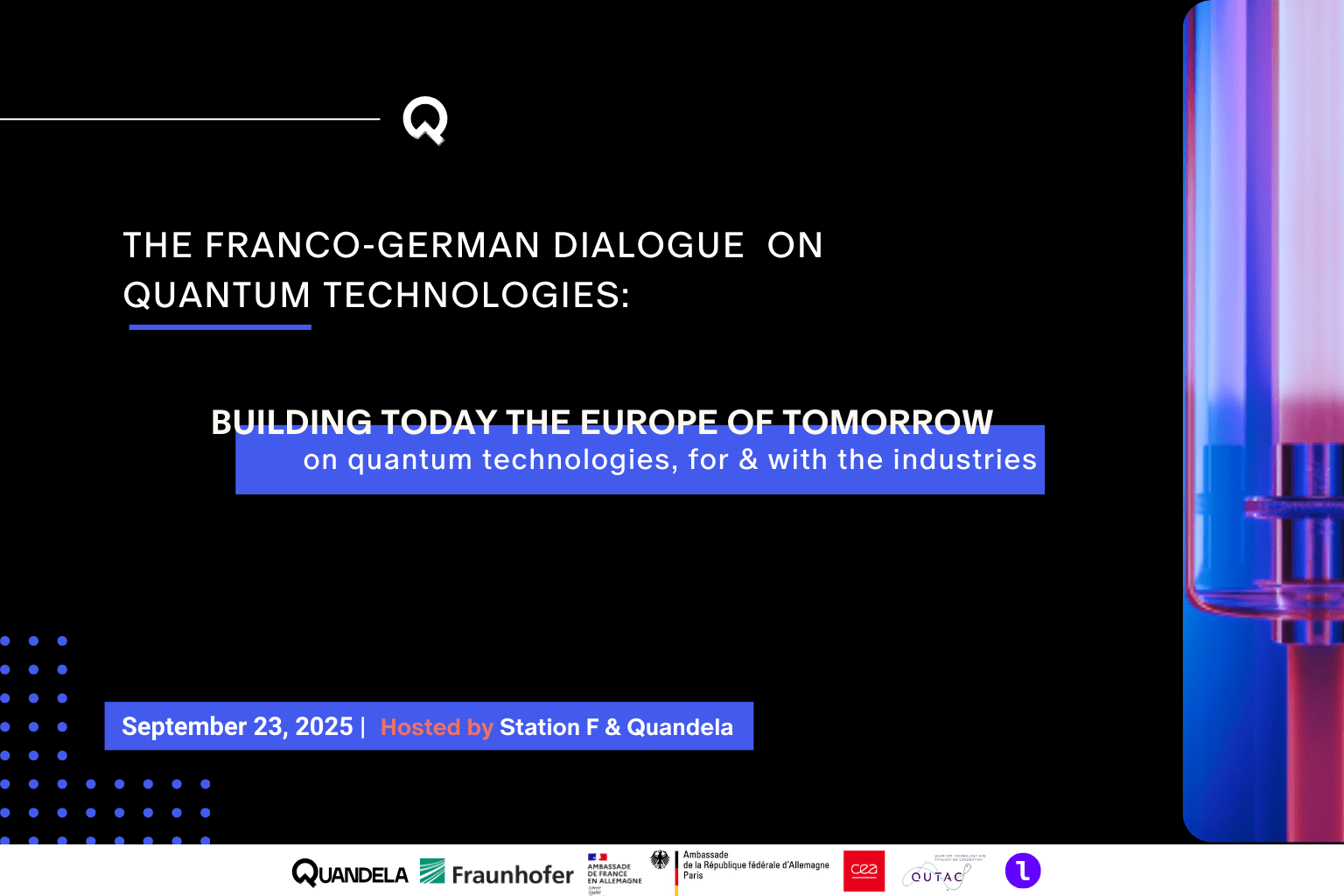
The Franco-German Dialogue on Quantum Technologies: building today the Europe of tomorrow on quantum technologies, for and with the industries

Paris, September 18, 2025 – France and Germany are organising a Franco-German Dialogue in Paris and Massy on Tuesday September, 23, a closed-door meeting bringing together representatives from the entire […]

Paris, September 18, 2025 – France and Germany are organising a Franco-German Dialogue in Paris and Massy on Tuesday September, 23, a closed-door meeting bringing together representatives from the entire spectrum of quantum players in France and Germany, with the aim of strengthening cooperation among both ecosystems. The discussion among representatives from major French and German industries, startups, research organisations, High Performance Computing (HPC) centres, and public bodies is taking place in emblematic locations of the quantum deep-tech innovation: at Station F, one of the main hubs of innovation in Paris and at the site of Quandela, a pioneering quantum computing company, in Massy.

France and Germany together for the European quantum technology

The Franco-German Dialogue is part of a broader dynamic of European acceleration regarding the adoption of quantum technologies by our industries.

By bringing together the French and German quantum ecosystems for a day, this initiative will help to forge a common approach and nurture the “Franco-German momentum” to a technology that is now a major cornerstone for Europe’s competitiveness and sovereignty.

Last year, the French Embassy in Germany gathered the French and the German quantum ecosystem on the 15th of November in Berlin for the first Franco-German Quantum Dialogue – with a view to explore how to tap into the full potential of French-German synergies for Europe’s technological sovereignty on quantum.

This ambition to move forward a Franco-German economic agenda paying attention to quantum technologies was reaffirmed in Toulon (France) on August 29, at the Franco-German Council of Ministers headed by President Macron and Chancellor Merz. There, both countries committed to “bringing together and scaling-up the quantum computing ecosystems in Germany, France and the EU”.

Taking place less than a month after this commitment, the Franco-German Dialogue happening in Paris and Massy on September 23 is a direct implementation of this intention. By gathering representatives from leading French and German industries, quantum startups, research, important infrastructures and public bodies, this Dialogue will help to identify relevant synergies and stimulate the intensification of cross-border cooperation, on which a broader European approach will be built.

With 2025 proclaimed by the UN the “International Year of Quantum Science and Technology,” the Franco-German Dialogue is an important step in highlighting current and future sector-needs, as well as in raising awareness among French and German decision-makers of the growing role of quantum technology as a driver of technological competitiveness and sovereignty in Europe. France and Germany unveiled national quantum strategies with ambitious roadmaps for the coming years, each with a clear commitment to close cooperation with European partners.

A multi-stakeholder approach focused on industries and the quantum end-users of tomorrow

Besides, this meeting also stands out by its unique format. For the first time, it is jointly organised by French and German leading players: CEA (the French Alternative Energies and Atomic Energy Commission), Fraunhofer, Le Lab Quantique, Quandela, the industrial consortium QUTAC, with the support from the two embassies.

In addition, so as to be as close as possible to where deep-tech innovation is taking place and steered, it is being hosted at Station F, one of the main hubs of innovation in Paris and at the site of Quandela, a pioneering quantum computing company, in Massy.

Along a multi-stakeholder approach, discussions in the morning will focus on the needs and expectations of French and German quantum players and on how best anticipate the ecosystem’s prospects over the next years, with a particular attention paid to facilitating the conditions for the adoption of quantum solutions by the French and German industry. The needs of the end-users, such as High-Performance Computing infrastructures and major industry players, will be particularly addressed.

Moreover, in the afternoon, a tour of the quantum computer production facility of the French company Quandela, followed by two round tables – devoted to industrial prospects on the one hand and to the building of an integrated European High Performance Computing-quantum infrastructure for research and industry on the other hand – should stimulate further the reflections on the possible synergies enabling to support Europe’s competitiveness and sovereignty on this critical technology.

“It is a great honour and a privilege for Quandela to host the Franco-German Dialogue on Quantum Technologies. Europe is among the frontrunners in the global quantum computing race, and both France and Germany have a driving role to play in consolidating and strengthening this leadership. Such an initiative brings together stakeholders who share the same ambitions, but who do not always have the opportunity to meet, exchange, confront their commonalities, or learn from their differences. I am convinced that this dialogue will foster new synergies and complementarities, in support of a quantum industry and ecosystem that is not only Franco-German, but also European, stronger and bolder”, said Dr. Niccolo Somaschi, co-founder and CEO of Quandela.

Representative of QUTAC Dr. Reinhard Ploss, highlighted: “QUTAC, as the voice of Germany’s application-driven quantum industry, strongly supports the establishment of a European quantum ecosystem to strengthen Europe’s digital sovereignty. The Franco-German engine is a driving force, and this dialogue between quantum stakeholders is just the beginning of creating significant value for Europe.”

“At Le Lab Quantique, we firmly believe that our two ecosystems must be both independent and closely linked. This is vital for the success of Europe’s quantum ambitions, just as it has been vital for Europe’s greatest successes. In order to ensure the success of the Quantum Flagship, it is our objective to dedicate all the necessary resources to fostering collaboration. This may be achieved through the establishment of academic/industrial research chairs, joint laboratories or any other collaborative initiative.”, emphasized Joseph Mikael, President of Le Lab Quantique.

“While quantum technologies are among the common priorities that were reaffirmed at the Franco-German Ministerial Council on August 29, 2025, I am delighted that the French and German ecosystems are coming together for the second consecutive year for the Franco-German Quantum Dialogue. The aim now is to step up our efforts and work together to develop industrial use cases in quantum computing.”, said French Ambassador to Germany, H.E. Francois Delattre

For German Ambassador to France, H. E. Stefan Steinlein: “Becoming a global pioneer in key technologies can only be achieved at the European level. Part of the large economic agenda adopted at the Franco-German Council of Ministers in Toulon is the agreement to deepen cooperation in the field of cutting-edge technologies, especially on pursuing and supporting initiatives in the field of Quantum technologies. We have what it takes. Both countries are already at the forefront. But we can do even better.”

To further accelerate a renewed Franco-German momentum on cutting-edge technologies, the Franco-German Dialogue on Quantum Technologies will be followed in the coming weeks by two other notable events: the Quantum Effects Fair – the second biggest technology fair dedicated to quantum technologies in Germany – on October 7 and 8 in Stuttgart, to which France will, for the first time, be guest country, as well as the high-level Franco-German Summit on Digital Sovereignty taking place in Berlin on November 18, during which accelerating the development of quantum computing in Europe could  also be discussed.

About Le Lab Quantique

Le Lab Quantique is a non-profit organisation whose mission is to promote quantum technologies in France and internationally. In order to foster synergies between public and academic players, large corporations, and start-ups, Le Lab Quantique organises events (workshops, hackathons, scientific and artistic exhibitions) bringing together all players in the ecosystem. It produces content to promote quantum technologies and help identify use cases, coordinates funding initiatives at the regional and national levels, and supports workforce development by connecting innovation and talent. The association’s board is composed of members from QCWare, Pasqal, Quantinuum, Quantonation, BMW Group, and QuantX. The association has also received support from leading French manufacturers and public institutions such as BPI.

About the CEA

The French Alternative Energies and Atomic Energy Commission (CEA) is a major research organization working in the best interests of the French State, its economy and citizens. Thanks to its strong roots in fundamental research, it is able to provide tangible solutions to meet their needs in four key fields: Low-carbon energy (nuclear and renewable), Digital technology, Technology for medicine of the future, Defense and national security. Three key values guide the work of the CEA and its teams: curiosity, cooperation and awareness of responsibilities. The CEA ranks among the top research organizations in the Top 100 Global Innovators list, according to Clarivate. It is also the leading French research organization in terms of patent filings in Europe, according to the European Patent Office (EPO) 2024.

In the field of quantum technology, the CEA, notably through its Laboratory for Systems and Technologies Integration (CEA List), focuses its research on intelligent digital systems: artificial intelligence, the factory of the future, cyber-physical systems, computing, quantum in particular, and digital health.

About Fraunhofer- Gesellschaft

The Fraunhofer-Gesellschaft, headquartered in Germany, is one of the world’s leading organizations for applied research. It plays a major role in innovation by prioritizing research on cutting-edge technologies and the transfer of results to industry to strengthen Germany’s industrial base and for the benefit of society as a whole. Since its founding as a nonprofit organization in 1949, Fraunhofer has held a unique position in the German research and innovation ecosystem.

With nearly 32,000 employees across 75 institutes and independent research units in Germany, Fraunhofer operates with an annual budget of €3.6 billion, €3.1 billion of which is generated by contract research − Fraunhofer’s core business model. Unlike other public research organizations, base funding from the German federal and state governments is merely the foundation for the annual research budget. This serves as the basis for groundbreaking precompetitive research that will become important for the private sector and society in the years ahead. Fraunhofer’s distinctive feature is its large share of industry revenue, guaranteeing close collaboration with the private sector and industry, and the consistent focus of Fraunhofer’s research on the market. In 2024, industry revenue accounted for €867 million of its budget. Fraunhofer’s research portfolio is augmented by competitively acquired public-sector funding, pursuing the right balance between public-sector and industry revenue.

About QUTAC

The Quantum Technology and Application Consortium (QUTAC) is a consortium that brings together some of Germany’s leading economic and industrial players to advance quantum computing to the level of large-scale industrial applications. QUTAC members include Airbus, BASF, BMW Group, Boehringer Ingelheim, Bosch, Deutsche Telekom, Infineon, Lufthansa Industry Solutions, Merck, Munich Re, SAP, Siemens, TRUMPF, and Volkswagen. Through a series of joint development projects, QUTAC members are making decisive progress towards the first practical applications of quantum computing, both within their own sectors and across sectors. The consortium’s objectives are to identify, develop, test, and share applications for quantum computing and to identify funding needs.

자세히 알아보기

Read more

Quandela Strengthens Leadership and Governance for Its Next Phase of Industrial Scale-Up 

×

Cyril Dujardin joins as Chief Operating Officer, Michel Zecri as VP Industrialization, and Michel Paulin becomes Chairman of the Board as Quandela accelerates the global deployment of photonic quantum computing.

Massy, France — May 29, 2026 — Quandela, a European leader in photonic quantum computing, today announced a major reinforcement of its leadership and governance with the appointment of Cyril Dujardin as Chief Operating Officer and Michel Zecri as Vice President of Industrialization. Michel Paulin, former CEO of OVHcloud, SFR and Neuf Cegetel, becomes Chairman of the Board.

These appointments mark a new stage in Quandela’s development. As quantum computing enters a more execution-driven phase, success will increasingly depend not only on scientific performance, but also on the ability to industrialize complex hardware, structure global operations, secure supply chains, support customer deployments, and build trusted infrastructure at scale.

With Cyril Dujardin, Michel Zecri and Michel Paulin, Quandela is strengthening the operational, industrial and governance foundations required to move from pioneering photonic quantum systems to repeatable, international deployment across cloud platforms, data centers, high-performance computing environments, research institutions and industrial customers.

“Quantum computing is now moving into a phase where execution matters as much as breakthrough science,” said Niccolò Somaschi, co-founder and CEO of Quandela. “Quandela has built a unique position in photonic quantum computing, with systems designed for real-world environments and a clear roadmap toward fault-tolerant quantum computing. The arrival of Cyril and Michel, together with Michel Paulin becoming Chairman of the Board, gives us the operational depth, industrial discipline and governance experience needed for our next chapter of scale.”

Cyril Dujardin (50 years old) brings more than 25 years of executive experience in deeptech, cybersecurity, defense, critical infrastructure and sovereign technologies. He has led large international organizations, managed major P&Ls, and driven complex transformations and integrations, notably at Atos and Eutelsat/OneWeb. As COO, he will lead Quandela’s global operations and support the company’s execution across product, R&D, go-to-market, partnerships and customer delivery. 

“Quandela is at a pivotal moment: exceptional technology must now be matched by an equally robust operating model,” said Cyril Dujardin, Chief Operating Officer of Quandela. “My focus will be to help the company scale with clarity, speed and reliability, aligning research, product, business execution and customer deployment so that Quandela can serve industrial, institutional and international markets at the highest level.”

Michel Zecri (54 years old) joins Quandela with more than 20 years of industrial leadership experience across high-tech environments, including semiconductors, infrared technologies, aerospace and defense. He has held senior operations and general management roles at Freescale/Motorola Sofradir/Lynred and Rakon, leading multi-site teams and large-scale transformations from R&D to industrial production.

As VP Industrialization, Michel Zecri will lead the scale-up of Quandela’s quantum hardware platforms and components into manufacturable, reliable and cost-optimised products. His scope will include manufacturing operations, industrial processes, supply chain resilience, quality systems, compliance, hardware operations and customer support.

“Scaling quantum hardware requires industrial discipline at every level: design for manufacturability, process control, supplier strategy, quality, reliability and lifecycle support,” said Michel Zecri, VP Industrialization of Quandela. “Quandela’s photonic approach has strong potential for scalable deployment, and I am excited to help turn this technological advantage into a repeatable industrial platform.”

Michel Paulin (65 years old), who joined Quandela’s Board of Directors in 2025, now becomes Chairman of the Board. A recognized leader in the digital industry, he brings extensive experience in cloud, telecoms, sovereign digital infrastructure, international expansion and high-growth technology companies. As Chairman, he will support Quandela’s long-term strategic direction, governance and ecosystem positioning as the company expands its role in the global quantum computing landscape. 

“Quandela brings together world-class science, a pragmatic product roadmap and a strategic European position in one of the defining technologies of the coming decades,” said Michel Paulin, Chairman of the Board of Quandela. “My role as Chairman will be to help the company turn this position into a sustainable international leadership story, with the governance, partnerships and execution standards expected from a global technology champion.”

The leadership reinforcement follows a series of milestones for Quandela, including the expansion of its cloud-accessible quantum computing offering, the deployment of photonic quantum systems in real-world environments, and the development of strategic partnerships across Europe and Asia. Together, these appointments reflect Quandela’s ambition to build not only leading quantum technology, but also the industrial organization capable of delivering it at scale.

About Quandela 

Quandela is a global leader in quantum computing, designing, building, and delivering cutting-edge quantum solutions for research and industry. Its offerings include the most energy-efficient quantum computers for data centers, full-stack quantum computing solutions accessible via the cloud, and algorithm access services for academic and industrial customers. Following a pragmatic, step-by-step roadmap, Quandela has been deploying industrial-grade systems since 2023 while developing future generations of fault-tolerant quantum computers capable of scaling through the integration of thousands of photonic components. Quandela is committed to making quantum computing accessible to all in order to address the most complex industrial and societal challenges. Learn more at https://www.quandela.com/ 

Contact – Media Relations 

Iva Baytcheva, iva.baytcheva@maarc.fr +33(0)6.28.59.07.03 
Charles Courbet, charles.courbet@maarc.fr +33(0)6.28.93.03.06 

Read more

French and German partners strengthen cooperation on quantum technologies

×

Paris – May 12th, 2026 – This evening, over a hundred high-level representatives from French and German industry, policy, start-up and investment sectors will gather for a reception hosted by the German Ambassador to France, His Excellency Mr Stephan Steinlein, with the support of the French Embassy in Germany. This event reflects the growing importance of quantum technologies for Europe’s technological and industrial sovereignty, building on the French-German agenda agreed in August 2025. France and Germany are home to some of the world’s leading players in this field.

At the heart of this dialogue lies a clear ambition: to strengthen ties and coordination between French and German industry, policymaking, funding, innovation and research. By connecting key players across borders and across the value chain, the initiative aims to help Europe accelerate the development and adoption of sovereign, competitive and market-ready quantum technologies.

With the same spirit, on the margins of today’s event, a group of leading industry and research organisations will sign a Joint Declaration of Intent to strengthen cooperation in quantum technologies and support the development of a competitive European quantum ecosystem.

Signed by CEA, Fraunhofer, CNRS, Inria, Le Lab Quantique, Quandela, QUTAC and the European Champions Alliance, this Declaration of Intent solidifies the stakeholders’ commitment to deepening and accelerating exchanges, partnerships and synergies.

Their cooperation will focus on four objectives:

  • the development of use cases for the industry and end-users of quantum technologies;
  • benchmarking and the development of credible and scalable pathways for the adoption of quantum technologies in Europe;
  • the facilitation of multi-stakeholder dialogues among industry, policymaking, funding, innovation and research, with a focus on accelerating deployment;
  • the promotion and dissemination of success stories demonstrating the industrial development and commercial use of quantum technologies.

The signatories also reaffirm their commitment to an open and collaborative approach, inviting additional stakeholders to join and contribute to these efforts.

About CEA

The CEA is a public research organisation whose mission is to contribute to the scientific, technological and industrial sovereignty of France and Europe in four key areas: low-carbon energy, digital technology, future medicine, and defence and security, by drawing on excellence in fundamental research. For more information: www.cea.fr

About CNRS

A major player in basic research worldwide, the National Centre for Scientific Research (CNRS) is the only French organisation active in all scientific fields. Its unique position as a multi-specialist enables it to bring together all of the scientific disciplines in order to shed light on and understand the challenges of today’s world, in connection with public and socio-economic stakeholders. Together, the different sciences contribute to sustainable progress that benefits society as a whole.

About European Champions Alliance

The European Champion Alliance (ECA) promotes European technology, European values and works to strengthen through a conscious business-related interdependence between European companies and all participants of the European economic ecosystem. To achieve this goal, the ECA builds bridges between national ecosystems, SMEs, companies, start-ups and other supporters of the tech ecosystem in Europe. The ECA harnesses the power of smart collaboration and accelerate the growth of Europe’s digital champions.

About Fraunhofer

Fraunhofer-Gesellschaft, headquartered in Germany, is the world’s leading applied research organization. With its focus on developing key technologies that are vital for the future and enabling the commercial exploitation of this work by business and industry, Fraunhofer plays a central role in the innovation process. As a pioneer and catalyst for ground-breaking developments and scientific excellence, Fraunhofer helps shape society now and in the future. Fraunhofer-Gesellschaft currently operates more than 70 institutes and research institutions throughout Germany.

About Inria

Inria, the French national institute for research in digital science and technology, supports the French government in national research and innovation strategies in the digital field, acting as Digital Programs Agency. Inria leads over 300 research and innovation projects with its 3,500 scientists, engineers, and support staff, in partnership with universities and the digital ecosystem (businesses, entrepreneurs, and public stakeholders). Together, we explore strategic fields such as artificial intelligence, cybersecurity, quantum computing, cloud technologies, digital transformation in healthcare, digital twins, and digital technologies for defence. We develop practical solutions such as software, tech startups, partnerships with national companies, and cutting-edge training programmes. Our goal is to drive scientific, technological, and industrial excellence to ensure France’s digital sovereignty.

About Le Lab Quantique

Le Lab Quantique is a French not-for-profit organisation created in 2018 to support the emergence of the global quantum ecosystem, gathering more than 50 members and partners and organising more than 20 workshops per year. Its mission is to foster the emergence of talent capable of addressing the major challenges of quantum physics, while also guiding the development of entrepreneurial and industrial projects towards the market launch of new products and services.

About Quandela

Quandela is a global leader in quantum computing, designing, building, and delivering cutting-edge quantum solutions for research and industry. Its offerings include the most energy-efficient quantum computers for data centers, full-stack quantum computing solutions accessible via the cloud, and algorithm access services for academic and industrial customers. Following a pragmatic, step-by-step roadmap, Quandela has been deploying industrial-grade systems since 2023 while developing future generations of fault-tolerant quantum computers capable of scaling through the integration of thousands of photonic components. Quandela is committed to making quantum computing accessible to all in order to address the most complex industrial and societal challenges. Learn more at: https://www.quandela.com/

About QUTAC

QUTAC (Quantum Technology & Application Consortium) is a consortium of internationally active German companies from various sectors and potential users of quantum computing technology. It intends to promote the politically desired digital sovereignty of Germany and Europe and to establish an economically successful, independent ecosystem of quantum computing technology in Germany and for Europe. To this end, the members of the consortium want to identify, develop, test and make available use cases for quantum computing technology both for their own sectors and across sectors. Learn more at www.qutac.de

Contact- Media Relations

Read more

Quandela and Safran are joining forces to develop quantum algorithms for modelling fluid flows

×

Paris, 7th May 2026 – Quandela and Safran Tech, Safran’s research and technology centre, have announced the launch of the AQeFLU research project. This partnership aims to develop new quantum algorithms dedicated to the complex modelling of fluid flows.

The simulation of airflow around aerodynamic profiles is a key challenge in optimising aircraft performance. At present, such studies rely on large-scale numerical calculations and lengthy, costly wind tunnel tests.

The AQeFLU project explores how quantum approaches can complement conventional methods to:

  • Increase the share of numerical simulation and reduce the need for physical testing
  • Multiply the number of configurations tested during the design phase with greater accuracy
  • Accelerate the development cycles of future engines and energy systems.

This project is supported by the PAQ Quantique programme, funded by the Île-de-France Region. It is based on close collaboration between two leading organisations:

  • Quandela contributes its unique photonic technology, which uses light to process quantum information, as well as its software expertise.
  • Safran Tech contributes its in-depth knowledge of fluid mechanics and “reference computational methods.

Together, the teams will first test the algorithms on standardised academic cases before moving on to advanced industrial applications, particularly in the field of combustion and propulsion systems.

“In the long term, the use of quantum computing could make industrial design phases more efficient, whilst paving the way for tangible advances, such as improved aerodynamic performance and reduced fuel consumption,” explains Frédéric Feyel, Director of the Digital Platform at Safran Tech.

“The coming years will be pivotal for industrial applications using quantum technology. We are delighted with this new partnership with Safran, an industrial group recognised worldwide for its expertise in the fields of aerospace, space and defence. Our collaboration is a further illustration of the interest European manufacturers have in quantum computing,” says Valérian Giesz, co-founder and COO of Quandela.

About Quandela

Quandela develops and deploys photonic quantum computers designed for real-world environments: they operate at room temperature, are compatible with data centre infrastructure, and feature a comprehensive software stack for programming and executing computations, both in the cloud and on-premises. Beyond hardware, Quandela supports businesses, research teams and public institutions in identifying, prototyping and integrating quantum use cases, through pilot projects carried out in partnership, training and technical support. Founded in Europe, Quandela follows a pragmatic and progressive path, ranging from systems already usable today to fault-tolerant quantum computing. Discover their vision at www.quandela.com

About Safran

Safran is an international high-tech group operating in the aerospace (propulsion, equipment and interiors), defence and space markets. Its mission is to contribute to a safer and more sustainable world, in which air travel is more environmentally friendly, more comfortable and more accessible. Safran has a global presence, with 110,000 employees and revenue of €31.3 billion in 2025, and holds, either alone or in partnership, global or regional leadership positions in its main markets. Safran conducts research and development programmes to support the environmental priorities of its R&T and Innovation roadmaps. Safran is listed on the Euronext Paris market and is included in the CAC 40 and Euro Stoxx 50 indices.

Contact- Media Relations