Newsroom / Press release

Quandela, the CNRS, Université Paris-Saclay and Université Paris Cité join forces to accelerate research and innovation in quantum photonics

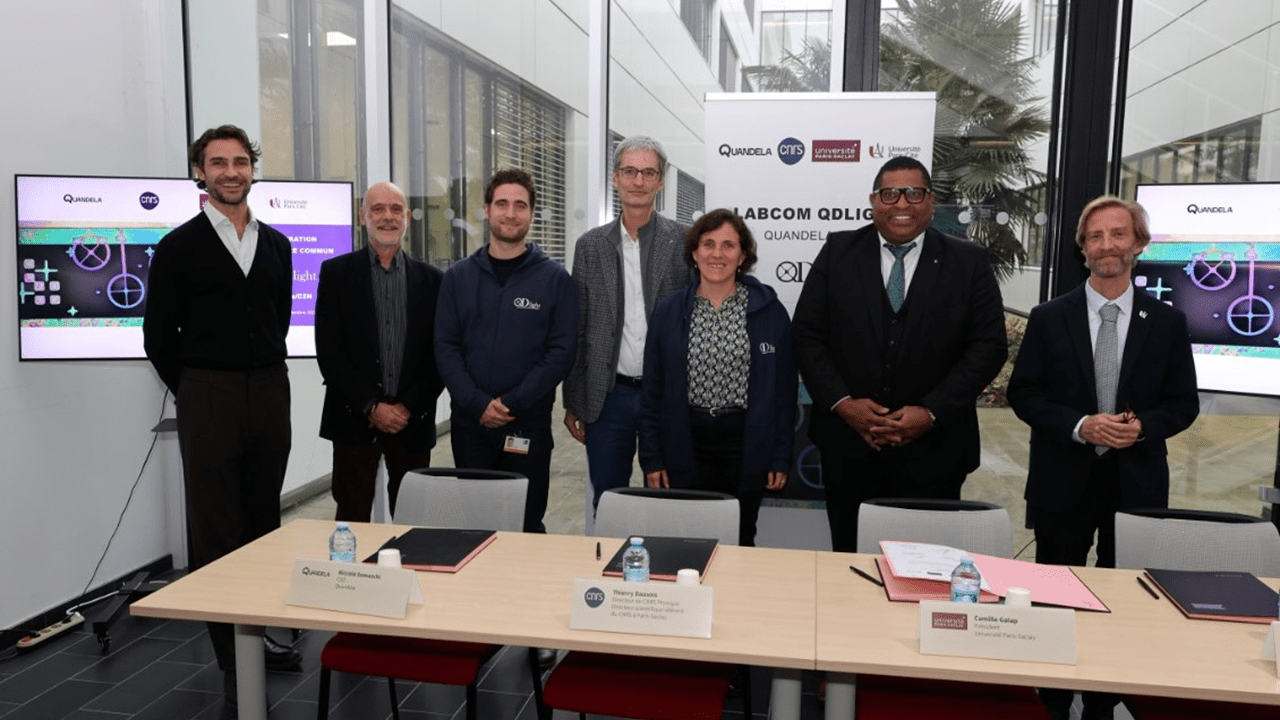
On November 13th 2024, Quandela, the CNRS, Université Paris-Saclay, and Université Paris Cité inaugurated at the Centre for Nanoscience and Nanotechnology (CNRS/Université Paris-Saclay/Université Paric Cité) the QDlight associated research laboratory […]

  • Quantum photonics, or the art of controlling light in the quantum regime, should revolutionise data processing and security, with an impact across a range of industries.
  • Quandela, a European leader company for photonic quantum computing, is combining its know-how with that of the CNRS, Université Paris-Saclay, and Université Paris Cité in order to intensify scientific research and innovation in this field. 
  • The objective is to preserve French sovereignty in the design of photonic quantum computers, namely by increasing their computing power.

On November 13th 2024, Quandela, the CNRS, Université Paris-Saclay, and Université Paris Cité inaugurated at the Centre for Nanoscience and Nanotechnology (CNRS/Université Paris-Saclay/Université Paric Cité) the QDlight associated research laboratory focusing on research in quantum photonics, which is to say the art of controlling light in the quantum regime inside nanoscale devices. Over the course of six years, the teams will expand scientific cooperation with a view to developing next generation quantum light emitters, as well as their applications in quantum information technology to secure unprecedented computing power.

Quantum photonics, or the art of controlling light in the quantum regime

Quantum photonics, which has been developed since the late twentieth century, seeks to take advantage of the specifically quantum properties of light—especially single photons (emitted one by one)—for quantum computing and communications security. This discipline offers one of the most promising avenues for quantum computing (quantum computers and networks), as well as for inviolable key distribution protocols in encryption (quantum cryptography).

Quandela, a leading European company for photonic quantum computing that emerged from the Centre for Nanoscience and Nanotechnology (CNRS/Université Paris-Saclay/Université Paris Cité), has produced and marketed quantum light emitters in Europe since 2017–components that are indispensable to photonic quantum computing technology–and also launched the production of photonic quantum computers in 2023. These emitters, which consist of a quantum dot that behaves like an artificial atom in a semiconductor matrix, can generate a series of on-demand and indistinguishable single photons through a succession of laser pulses concentrating on this artificial atom.

In the optimal resonance and photon extraction conditions provided by the optical cavity in which it is positioned, these quantum dots can generate a photon flux with a rate of a few dozen megahertz, which efficiently implement quantum computing protocols on a photonic chip.

Toward unprecedented computing power and efficiency

This new associated research laboratory aims to develop emitters and protocols to generate new quantum states of light, with a view to creating a fault-tolerant photonic quantum computer1, and to demonstrating quantum communication protocols.

Pour ce faire, les travaux s’inscriront dans deux axes de recherche :

  • The project’s “optical” focus will first develop quantum photonic entanglement protocols,2 in order to create multi-partite entangled photon chains and graphs . These non-classical states of light are central to the “made-to-measure” quantum computing paradigm, which is the most promising framework for creating a universal quantum machine.
  • The “growth” research focus will concentrate on the quality of the quantum-dot-based photonic devices that will be produced within the Labcom. This will notably involve growing materials of very high purity–on which the “quantum purity” of photons depends–as well as increasing the reproducibility of photonic device production.

QDlight, pursuing close public-private research collaboration

This associated research laboratory (Labcom) is in line with the collaboration, since 2017, between Quandela and the research laboratory from which it emerged, the Centre for Nanoscience and Nanotechnology. This collaboration led to numerous interactions between researchers and engineers for basic research on the physics of semiconductor quantum dots, light-matter interaction in solid microcavities, protocols for the generation and measurement of quantum light, and for the first implementation of quantum protocols and computing.

The QDlight Labcom represents the next phase in conserving a global competitive head-start in semiconductor single-photon source technology, in addition to ensuring their constant improvement and using their exceptional properties in research and development activities.

The CNRS is thrilled by the creation of QDlight, which combines the excellence of teams from the C2N laboratory with the Quandela company, a European leader in photonic quantum computing that emerged from the academic world, and doubly contributes to positioning French public research in quantum technology at the highest global level”, explains Antoine Petit, the CNRS Chairman and CEO.

This research aims to preserve our global technological leadership in quantum photonics”, indicates Quandela co-founder and CEO Niccolo Somaschi.

It is a great pleasure to be here at C2N, a leading site for French research in nanoscience and nanotechnology, in order to inaugurate this new Labcom, a symbol of successful synergy between national research organisations, universities, and deeptech enterprises. It will combine high-level academic and technological expertise in order to overcome scientific and technological obstacles in this crucial field of quantum photonics, all while contributing to the training of students and young researchers”, says Camille Galap, the President of Université Paris-Saclay.

Université Paris Cité is proud to have contributed to the creation of this joint laboratory, which illustrates the capacity for collaboration between universities, NROs and the private sector. It is essential to combine our strengths and expertise for the benefit of research and innovation, particularly in a field as strategic as quantum technology”, explains Édouard Kaminski, President of Université Paris Cité.

“ We are proud of the creation of this associated research laboratory, which gives concrete form to years of a trusting relationship, and will help us support efforts to strengthen Quandela’s knowledge and expertise in quantum photonics alongside our partners”, emphasises Thierry Dauxois, Director of CNRS Physique.

ABOUT THE CNRS

A major player in basic research worldwide, the National Centre for Scientific Research (CNRS) is the only French organisation active in all scientific fields. Its unique position as a multi-specialist enables it to bring together all of the scientific disciplines in order to shed light on and understand the challenges of today’s world, in connection with public and socio-economic stakeholders. Together, the different sciences contribute to sustainable progress that benefits society as a whole. (www.cnrs.fr/en)

ABOUT UNIVERSITÉ PARIS-SACLAY

Université Paris-Saclay was born from the shared ambition of French universities, grandes écoles and national research organisations. As a leading university in Europe and the world, it covers the fields of science and engineering, life sciences and health, and humanities and social sciences. The university’s science policy closely intertwines research and innovation, incorporating both basic and applied science to tackle major societal challenges. Université Paris-Saclay offers a varied range of undergraduate to doctorate level degrees, including programmes with its grandes écoles, all of which are focused on achieving student success and employability. The university prepares students for an ever-changing world where the ability to think critically, remain agile and renew one’s skills are crucial. Université Paris-Saclay also offers a comprehensive range of lifelong learning courses. Located to the south of Paris, the university extends across a vast and rich local area. Its location strengthens both its international visibility and its close ties with its socio-economic partners (major companies, SMEs, start-ups, local authorities, charities). (www.universite-paris-saclay.fr/en/)

ABOUT UNIVERSITE PARIS CITÉ

At the heart of a global network of knowledge and innovation, Université Paris Cité is one of France’s leading multidisciplinary universities. Born in 2019 from the merger of the universities of Paris Diderot, Paris Descartes and Institut de physique du globe de Paris, the ambition of Université Paris Cité is to lead and develop an exceptional potential to meet the challenges of tomorrow’s society. It covers a wide range of disciplines, with one of the most comprehensive and ambitious educational offerings available in the world. Université Paris Cité is part of the incarnation of a world city, aware of its place and missions, open to youth and knowledge. It has 63,000 students, 7,500 teaching and research staff, 21 doctoral schools and 117 research units. u-paris.fr (u-paris.fr/en)
자세히 알아보기

Read more

Quandela Validates Low-Latency Photonic QPU Integration with NVIDIA Accelerated Computing​

×

Hamburg, Germany – June 23, 2026 – Quandela today announced that it has experimentally validated a low-latency integration path between photonic quantum processors and NVIDIA ​AI​​ infrastructure, marking an important milestone toward bringing quantum processing units directly into high-performance computing environments. Results presented at ISC 2026 demonstrate a path toward accelerator-style integration of photonic quantum processors in GPU-driven HPC environments.

The results show how a Quandela photonic QPU can be integrated with an NVIDIA GPU host and an FPGA-based Quantum System Controller through ​​NVIDIA NVQLink. More than a simple interconnect, NVQLink provides a hardware-and-software architecture for low-latency, real-time communication between GPU supercomputing infrastructure ​and quantum system controllers. The validation supports a new execution model for hybrid quantum-classical computing: moving beyond remote quantum access toward collocated quantum acceleration inside HPC infrastructure.

Today, most quantum processors are accessed through cloud APIs, job queues and orchestration layers. This approach remains valuable for experimentation and batch execution, but its asynchronous nature introduces latency that limits workflows requiring real-time responses inside AI or HPC pipelines.

Quandela’s results address this bottleneck. By measuring low-latency communication between GPU infrastructure and the FPGA-based Quantum System Controller, the company has validated a practical route for photonic QPUs to participate more directly in GPU-driven workloads.

“This is not just a demonstration of connectivity,” said Jean Senellart, Chief Technology & Product Officer at Quandela. “This validation confirms a technical path toward integrating photonic QPUs into the HPC accelerator stack. For the HPC community, the important shift is that quantum processors can start to be treated less like remote experimental instruments and more like accelerators deployed alongside GPUs.”

The validation is based on a collocated architecture combining NVIDIA accelerated computing and networking ​with an FPGA-based Quantum System Controller connected to a Quandela photonic QPU. In this model, existing HPC schedulers remain responsible for reservation, allocation and accounting, while the active GPU–QPU session is designed to avoid repeated traversal of the full cloud-style orchestration path.

The first target workloads are in photonic Quantum Machine Learning, including quantum reservoir computing, quantum feature maps and hybrid neural-network architectures. These workloads are particularly well suited to the architecture because many photonic circuits can remain configured during inference, while new data points require only lightweight updates before measurement.

This is where photonics offers a distinctive advantage. For selected QML workloads, the same optical configuration can be reused across many inference calls, while new data points require only lightweight updates before measurement. Combined with fast photonic sampling, this makes system-level latency – not only quantum execution time – a decisive factor in performance, which is why​ the low-latency interaction model enabled by NVQLink is​ crucial for successful operation​.

Quandela’s MerLin framework provides the software environment used to design, simulate, benchmark and validate these hybrid photonic QML workflows. The work also builds on Quandela’s MosaiQ photonic quantum computing platform, whose current systems are designed with FPGA-based control capabilities aligned with the Quantum System Controller model defined by NVIDIA​ ​NVQLink.

​For HPC centers, sovereign AI and quantum programs, advanced research organizations and industrial users, the validation points toward a future deployment model in which a customer-owned photonic QPU could be installed on-premise or in a dedicated data center environment and connected to NVIDIA accelerated computing infrastructure​.​

“​Tightly integrating quantum systems with accelerated computing is proving hugely impactful for quantum research,” said Sam Stanwyck, Director of Quantum Product at NVIDIA. “Quandela’s work with NVQLink shows how quantum-GPU supercomputing systems will fundamentally transform how we are able to think about computing applications when information can be passed seamlessly between different processors.”​

This announcement marks a technical validation milestone toward low-latency GPU–QPU integration, paving the way for future NVQLink-enabled MosaiQ deployments.

Beyond near-term hybrid AI and QML workloads, the same integration principles are relevant to future quantum computing architectures, where QPUs, FPGA-based control systems and GPU-accelerated infrastructure will need to operate in tightly coordinated environments. Low-latency GPU–QPU integration is therefore both a near-term enabler and a foundation for future hybrid quantum-classical computing systems.

Quandela will present these results at ISC High Performance 2026 in Hamburg on 23 June 2026.

About Quandela

Quandela is a global leader in quantum computing, designing, building, and delivering cutting-edge quantum solutions for research and industry. Its offerings include the most energy-efficient quantum computers for data centers, full-stack quantum computing solutions accessible via the cloud, and algorithm access services for academic and industrial customers. Following a pragmatic, step-by-step roadmap, Quandela has been deploying industrial-grade systems since 2023 while developing future generations of fault-tolerant quantum computers capable of scaling through the integration of thousands of photonic components. Quandela is committed to making quantum computing accessible to all in order to address the most complex industrial and societal challenges.

Learn more at: Quandela | Leading Photonic Quantum Computing Solutions

Media Relations

Maarc PR agency

Read more

Quandela and Qatar’s Mekdam Holding Group Partner to Accelerate the Deployment of Quantum Computing Across the Gulf Region

×

Paris, June 18th, 2026 – Signed this Thursday during Vision Golfe – the Franco-Gulf economic forum organized by Business France under the high patronage of the French President, at the Ministry for the Economy, Finance and Industrial and Digital Sovereignty – this partnership marks Mekdam’s entry into quantum computing and strengthens Quandela’s presence in Qatar and strategic Middle Eastern markets.

Quandela, a European leader in photonic quantum computing, and Mekdam Holding Group (QSE: MKDM), a Qatari technology group listed on the Qatar Stock Exchange, signed a Memorandum of Understanding (MoU) this Thursday at the French Ministry for the Economy, Finance and Industrial and Digital Sovereignty, as part of Vision Golfe. The agreement aims to explore and deploy quantum computing solutions for Gulf markets, positioning both partners among the first organizations to introduce this technology to the region.

This partnership is fully aligned with Qatar National Vision 2030 and the major national strategies for digital sovereignty and artificial intelligence being implemented across Gulf countries.

From left to right: Bara’ Sami, General Group Manager of Mekdam Holding Group, and Xavier Pereira, Chief Growth Officer at Quandela, during the signing ceremony held this Thursday at the French Ministry of the Economy.

Complementary Expertise for a Strategic Market

Mekdam Holding Group, the first publicly listed technology group in Qatar, has demonstrated sustained growth, with revenues reaching QAR 681.1 million (approximately €161 million), an increase of more than 20% in 2025, and an order backlog of QAR 3.1 billion (€734 million). Active in artificial intelligence, cloud computing, cybersecurity, IoT, data infrastructure and smart systems, the Group has identified quantum computing as a strategic pillar of its development in emerging technologies.

Quandela brings world-class expertise in photonic quantum computing, fault-tolerant quantum computing (FTQC), and quantum machine learning (QML).

Together, the two partners intend to identify and develop high-value use cases for the region’s priority sectors: energy, government, critical infrastructure, healthcare, and education.

Toward a Regional Quantum Ecosystem

Beyond immediate applications, the partnership aims to build a sustainable ecosystem through cloud access to Quandela’s photonic quantum computers, local skills development, training and certification programs, and the creation of a Quandela–Mekdam Quantum Center of Excellence serving countries of the Gulf Cooperation Council (GCC).

This ambition aligns with various government-led initiatives across the region, including Qatar National Vision 2030, Saudi Vision 2030, and the UAE National Quantum Strategy.

“Based in Doha and a leading technology player in the Middle East, Mekdam enables us to accelerate our development in a dynamic, innovative, and strategically important region for the future of quantum computing. It is a strong asset in supporting Quandela’s global ambitions,” says Xavier Pereira, Chief Growth Officer at Quandela.

“This partnership marks Mekdam’s entry into quantum computing and reflects our ambition to become a leading player in the field across the region. Together with Quandela, we aim to deliver high-value use cases for the Gulf’s strategic sectors and build a strong local skills ecosystem, fully aligned with Qatar National Vision 2030,” says Bara’ Sami, General Group Manager of Mekdam Holding Group.

About Quandela 

Quandela is a global leader in quantum computing, designing, building, and delivering cutting-edge quantum solutions for research and industry. Its offerings include the most energy-efficient quantum computers for data centers, full-stack quantum computing solutions accessible via the cloud, and algorithm access services for academic and industrial customers. Following a pragmatic, step-by-step roadmap, Quandela has been deploying industrial-grade systems since 2023 while developing future generations of fault-tolerant quantum computers capable of scaling through the integration of thousands of photonic components. Quandela is committed to making quantum computing accessible to all in order to address the most complex industrial and societal challenges.
Learn more at www.quandela.com

About Mekdam Holding Group (Q.P.S.C.)

Mekdam Holding Group Q.P.S.C. (QSE: MKDM) is a publicly listed Qatari technology and services group headquartered in Doha, and a pioneer among Qatari technology companies listed on the Qatar Stock Exchange. Founded in 2018, Mekdam has grown into one of Qatar’s leading technology groups, delivering 21.9% year-on-year revenue growth in FY2025, with contracts under execution valued at QAR 3.1 billion.

Through its specialized subsidiaries — Mekdam Technology, Mekdam Software Services, Mekdam Technology Solutions, Mekdam Technical Services, and Mekdam CAMS — the Group delivers across artificial intelligence (AI), cloud, cybersecurity, IoT, ICT, data-center, smart infrastructure, and security systems. Mekdam serves clients across government, energy, ICT and critical infrastructure, healthcare, and education, supporting large-scale digital transformation. The Group is now extending its capability beyond Qatar, scaling its technology and emerging-technology businesses across the wider Gulf.

Aligned with Qatar National Vision 2030, Mekdam has identified quantum computing as a strategic capability pillar — already part of its emerging-technology portfolio. This partnership with Quandela advances that commitment from foundational capability to active execution, positioning Mekdam among the region’s first movers in bringing quantum technology to market.

Headquarters: Doha, Qatar
Founded: 2018
Stock Exchange: Qatar Stock Exchange (QSE: MKDM)
Core Activities: Artificial Intelligence (AI), Cloud, Cybersecurity, IoT, ICT, Data-Center, Smart Infrastructure, and Security Systems.

Media Relations

Maarc PR agency

Read more

DARPA Selects Quandela for Stage A of the Quantum Benchmarking Initiative

×

Quandela’s spin-photon quantum computing architecture advances into DARPA program evaluating utility-scale, fault-tolerant quantum systems

WASHINGTON, D.C., June 16, 2026 — Quandela today announced it has been selected by the U.S. Defense Advanced Research Projects Agency (DARPA) to participate in Stage A of the Quantum Benchmarking Initiative, a multi-stage program designed to assess whether any quantum computing architecture can achieve utility-scale operation by 2033.

Under Stage A, Quandela will present a detailed concept for a utility-scale, fault-tolerant quantum computer, along with technical evidence supporting its near-term feasibility. Within DARPA’s framework, utility-scale refers to systems whose computational value exceeds their cost.
The QBI program is intended to rigorously evaluate approaches to practical quantum computing and provide government with a clearer basis for assessing which technologies can realistically scale.

“Selection for Stage A of the QBI program reflects the progress and maturity of our approach,” said Yoni Elmalem, General Manager of Quandela Federal. “It highlights the growing relevance of photonic and spin-photon hybrid architectures in addressing the requirements for scalable, fault-tolerant quantum systems. Our focus is on translating validated scientific principles into engineering pathways that can support practical deployment.”

Quandela is developing a spin-photon quantum computing architecture that combines the natural connectivity and modularity advantages of photons with the high-speed logic operations and resource efficiency of semiconductor spin-based technologies. The company believes this approach can enable modular, high-performance quantum systems designed for scalability.

“QBI establishes a structured framework for evaluating quantum computing approaches against clear performance and scalability criteria,” said Niccolo Somaschi, CEO of Quandela. “This aligns closely with our engineering methodology, which emphasizes measurable progress, architectural clarity and system-level scalability from the outset.”

Companies that successfully complete Stage A may advance to subsequent QBI phases focused on research and development planning, risk reduction, and independent validation of system performance.

About Quandela

Quandela is a global quantum computing company that designs, builds and delivers quantum solutions for research and industry. Its offerings include energy-efficient quantum computers for data centers, full-stack quantum computing solutions accessible through the cloud, and quantum algorithm services for academic and industrial customers. Quandela’s mission is to make quantum computing accessible in order to address complex industrial and societal challenges.

For more information, visit: www.quandela.com

Media Relations