Newsroom / Press release

Quandela livre Lucy, l’ordinateur quantique photonique le plus avancé au monde, à EuroHPC et GENCI au TGCC du CEA

Paris, France – 23 octobre – Quandela, GENCI et le CEA annoncent la livraison de Lucy, un ordinateur quantique photonique universel de 12 qubits, au Très Grand Centre de calcul […]

Paris, France – 23 octobre – Quandela, GENCI et le CEA annoncent la livraison de Lucy, un ordinateur quantique photonique universel de 12 qubits, au Très Grand Centre de calcul (TGCC) du CEA. Le système, livré par le consortium franco-allemand Quandela – attocube systems AG, a été acquis par l’entreprise commune EuroHPC dans le cadre du consortium EuroQCS-France.

Une nouvelle capacité quantique européenne

Lucy, l’ordinateur quantique photonique le plus puissant jamais déployé dans un centre de calcul européen, vient d’être installé au TGCC. Doté de 12 qubits photoniques, il offre aux chercheurs et aux industriels une plateforme inédite pour tester des algorithmes quantiques, explorer des workflows hybrides HPC–quantique et développer des applications de première phase en optimisation, chimie et machine learning.

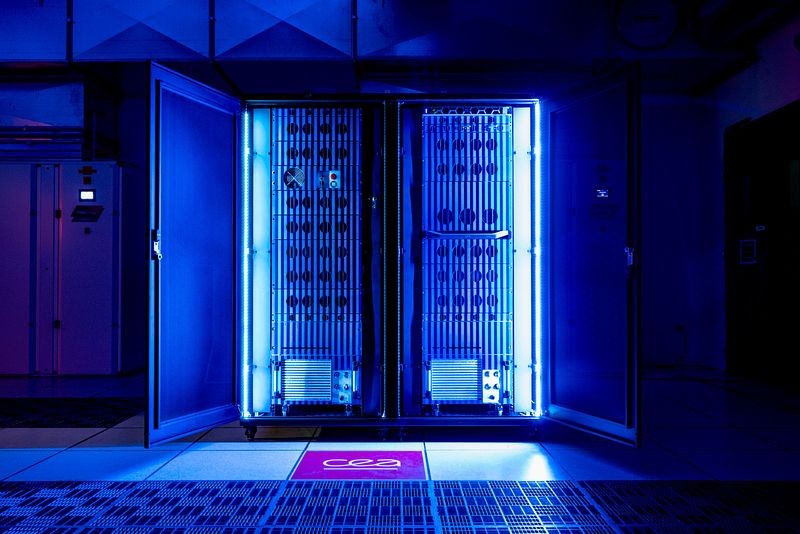
Lucy est fortement orienté vers les usages. Hébergé et opéré au TGCC du CEA, où il est couplé au supercalculateur Joliot-Curie, il sera accessible à une large communauté d’utilisateurs européens. Les premiers cas d’usage couvrent notamment l’optimisation des réseaux énergétiques et l’intégration des énergies renouvelables, l’optimisation de portefeuilles financiers et la modélisation des risques, la logistique et les chaînes d’approvisionnement, ainsi que la conception aéronautique, les matériaux et l’optimisation de trajectoires.

Ces cas d’usage renforcent la position de l’Europe à la pointe de la recherche quantique, tout en préparant les acteurs industriels aux futures applications.

Un ordinateur quantique fabriqué dans l’Union européenne

Lucy a été acquis par EuroHPC dans le cadre du consortium EuroQCS-France.[1] S’appuyant sur les déploiements réalisés chez OVHcloud en 2023 et dans les datacenters d’Exaion au Canada en 2024, il marque une nouvelle étape du développement du quantique en Europe.

Assemblé en douze mois dans les installations de Quandela, le système illustre la solidité de la collaboration européenne : modules cryogéniques conçus par attocube systems AG près de Munich, dispositifs quantiques fabriqués dans la ligne pilote semi-conducteurs de Quandela à Palaiseau, et intégration finale sur le site de Massy. Avec 80 % de ses composants produits en Europe — dont l’ensemble de ses éléments critiques — Lucy illustre la capacité européenne à concevoir et produire des technologies quantiques souveraines.

Accès distant pour accélérer l’adoption

Le système entre dans une phase d’acceptation avant son ouverture aux chercheurs européens début 2026. Afin d’accélérer son adoption et de permettre à la communauté scientifique de se préparer à cette nouvelle capacité, EuroHPC et GENCI ont déjà mis en place un accès distant à d’autres processeurs quantiques photoniques de Quandela hébergés à Massy, via le portail eDARI de GENCI[1].

Les utilisateurs peuvent programmer et exécuter des algorithmes directement via les environnements Perceval et MerLin de Quandela (ce dernier étant dédié au quantum machine learning), garantissant une transition fluide vers l’accès on-premise lorsque Lucy sera pleinement opérationnel.

Par ailleurs, GENCI, le CEA et Quandela proposent déjà des webinaires[2] et des sessions de formation dédiées afin de préparer les communautés d’utilisateurs. Ces initiatives couvrent l’accès aux QPU (Quantum Processing Units) dans le cloud, des cas d’usage en quantum machine learning, ainsi que des sessions pratiques sur Lucy au TGCC. L’objectif est de favoriser une adoption large du calcul quantique dans les milieux académiques et industriels.

Lucy sera la deuxième QPU intégrée à l’environnement de calcul du TGCC, illustrant l’expertise du CEA dans l’intégration de systèmes de calcul complexes à grande échelle. Il s’agit d’une étape majeure vers le calcul quantique hybride pour les applications haute performance.

Citations

QUANDELA

« La livraison de Lucy n’est pas seulement une nouvelle étape : c’est un jalon structurant pour l’avenir du calcul hybride en Europe. En collaboration avec attocube systems, nous avons développé un processeur quantique photonique capable de s’interfacer avec le supercalculateur Joliot-Curie, permettant des workflows HPC–quantique hybrides. En mettant cette capacité à disposition d’une large communauté de chercheurs et d’industriels européens, nous leur permettons d’explorer de nouvelles frontières en simulation, optimisation et machine learning. Cette réalisation renforce la souveraineté technologique européenne et illustre la puissance de la coopération transfrontalière pour façonner la prochaine génération de calcul. »
Niccolo Somaschi, Co-founder & CEO, Quandela

GENCI

« Dans la course mondiale aux ordinateurs quantiques, la livraison au CEA de Lucy, l’ordinateur quantique photonique le plus avancé d’Europe, fabriqué par la société française Quandela, constitue une avancée majeure pour les ambitions quantiques françaises et européennes. GENCI et le programme HQI sont particulièrement fiers d’avoir contribué à l’acquisition par EuroHPC de cette technologie souveraine, qui sera connectée au supercalculateur Joliot-Curie et, en 2026, au supercalculateur exascale franco-européen Alice Recoque, afin de renforcer les synergies entre HPC et calcul quantique au service d’une recherche de rang mondial. »
Philippe Lavocat, CEO and President, GENCI

CEA

« Acteur majeur du calcul quantique, de la recherche fondamentale à l’implémentation des systèmes, le CEA est heureux d’accueillir une deuxième QPU dans son centre de calcul. Cette étape marque une avancée importante vers le calcul quantique hybride tolérant aux fautes. Elle s’inscrit dans le développement de la plateforme HQI, confiée au CEA dans le cadre de la stratégie nationale quantique française. La machine Lucy s’intègre dans l’environnement HPC et quantique partagé du TGCC, en apportant une technologie de qubits photoniques en forte évolution et à fort potentiel. Le CEA se réjouit de mettre Lucy à disposition des chercheurs et industriels, et de continuer à accompagner les start-ups françaises dans leur développement. »
Jean-Philippe Verger, Director of the CEA DAM Île-de-France center


À propos

GENCI

Créée en 2007 par les pouvoirs publics, GENCI (Grand Équipement National de Calcul Intensif) est une infrastructure de recherche majeure. Cet opérateur public vise à démocratiser l’usage de la simulation numérique via le calcul haute performance associé à l’intelligence artificielle et au calcul quantique, au service de la compétitivité scientifique et industrielle française.

GENCI a trois missions :

  • Mettre en œuvre la stratégie nationale de calcul haute performance, du stockage et du traitement massif de données associés à l’IA et au calcul quantique, au service de la recherche française, en lien avec les trois centres nationaux (CEA/TGCC, CNRS/IDRIS, France Universités/CINES)
  • Soutenir la structuration d’un écosystème intégré national et européen
  • Promouvoir la simulation numérique et le supercalcul auprès de la recherche académique et industrielle

GENCI est une société civile détenue à 49% par l’État, 20% par le CEA, 20% par le CNRS, 10% par les universités représentées par France Universités et 1% par Inria.

France 2030

La part française de cette acquisition est soutenue par le Secrétariat général pour l’investissement (SGPI) dans le cadre du programme France 2030 et de la stratégie nationale quantique. GENCI et le CEA, avec Inria, ont mis en place une infrastructure hybride HPC–quantique appelée HQI (France Hybrid HPC Quantum Initiative), dans laquelle différentes technologies quantiques sont couplées au supercalculateur Joliot-Curie hébergé au TGCC (projet HQI-Acquisitions réf. ANR-22-PNCQ-0001).


Notes

[1] Piloté par GENCI avec le CEA, l’Université de Bucarest (UPC), ICHEC et le Forschungszentrum Jülich (FZJ)
[1] www.edari.fr
[2] https://www.canal-u.tv/chaines/genci/webinaire-access-the-quandela-cloud-via-genci
자세히 알아보기

Read more

Quandela and Safran are joining forces to develop quantum algorithms for modelling fluid flows

×

Paris, 7th May 2026 – Quandela and Safran Tech, Safran’s research and technology centre, have announced the launch of the AQeFLU research project. This partnership aims to develop new quantum algorithms dedicated to the complex modelling of fluid flows.

The simulation of airflow around aerodynamic profiles is a key challenge in optimising aircraft performance. At present, such studies rely on large-scale numerical calculations and lengthy, costly wind tunnel tests.

The AQeFLU project explores how quantum approaches can complement conventional methods to:

  • Increase the share of numerical simulation and reduce the need for physical testing
  • Multiply the number of configurations tested during the design phase with greater accuracy
  • Accelerate the development cycles of future engines and energy systems.

This project is supported by the PAQ Quantique programme, funded by the Île-de-France Region. It is based on close collaboration between two leading organisations:

  • Quandela contributes its unique photonic technology, which uses light to process quantum information, as well as its software expertise.
  • Safran Tech contributes its in-depth knowledge of fluid mechanics and “reference computational methods.

Together, the teams will first test the algorithms on standardised academic cases before moving on to advanced industrial applications, particularly in the field of combustion and propulsion systems.

“In the long term, the use of quantum computing could make industrial design phases more efficient, whilst paving the way for tangible advances, such as improved aerodynamic performance and reduced fuel consumption,” explains Frédéric Feyel, Director of the Digital Platform at Safran Tech.

“The coming years will be pivotal for industrial applications using quantum technology. We are delighted with this new partnership with Safran, an industrial group recognised worldwide for its expertise in the fields of aerospace, space and defence. Our collaboration is a further illustration of the interest European manufacturers have in quantum computing,” says Valérian Giesz, co-founder and COO of Quandela.

About Quandela

Quandela develops and deploys photonic quantum computers designed for real-world environments: they operate at room temperature, are compatible with data centre infrastructure, and feature a comprehensive software stack for programming and executing computations, both in the cloud and on-premises. Beyond hardware, Quandela supports businesses, research teams and public institutions in identifying, prototyping and integrating quantum use cases, through pilot projects carried out in partnership, training and technical support. Founded in Europe, Quandela follows a pragmatic and progressive path, ranging from systems already usable today to fault-tolerant quantum computing. Discover their vision at www.quandela.com

About Safran

Safran is an international high-tech group operating in the aerospace (propulsion, equipment and interiors), defence and space markets. Its mission is to contribute to a safer and more sustainable world, in which air travel is more environmentally friendly, more comfortable and more accessible. Safran has a global presence, with 110,000 employees and revenue of €31.3 billion in 2025, and holds, either alone or in partnership, global or regional leadership positions in its main markets. Safran conducts research and development programmes to support the environmental priorities of its R&T and Innovation roadmaps. Safran is listed on the Euronext Paris market and is included in the CAC 40 and Euro Stoxx 50 indices.

Contact- Media Relations

Read more

OVH Cloud accelerates the European quantum industry with Quandela’s Belenos

×

Roubaix – April 17th 2026 – At the Quantum Defence Summit, OVHcloud, a global cloud player and the European cloud leader, and Quandela announce the availability of the Belenos computer on OVHcloud’s Quantum platform.

Unveiled last autumn, the OVHcloud Quantum Platform makes quantum computing, a breakthrough technology, more accessible through a Quantum-as-a-Service (QaaS) consumption model. With the addition of Belenos, OVHcloud continues to deploy its ambitious roadmap of quantum computers accessible through the cloud.  

Quandela Belenos leverages photonic quantum technology to offer a compute power of 12 qubits. It helps organisations to experiment with new algorithms in innovative domains such as image sorting and generation, accelerated AI calculus, or quantum machine learning (QML). New use cases in the fields of electromagnetic simulation, structural mechanics, engine combustion, material simulation, meteorology, and earth observation also benefit from the advances in quantum computing. 

Supporting the European quantum ecosystem since 2022, the Group offers the widest range of quantum emulators leveraging its infrastructures with over a thousand users. With 15 affordable quantum emulators (including Perceval and MerLin) starting at 0.03 euros per hour, the Group helps users to grow their familiarity with different quantum computing models.  

We are delighted to deliver on the promise of the Quantum Platform by adding a second reference quantum computer, Belenos from the French company Quandela. The quantum revolution accelerates and OVHcloud is taking its part as the European Cloud leader within the ecosystem,

said Miroslaw Klaba, R&D Director OVHcloud. 

The OVHcloud Quantum Platform gives access to full-fledged quantum computers, to support the acceleration and growing adoption of quantum computing within private organisations. The Belenos QPU is offered in a “as-a-service” mode and benefits from a pay-as-you-go billing with billing per second without commitment.

The integration of Belenos 12 qubits into the OVHcloud portfolio marks a decisive step for quantum in Europe. Accessible through the cloud, this photonic computer becomes a concrete tool for businesses. With OVHcloud we are offering data scientists and innovators alike the mean to develop their algorithms on a flexible and sovereign infrastructure

said Niccolò Somaschi, CEO and co-founder Quandela.  

About OVHcloud 

OVHcloud is a global cloud player and the leading European cloud provider operating over 500,000 servers within 46 data centers across 4 continents to reach 1,6 million customers in over 140 countries. Spearheading a trusted cloud and pioneering a sustainable cloud with the best performance-price ratio, the Group has been leveraging for over 20 years an integrated model that guarantees total control of its value chain: from the design of its servers to the construction and management of its data centers, including the orchestration of its fiber-optic network. This unique approach enables OVHcloud to independently cover all the uses of its customers so they can seize the benefits of an environmentally conscious model with a frugal use of resources and a carbon footprint reaching the best ratios in the industry. OVHcloud now offers customers the latest-generation solutions combining performance, predictable pricing, and complete data sovereignty to support their unfettered growth. 

About Quandela 

Quandela is a leading quantum computing company that designs, builds, and delivers cutting-edge quantum solutions for industry: ready-to-use quantum computers for data centres, cloud-accessible quantum processors, and algorithm access services for industrial clients. Quandela is committed to making quantum computing accessible to all in order to address the most complex industrial and societal challenges.

Contact- Media Relations

Read more

Strengthening Digital Sovereignty: Inauguration of “Lucy”, the Photonic Quantum Computer at CEA’s TGCC

×

Anne Le Hénanff, Minister Delegate for Artificial Intelligence and Digital Affairs, and Bruno Bonnell, Secretary General for Investment, today inaugurated the Lucy quantum computer. Procured by EuroHPC through GENCI as part of the EuroQCS-France consortium, and co-funded under France 2030’s national quantum strategy, it is hosted at CEA’s Très Grand Centre de Calcul (TGCC). Based on photonic technology developed by Quandela, with cryogenic systems supplied by its German partner Attocube, this new machine is the most powerful of its kind, marking a decisive milestone for the European ecosystem. Coupled with the Joliot-Curie supercomputer, Lucy is now freely accessible to research and industry stakeholders to tackle major scientific challenges.

Bruyères-le-Châtel, 14th April 2026 – Lucy, inaugurated today by Anne Le Hénanff, Minister Delegate for Artificial Intelligence and Digital Affairs, is the world’s most powerful quantum computer based on photonic technology. It is now coupled with the GENCI Joliot-Curie1 supercomputer, hosted and operated by the CEA at the TGCC. This hybrid “HPC-Quantum” architecture combines the computing power of classical high-performance computing with quantum processors, which function as accelerators to solve complex problems. This hybrid approach is central to Europe’s strategy to explore the potential of quantum computing. The system is now freely available to European academic and industrial users, who can submit research projects spanning logistics optimisation, machine learning, materials simulation, and the discovery of therapeutic molecules.

A sovereign quantum capacity at the heart of TGCC

Lucy is built by the Franco-European consortium formed by Quandela and Attocube, illustrating a strategic Franco-German industrial collaboration for the European quantum sector. Produced at Quandela’s facilities in Massy, near Paris, it expands the existing range of computing resources available at TGCC. Procured by EuroHPC Joint Undertaking as part of the EuroQCS-France consortium via GENCI, the system is based exclusively on European technological components. Its deployment under France’s national quantum strategy (HQI programme, France 2030) highlights the dynamism and expertise of French stakeholders while while supporting the competitiveness of the European ecosystem.

Photonics: a credible path to industrial deployment

Photonic technology, which uses light as the carrier of quantum information, is considered one of the most promising approaches for scaling quantum systems to industrial use. Unlike architectures that require processors to operate at temperatures close to absolute zero, photonics enables easier manipulation of qubits and smoother integration into existing data centre infrastructures.

Anne-Isabelle Étienvre, Chairwoman of the CEA:

“With Lucy, CEA is turning its long-standing commitment to quantum technologies into concrete reality. From pioneering work on early qubit development within our fundamental research teams — recognised at the highest level in recent years — to the deployment of advanced systems at TGCC, we are demonstrating the strength of an integrated research-to-operations model. This continuity allows us to turn scientific breakthroughs into sovereign industrial capabilities. Lucy is now available to our researchers, as well as to the wider European scientific and industrial community, to help push the boundaries of computing.”

Michaël Krajecki, CEO of GENCI:

“With Lucy, the EuroHPC Joint Undertaking, CEA and GENCI are delivering a unique sovereign hybrid quantum computing capability to European and French scientific and industrial communities. Freely available, Lucy is a pioneering sovereign resource for research and innovation. Powered by photonic technology from Quandela and hosted at TGCC, it brings the industrial scaling of the quantum era closer than ever. This is a major milestone for France and for Europe.”

Niccolo Somaschi, co-foudner and CEO of Quandela:

“With Lucy, we are reaching a major milestone in the industrialization of photonic quantum computing in Europe. Its installation at the TGCC and coupling with the Joliot-Curie supercomputer provide concrete evidence of our ambition: to bring about a sovereign, high-performance quantum capability that is accessible to both researchers and industry. This project is also the result of close cooperation with our German partner attocube, and fully embodies the Franco-German partnership in support of European technological sovereignty. This inauguration shows that cutting-edge quantum technologies designed and manufactured in Europe can already be integrated into the most advanced computing infrastructures to address high-impact scientific and industrial use cases.”

Anders Dam Jensen, Executive Director of the EuroHPC Joint Undertaking:

“Lucy is the fourth EuroHPC quantum computer to be inaugurated. It brings new quantum capabilities to Europe’s supercomputing ecosystem and marks another important milestone for our technological sovereignty. By bringing together quantum and high-performance computing, EuroHPC JU is enabling researchers and industry to tackle complex challenges and unlock new opportunities for innovation across strategic sectors.”


  1. Replaced in 2027 by Alice Recoque, the European exascale supercomputer that will combine HPC, AI, and quantum technologies for the academic and industrial communities.
About CEA

CEA is a public research organisation in France. It supports public decision-making and provides French and European companies, as well as public authorities, with scientific and technological capabilities to address four major societal transitions: energy, digital transformation, future healthcare, and defence and security. Its mission is to help ensure French and European leadership in science, technology and industry, while contributing to a safer, more controlled present and future for all. For more information: http://www.cea.fr

About GENCI

GENCI (Grand Équipement National de Calcul Intensif) was created by the French government in 2007. It is a major research infrastructure and public operator dedicated to democratising access to numerical simulation through high-performance computing (HPC), combined with artificial intelligence and emerging quantum computing technologies, in order to strengthen French scientific and industrial competitiveness.

GENCI pursues three main missions:

  • Implement the national strategy for high-performance computing, data storage and processing infrastructure, including AI and future quantum computing technologies, in support of open scientific research in France and Europe, relying on the country’s three national computing centres;
  • Support the development of an integrated national and European ecosystem;
  • Promote numerical simulation and high-performance computing among academic and industrial research teams engaged in open science.

GENCI is a civil company owned 49% by the French State (represented by the Ministry for Higher Education, Research and Space), 20% by CEA, 20% by CNRS, 10% by French universities represented by France Universités, and 1% by Inria.

About Quandela

Quandela is a leading quantum computing company that designs, builds, and delivers cutting-edge quantum solutions for industry: ready-to-use quantum computers for data centres, cloud-accessible quantum processors, and algorithm access services for industrial clients. Quandela is committed to making quantum computing accessible to all in order to address the most complex industrial and societal challenges. Discover our vision at www.quandela.com