


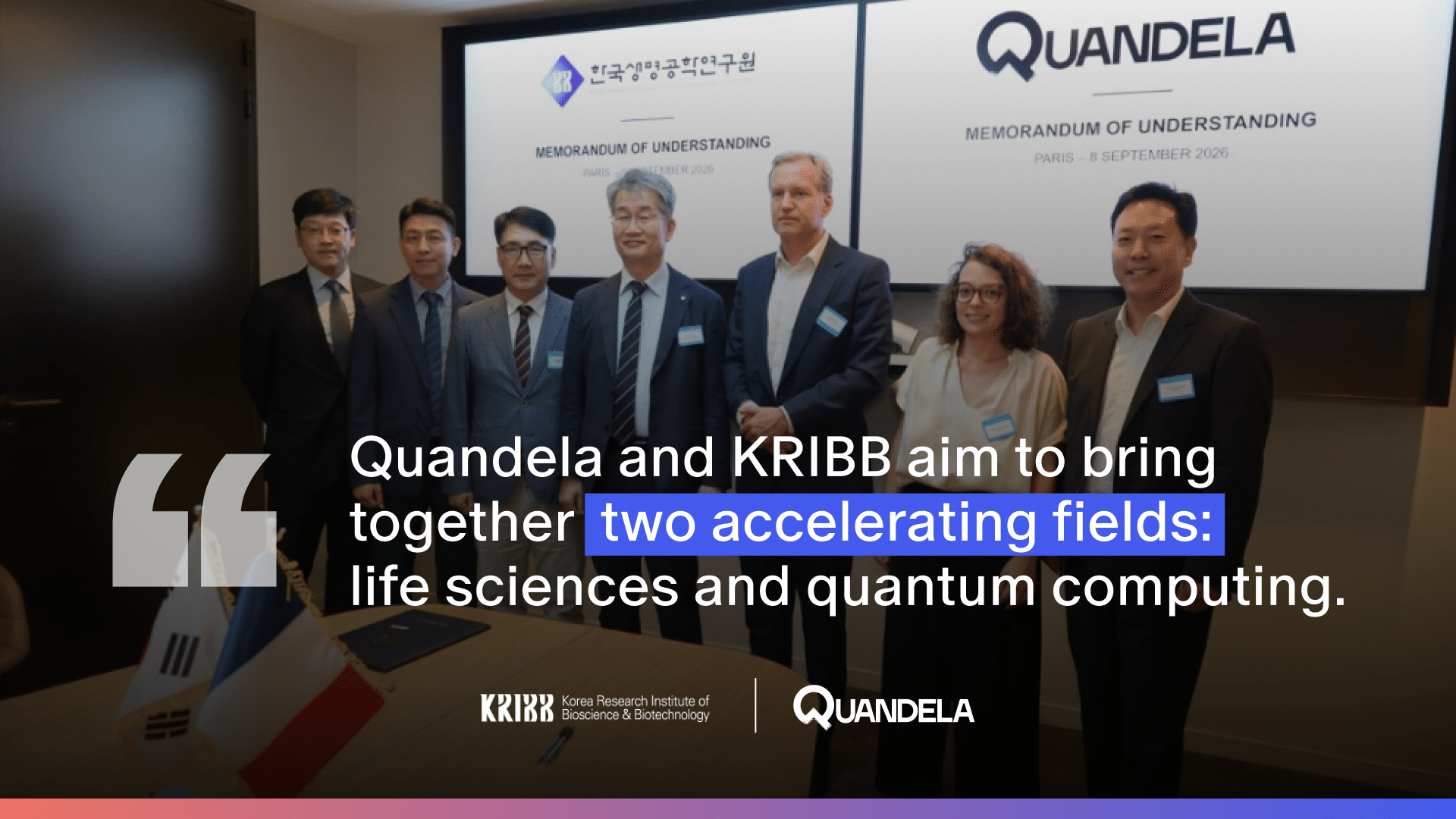
The partnership between Quandela and the Korea Research Institute of Bioscience and Biotechnology (KRIBB) aims to develop new use cases combining artificial intelligence, classical computing, and photonic quantum computing to tackle some of the most complex challenges in the life sciences.
Massy, October 7, 2026 – Quandela, a European company, leader in photonic quantum computing, and the Korea Research Institute of Bioscience and Biotechnology (KRIBB), South Korea’s national reference institute for biosciences and biotechnology, signed a Memorandum of Understanding (MoU) in Paris on September 8, 2026, to strengthen their collaboration on applying quantum technologies to advanced biotechnology research and drug discovery.
Through this partnership, Quandela and KRIBB aim to bring together two accelerating fields: life sciences and quantum computing. Their objective is to develop and validate practical applications of photonic quantum computing capable of addressing complex biological challenges, while pioneering new research models that combine artificial intelligence, classical computing, and quantum technologies.
This partnership arrives at a pivotal moment to strengthen Franco-South Korean scientific and technological cooperation. Building on the Memorandum of Understanding signed in Paris on September 8 during South Korean President Lee Jae-myung’s state visit, both nations have committed to deepening collaboration in key strategic sectors, including artificial intelligence, semiconductors, and quantum technologies.
“Our goal is to give researchers new tools for navigating the complexity of biological systems. By combining KRIBB’s bioscience expertise with Quandela’s photonic quantum technology, we aim to accelerate the path from computational insight to experimental validation.” says Suk-Yoon Kwon, President at KRIBB.
Combining AI and quantum technologies to explore new frontiers in biomedical research
By combining KRIBB’s expertise in biotechnology and life sciences with Quandela’s capabilities in photonic quantum computing, both partners aim to develop new approaches for analyzing and solving biological problems characterized by vast search spaces and complex interactions.
Several application areas will be explored: Targeted Protein Degradation (TPD), particularly the design of PROTAC candidates; cellular therapy optimization; the identification of new therapeutic targets for rare diseases; and the analysis of gene regulatory networks involved in infectious diseases.
“Quantum computing becomes meaningful when it helps researchers solve real-world problems. With KRIBB, we are developing hybrid workflows that combine AI, classical computing and photonic quantum computing to create practical, reproducible applications for biotechnology and drug discovery.” says Sam Yoosuk Kim, General Manager of South Korea at Quandela.
At the core of this partnership lies a hybrid computing approach that seamlessly combines artificial intelligence, classical computing, and photonic quantum technologies. AI enables the analysis of large volumes of biological data and progressively narrows down the number of candidates to evaluate. Classical computing resources then handle processing and simulations suited to their architectures, while photonic quantum processors are deployed to explore particularly complex combinatorial optimization problems.
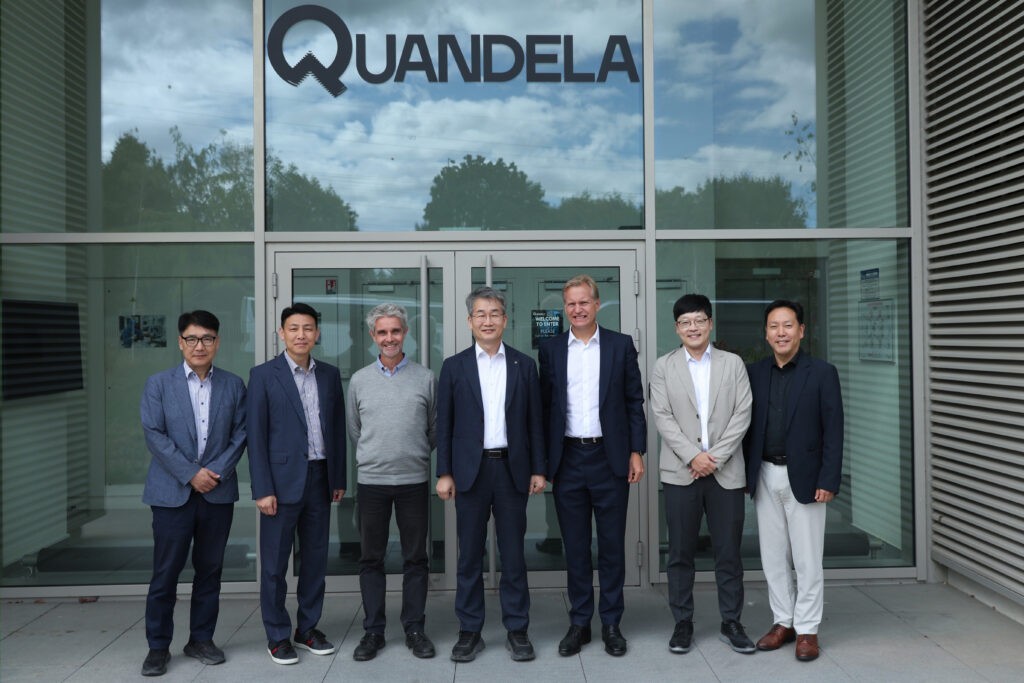
The project seeks to assess how this integrated model can refine the way researchers prioritize and select candidates prior to experimental validation, particularly in drug discovery, cell therapy design, and genetic target identification.
Transforming initial research into reproducible use cases
As part of this collaboration, KRIBB researchers have already shared initial findings generated on Quandela’s platform, with plans to build upon these results for an upcoming scientific publication. For its part, Quandela will analyze these outcomes as a breakthrough use case for photonic quantum computing in biotechnology, aiming to assess their reproducibility and potential to address broader drug discovery challenges.
Training a new generation of researchers at the intersection of biology, AI, and quantum technologies
Beyond joint research, the partnership also focuses on talent development. Both organizations plan to launch joint training programs, hackathons, seminars, scientific workshops, and technology exchange initiatives to support work at the intersection of biosciences, artificial intelligence, and quantum computing.
About Quandela
Quandela is a global leader in quantum computing, designing, building, and delivering cutting-edge quantum solutions for research and industry: providing the most energy-efficient quantum computers for computing centers, comprehensive quantum computing solutions accessible via the cloud, and algorithm access services for academic and industrial customers. Quandela follows a pragmatic and progressive roadmap, deploying industrial systems since 2023 while developing future generations of fault-tolerant quantum computers capable of scaling by integrating thousands of photonic components. Quandela is committed to making quantum computing accessible to all in order to tackle the most complex industrial and societal challenges. For more information: www.quandela.com
About KRIBB
The Korea Research Institute of Bioscience and Biotechnology (KRIBB) is one of South Korea’s leading national research institutes specializing in biotechnology and the life sciences. Founded in 1985, KRIBB works to advance scientific knowledge in areas including molecular biology, genomics, bioinformatics, synthetic biology, and aging research. As a government-funded institute, KRIBB plays a key role in fostering innovation, supporting national research and development strategies, and collaborating with academic and industry partners in South Korea and internationally. For more information: https://www.kribb.re.kr
Press Contacts
Quandela – Maarc Agency
- Iva Baytcheva – iva.baytcheva@maarc.fr – 06 28 59 07 03
- Oréna Cigar – orena.cigar@maarc.fr – 06 52 02 93 35