Newsroom / Press release

Quandela publie sa nouvelle vision pour intégrer les QPU aux infrastructures d’IA et de calcul haute performance avec NVIDIA NVQLink

À l’occasion de l’IEEE Quantum Week 2026, qui se tiendra du 13 au 18 septembre à Toronto, Quandela présente une approche permettant d’intégrer progressivement le calcul quantique aux infrastructures d’IA […]

À l’occasion de l’IEEE Quantum Week 2026, qui se tiendra du 13 au 18 septembre à Toronto, Quandela présente une approche permettant d’intégrer progressivement le calcul quantique aux infrastructures d’IA et de calcul haute performance (HPC) existantes, grâce à la technologie NVIDIA NVQLink. Dans cette approche, le GPU reste au cœur du workflow d’IA, tandis que le processeur quantique (QPU) vient le compléter comme un accélérateur spécialisé pour certains workloads.

Paris, 14 septembre 2026 – Après avoir annoncé en juin la validation technique d’une intégration à faible latence entre une infrastructure de calcul accéléré NVIDIA AI et un QPU photonique de Quandela, les deux entreprises publient aujourd’hui un livre blanc technique commun qui présente leur vision et une approche architecturale pour intégrer progressivement le calcul quantique aux infrastructures d’IA et de HPC existantes.

Cette approche repose sur la complémentarité des CPU, GPU et QPU. Le CPU orchestre les workflows, tandis que le GPU reste au centre des traitements d’IA, en prenant notamment en charge les calculs intensifs et la simulation. Le QPU intervient comme un accélérateur spécialisé pour les workloads pour lesquels le calcul quantique pourrait apporter une valeur significative.

Grâce à NVIDIA CUDA-Q (plateforme de programmation ouverte dédiée au supercalcul combinant technologies quantiques et GPU) et NVIDIA cuQuantum (un SDK optimisé pour simuler des calculs quantiques sur des GPU) de NVIDIA, les algorithmes peuvent être développés, simulés et testés sur GPU avant d’être exécutés sur un QPU photonique réel. NVQLink permet quant à lui d’établir une connexion à faible latence entre l’environnement GPU NVIDIA et le Quantum System Controller, qui contrôle ensuite le QPU.

Les organisations peuvent ainsi explorer progressivement les applications quantiques en s’appuyant sur leurs infrastructures de calcul existantes, sans avoir à remplacer leurs environnements actuels.

Une avancée vers un calcul quantique plus accessible

Cette collaboration vise à faciliter l’intégration du calcul quantique dans les environnements d’IA et de HPC existants. Les utilisateurs peuvent ainsi expérimenter, développer et tester des applications quantiques à partir de leurs workflows de calcul habituels.

L’objectif est notamment d’identifier les workloads pour lesquels le calcul quantique pourrait apporter une valeur significative et de faire émerger progressivement les applications les plus pertinentes.

La collaboration s’inscrit dans une démarche en trois étapes : Access, Integration & Discovery et Scale.

  • Access permet aux chercheurs et aux organisations de découvrir et d’expérimenter le calcul quantique sans disposer de leur propre infrastructure.
  • Integration & Discovery consiste à intégrer le QPU aux environnements CPU et GPU existants afin de développer, simuler et tester différents algorithmes, et d’identifier les workloads pour lesquels le calcul quantique pourrait être particulièrement pertinent.
  • Scale vise à faire évoluer les applications ayant démontré leur potentiel vers des systèmes quantiques plus importants et performants.

Cette approche permet aux utilisateurs de progresser étape par étape vers le calcul quantique, en capitalisant sur leurs infrastructures existantes et en développant de nouvelles capacités au fur et à mesure que des applications à fort potentiel sont identifiées.

Une architecture présentée à l’IEEE Quantum Week

L’architecture développée par Quandela en s’appuyant sur les technologies NVIDIA sera présentée lors de l’IEEE Quantum Week 2026 à Toronto le 17 septembre matin sur le stand de NVIDIA (#600).

À cette occasion, les équipes de Quandela échangeront avec les visiteurs sur l’intégration des QPUs photoniques dans les infrastructures d’IA et de HPC et présenteront la publication commune consacrée à cette nouvelle architecture hybride, qui associe les capacités de calcul des GPU et des QPUs.


Jean Senellart, Chief Technology and Product Officer chez Quandela déclare :

« L’enjeu n’est plus seulement d’accéder à un QPU, mais de l’intégrer directement aux workflows d’IA. Avec NVIDIA, nous ouvrons une voie où le QPU photonique devient un accélérateur spécialisé pour explorer et valider des algorithmes hybrides, notamment en QML, avant de faire passer les usages les plus prometteurs à l’échelle. »

Sam Stanwyck, Director Quantum Product NVIDIA commente :

« L’informatique quantique prend toute sa valeur lorsqu’elle s’intègre aux infrastructures de calcul accéléré, que les chercheurs utilisent déjà. Avec Quandela, nous développons une approche progressive permettant d’intégrer les QPU photoniques aux supercalculateurs combinant processeurs quantiques et GPU NVIDIA. Les équipes peuvent ainsi identifier dès aujourd’hui les applications les plus prometteuses et les faire évoluer au rythme des avancées technologiques. »

À propos de Quandela

Quandela est un leader mondial de l’informatique quantique, concevant, construisant et fournissant des solutions quantiques de pointe pour la recherche et l’industrie. Son offre comprend les ordinateurs quantiques les plus économes en énergie pour les centres de données, des solutions d’informatique quantique « full-stack » accessibles via le cloud, ainsi que des services d’accès à des algorithmes pour les clients universitaires et industriels. Suivant une feuille de route pragmatique et progressive, Quandela déploie des systèmes de niveau industriel depuis 2023 tout en développant les futures générations d’ordinateurs quantiques tolérants aux pannes, capables d’évoluer grâce à l’intégration de milliers de composants photoniques. Quandela s’engage à rendre l’informatique quantique accessible à tous afin de relever les défis industriels et sociétaux les plus complexes. Pour en savoir plus : https://www.quandela.com/ 

Contacts presse

Agence MAARC

En savoir plus

Read more

Quandela publishes a vision for integrating QPUs into AI and HPC infrastructure with NVIDIA NVQLink

×

For IEEE Quantum Week 2026, held in Toronto from September 13 to 18, Quandela is showcasing an approach to progressively integrating quantum computing into existing AI and high-performance computing (HPC) infrastructures with NVIDIA NVQLink. In this approach, the GPU remains at the core of the AI workflow, with the quantum processor (QPU) acting as a specialized accelerator for specific workloads.

Paris, September 14, 2026 – Building on our June announcement of a low-latency integration between a Quandela photonic QPU and NVIDIA AI infrastructure, the companies are publishing a technical white paper today. This paper outlines a vision and architectural framework for gradually integrating quantum computing into current AI and HPC environments.

This approach is based on the complementarity of CPUs, GPUs and QPUs. The CPU orchestrates workflows, while the GPU remains at the center of AI processing, notably handling intensive computation and simulation. The QPU acts as a specialized accelerator for workloads for which quantum computing could bring significant value.

Thanks to the NVIDIA CUDA-Q platform (an open quantum-GPU supercomputing programming platform) and NVIDIA cuQuantum (an SDK optimized for simulating quantum computations on GPUs), algorithms can be developed, simulated and tested on GPU before being run on an actual photonic QPU. NVIDIA NVQLink enables a low-latency connection between the NVIDIA GPU environment and the Quantum System Controller, which then controls the QPU.

Organizations can thus progressively explore quantum applications by relying on their existing computing infrastructure, without having to replace their current environments.

A step toward more accessible quantum computing

By facilitating the integration of quantum computing into current AI and HPC environments, this platform empowers users to experiment, develop, and test quantum applications directly from their standard workflows.

The primary goal is to identify workloads where quantum computing can deliver significant value and progressively bring the most relevant applications to light.

The collaboration follows a three-step approach: Access, Integration & Discovery, and Scale.

  • Access allows researchers and organizations to discover and experiment with quantum computing without having their own infrastructure.
  • Integration & Discovery involves integrating the QPU into existing CPU and GPU environments to develop, simulate and test various algorithms, and to identify the workloads for which quantum computing could be particularly relevant.
  • Scale aims to scale up applications that have demonstrated their potential toward larger, more powerful quantum systems.

This approach allows users to progress step by step toward quantum computing, building on their existing infrastructure and developing new capabilities as high-potential applications are identified.

An architecture presented at IEEE Quantum Week

The architecture developed by Quandela building on NVIDIA technologies will be presented at IEEE Quantum Week 2026 in Toronto on the morning of September 17, at the NVIDIA booth (#600).

At the event, Quandela’s teams will discuss the integration of photonic QPUs into AI and HPC infrastructures with visitors and present their joint publication on this new hybrid architecture combining GPU and QPU computing capabilities.

Jean Senellart, Chief Technology and Product Officer at Quandela states:

“The challenge is no longer just about accessing a QPU, but about integrating it directly into AI workflows. With NVIDIA, we are opening a path where the photonic QPU becomes a specialized accelerator for exploring and validating hybrid algorithms, particularly in QML, before scaling the most promising use cases.”

Sam Stanwyck, Director of Quantum Product at NVIDIA says:

“Quantum computing becomes more useful when it moves beyond standalone access and becomes part of the accelerated computing researchers already use. Our work with Quandela provides a step-by-step model for bringing photonic QPUs into NVIDIA quantum-GPU supercomputing, helping teams identify promising applications today and scale them as more powerful systems come online.”

About Quandela:

Quandela is a global leader in quantum computing, designing, building and delivering cutting-edge quantum solutions for research and industry. Its offering includes the most energy-efficient quantum computers for data centers, cloud-accessible full-stack quantum computing solutions, as well as algorithm access services for academic and industrial clients. Following a pragmatic, step-by-step roadmap, Quandela has been deploying industrial-grade systems since 2023 while developing future generations of fault-tolerant quantum computers, capable of scaling through the integration of thousands of photonic components. Quandela is committed to making quantum computing accessible to all in order to address the most complex industrial and societal challenges. To learn more: Quandela | Leading Photonic Quantum Computing Solutions

Media Relations

Maarc PR agency

Read more

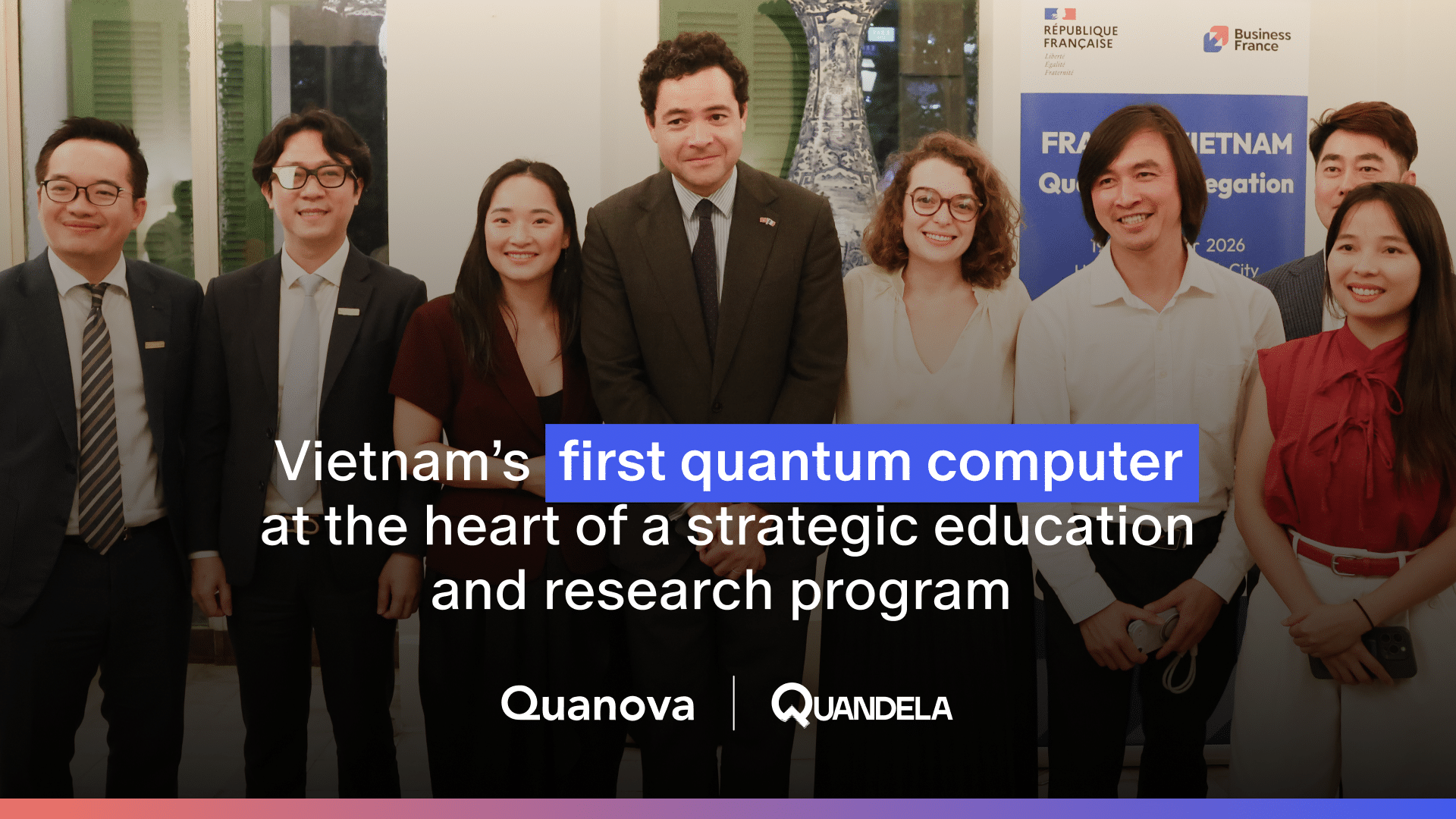
Quandela and Quanova sign strategic partnership to build quantum capabilities in Vietnam

×

Announced during the Vietnam–France Leaders Forum, in presence of Vietnamese General Secretary and President Tô Lâm and French President Emmanuel Macron, the agreement combines Quandela’s full-stack photonic quantum computing platform with Quanova’s local integration capabilities, backed by strategic investment from Nam A Bank, to develop talent, infrastructure and concrete quantum use cases in Vietnam.

Paris, 11 September 2026 Quandela, a European leader in photonic quantum computing, and Quanova, a Vietnamese quantum technology and ecosystem development company, announce the signing of a strategic partnership agreement aimed at supporting the long-term development of quantum computing capabilities in Vietnam.

The agreement was formalized during the Vietnam–France Leaders Forum, held in the presence of French President Emmanuel Macron and General Secretary and President of Vietnam Tô Lâm as part of his official visit to France.

Under the agreement, Quanova will act as a strategic integrator for Quandela in the Vietnamese market. The two companies will work together to promote, develop and commercialize solutions based on Quandela’s photonic quantum computing technology.

Their collaboration will include the training of Quanova’s technical and commercial teams, the development of joint offerings, customer engagement and demonstrations, and the identification of relevant use cases with Vietnamese universities, research organizations and businesses.

“Vietnam is emerging as one of Southeast Asia’s most dynamic quantum ecosystems. Our ambition is to help turn this momentum into lasting capabilities: trained talent, access to photonic quantum computing and concrete projects for universities, research institutions and businesses,” said Niccolo Somaschi, co-founder and CEO of Quandela. “Quanova’s strong local roots and expertise as a strategic integrator make it the right partner to build this bridge with us.”

The agreement builds on several initiatives already undertaken by Quandela and its Vietnamese partners. With Quanova and other local stakeholders, Quandela recently supported a quantum hackathon organised by VNQuantum and the province of Gia Lai, focused on applications connected to Vietnam’s development priorities.

One of the first concrete initiatives supported by the partnership with Quanova is the quantum technology training programme at Quang Trung University, backed by Nam A Bank as a strategic investor. The programme aims to train students and researchers while expanding their access to quantum computing capabilities.

“Vietnam’s opportunity in quantum will be built through real capabilities: trained teams, access to world-class platforms and projects connected to local needs,” said Rossy Nguyen Hoang Hong Nhung, CEO of Quanova. “Working with Quandela will help Vietnamese organizations move from initial exploration to concrete applications, while strengthening the national ecosystem for the long term.”

The two companies also share the ambition of preparing for the future deployment of a photonic quantum computer in Vietnam. Their approach is based on ensuring that any future infrastructure is supported by the skills, software and local ecosystem required to use it effectively and create long-term value.

The agreement signed in Paris provides a framework for developing joint offerings and new opportunities with Vietnamese stakeholders. Quandela and Quanova expect to announce further concrete steps in the coming months.

About Quandela

Quandela is a leading quantum computing company that designs, builds, and delivers cutting-edge quantum solutions for industry: ready-to-use quantum computers for data centres, cloud-accessible quantum processors, and algorithm access services for industrial clients. Quandela is committed to making quantum computing accessible to all in order to address the most complex industrial and societal challenges.

Discover our vision at: Quandela | Leading Photonic Quantum Computing Solutions

About Quanova

Founded in 2025, Quanova is a Vietnamese quantum technology and innovation company focused on education, quantum-readiness consulting, ecosystem building and international collaboration. The company works to connect research, industry and talent development to support the emergence of quantum capabilities in Vietnam.

For more information: www.quanova.org

Media Relations

Maarc PR agency

Implanté au Canada, l’ordinateur quantique photonique de Quandela est le seul appareil en son genre disponible aux entreprises participant à ce programme de recherche et développement pancanadien.

MONTRÉAL, le 2 septembre 2026 – Quandela, acteur de référence en technologies de calcul quantique photonique, a signé un protocole d’entente avec CMC Microsystèmes afin de rejoindre le Bac à sable d’informatique quantique en tant que fournisseur de services de calcul accessibles via l’infonuagique. L’expertise de Quandela, basée au pays, s’associe désormais aux autres fournisseurs formant l’ensemble des options quantiques auxquelles peuvent accéder les petites et moyennes entreprises, organisations et chercheurs universitaires afin de développer et accélérer les solutions qui seront appliquées à de
nombreux domaines et besoins.

« Alors que la souveraineté des données dans le domaine numérique est un enjeu de plus en plus important en raison du contexte mondial actuel, nous sommes fiers d’être les premiers à ajouter un ordinateur quantique photonique établi en sol canadien parmi les options infonuagiques offertes aux participants du programme BIQ, a souligné Valérian Giesz, cofondateur et directeur des partenariats stratégiques chez Quandela, ainsi que physicien de formation. Cela permettra à leurs travaux et données d’être entièrement hébergés en sol canadien, sans qu’ils aient à transiter par une structure située dans un autre pays. »

Le bac à sable d’informatique quantique (BIQ) est soutenu par FABrIC, organisme financé par Innovation, Sciences et Développement économique Canada (ISDE) et dont la mission est de bâtir un écosystème servant à renforcer le domaine des semiconducteurs au Canada. Le rôle du BIQ, par le biais d’un soutien technique et de subventions destinées à la recherche, est de favoriser le développement d’applications quantiques destinées aux différents secteurs industriels et domaines d’activité du Canada, y compris des projets d’ordre national et stratégiques. CMC Microsystèmes est l’organisme sans but lucratif chargé de gérer FABrIC pour le compte du gouvernement du Canada ; son mandat consiste à faciliter l’accès abordable aux outils permettant de développer des technologies avancées.

Un soutien à multiples facettes

Le protocole d’entente entre Quandela et CMC Microsystèmes comprend également un aspect de soutien auprès des entreprises et organisations dont les projets prometteurs ont été retenus, ce qui leur donne accès au Bac à sable d’informatique quantique. Cette assistance, qui peut prendre une dimension de nature autant technique que pratique, sera offerte par Quandela en collaboration avec CMC Microsystèmes. Cette dernière est directement impliquée dans la sélection des entreprises ayant droit à une subvention.

Quandela et CMC Microsystèmes bénéficiant déjà d’une relation solidement établie, le cadre du programme BIQ permettra de partager davantage l’expertise et l’expérience des deux entités auprès des entreprises, organismes et universités n’ayant pas d’équipe ou de talents su isamment formés aux règles été exigences du calcul quantique.

« Sachant que les algorithmes de certains projets fonctionnent mieux sur certaines architectures informatiques en particulier, l’ajout de Quandela comme outil supplémentaire permet de diversifier davantage les options offertes aux participants ayant accès au BIQ, que ce soit en termes de recherche, de prototypage ou de mise en application des solutions, a ajouté Valérian Giesz. C’est ce qui rend la formule du BIQ encore plus intéressante pour les entreprises souhaitant non seulement investir dans le développement de solution quantiques, mais également dans le développement du calcul quantique lui-même. »

À propos de Quandela

Quandela est un leader mondial du calcul quantique qui conçoit, construit et fournit des solutions quantiques de pointe pour la recherche et l’industrie, offrant les ordinateurs quantiques les plus efficaces en consommation d’énergie pour les centres de calcul, des solutions complètes de calcul quantique accessibles via le nuage, ainsi que des services d’accès aux algorithmes pour les clients académiques et industriels. Quandela suit une trajectoire pragmatique et progressive, en installant des systèmes industriels depuis 2023 et en développant les futures générations d’ordinateurs quantiques tolérants aux erreurs, capables de passer à l’échelle en intégrant des milliers de composants photoniques. Quandela s’engage à rendre l’informatique quantique accessible à tous afin de relever les défis industriels et sociétaux les plus complexes.

Contact média :
Read more

Quandela devient la première plateforme photonique du Bac à sable d’informatique quantique canadien accessible via le nuage

×

Established in Canada, Quandela’s photonic quantum computer is the only device of its kind available to companies participating in this Canada-wide research and development program.

MONTREAL, September 2, 2026 – Quandela, a leading player in photonic quantum computing technologies, has signed a memorandum of understanding with CMC Microsystems to join the Quantum Computing Sandbox as a provider of cloud-based computing services. Quandela’s expertise, based within the country, now joins forces with other providers to offer a comprehensive suite of quantum options made available to small and medium-sized enterprises, organizations, and academic researchers, with the aim of developing and accelerating the solutions that will be applied to a wide range of fields and needs.

“As data sovereignty in the digital realm becomes an increasingly important issue given the current global context, we are proud to be the first to include a Canada-based photonic quantum computer among the cloud computing options available to the participants of the QCS program”, stated physicist Valérian Giesz, Co-Founder and Director of Strategic Partnerships at Quandela. “This will allow their work and data to be entirely hosted on Canadian soil, without having to go through a structure located in another country.”

The Quantum Computing Sandbox (QCS) is supported by FABRiC, an organization funded by Innovation, Science and Economic Development Canada (ISED), whose mission is to build an ecosystem which strengthens Canada’s semiconductor sector. QCS’ role, through technical support and research grants, is to foster the development of quantum applications for Canada’s various industrial sectors and fields of activity, including national and strategic projects. CMC Microsystems is the nonprofit organization responsible for managing FABrIC on behalf of the Government of Canada; its mandate is to facilitate affordable access to the tools required for the development of advanced technologies.

Multifaceted support

The memorandum of understanding between Quandela and CMC Microsystems also includes a provision to provide support to companies and organizations whose high-potential projects have been selected, thus granting them access to the Quantum Computing Sandbox. This assistance, which may be both technical and practical in nature, will be offered by Quandela in collaboration with CMC Microsystems. The latter is directly involved in selecting the companies eligible for a grant.

As Quandela and CMC Microsystems already have a well-established relationship, the framework of the QCS program will enable the two entities to further share their expertise and experience with companies, organizations, and universities which do not have teams or personnel sufficiently trained in the rules and requirements of quantum computing.

“Since the algorithms used in certain projects perform better on certain specific computing architectures, integrating Quandela as an additional tool further diversifies the options made available to the participants who have access to QCS, whether in terms of research, prototyping, or implementing solutions,” added Valérian Giesz. “This is what makes the QCS model even more attractive to companies looking to invest not only in the development of quantum solutions, but also in the development of quantum computing itself.”

About Quandela

Quandela is a global leader in quantum computing which designs, builds, and delivers cutting-edge quantum solutions for research and industry, offering the most energy-efficient quantum computers for data centres, comprehensive quantum computing solutions accessible through the cloud, and algorithm access services for academic and industrial customers. Quandela follows a pragmatic and incremental approach, installing industrial systems since 2023 and developing future generations of fault-tolerant quantum computers capable of scaling up through the integration of thousands of photonic components. Quandela is committed to making quantum computing accessible to all in order to address the most complex industrial and societal challenges.

Media Relations: